What’s Stopping You?
So many of us have thought at one time or another that we would like to write a book. I wanted to write a book most of my life. I always excelled in my creative writing classes. What stopped me?
Lack of time
Lack of confidence
Lack of proper tools
Reality – Very few books and authors accepted by publishers
Fear I was wasting my time
Fear of accidentally plagiarizing a story or book I had read
Fear of ridicule
Comments from a reader:
Life got in the way
The Lacks
How can we overcome some of these lacks and fears:
LACK OF TIME/LIFE GETS IN THE WAY affects us all. The list is endless, regardless of whether we find time to pursue our dreams amidst employment, raising children, illness, responsibility toward others, charitable work, or volunteering. Even a life blessed with wonderful activities can stifle our ability to find the time we need to write.
If you are reading this, you have probably already researched ways to carve out a niche of time for writing. Many of them work, some don’t. I always found it easier to write if I labeled the top of my first drafts in BIG LETTERS – ROUGH DRAFT. Maybe this will make sense to you, maybe not, but if you think the way I do, you will understand my fear: If I died before I could finish/proofread/edit the work, I didn’t want anyone to think it was the best I could do if they found it on a printed page or computer document.
LACK OF CONFIDENCE is not easy to control or squash, but you must. One good way is to read autobiographies and reflections of other writers. Everyone had little confidence when they began but begin they did! Just do it.
LACK OF PROPER TOOLS is easily remedied in this age of technology, but it can get pricey. Most of us have a keyboard or microphone ready at all times. I have even walked around the neighborhood, had a good idea burst into my imagination, and sent myself an email using my phone’s microphone to record the details. That sounds silly, but oh, how easy it is to do. The email can be immediately pasted into a document as a ROUGH DRAFT!
Here are a few of my favorites for help in writing a polished final draft:
GRAMMARLY – Even as I write these words, I am checking my grammar and if my sentence structure is correct.
MICROSOFT WORD – Creates documents that are easily downloaded to my publishing app. It has excellent Spell Check; a thesaurus is included, and it is easy to use.
AUTOCRIT – A little different than Grammarly; it is excellent at finding repeated words, too many adverbs, etc. It also has an excellent audio readback ability. Funny, I’m from the U.S., but I can hear mistakes more easily when I listen to a reader with a British accent. Strange.
The Fears – Unintended Plagiarism
A fear I had about writing is shared by hundreds of other would-be and published authors: unintentional plagiarism. If you place those words (unintentional plagiarism) in a search box, you will have hundreds of articles to choose from on the subject. Before I used Grammarly, which has a plagiarism and AI check for possible infractions, I used personal experiences to craft my story to counteract this fear. I also checked every chapter and word with Grammarly; there were no instances of plagiarism in my story.
How many personal experiences in my life and the lives of family members did I use to write this story. As I paged through, I counted thirty, and I am sure I missed a few. Perhaps the old adage that many first novels are semi-autobiographical is not all myth.
Below you will find an explanation of how I fictionalized three life experiences to create the content and tone of Chapter 20.
- My Uncle and Aunt once had snakes in their basement. They think they came in through laundry pipes.
- When a long black rat snake slithered out of the ivy in our front garden one summer day, my husband’s legs went up and down, but he went nowhere while all the time choking out the words, “Snake, big snake…”
- My sister and I, fooling around as kids do and scaring each other on the basement stairs, accidentally knocked a full paint can over. It opened up and exploded across the basement floor like a sunburst. Extreme panic ensued; our feet created all kinds of tracks, making the whole situation worse.
All of those things were woven into Chapter 20 of Birch Run
The Fears – Ridicule
The definition of ridicule according to Vocabulary.com: When you ridicule someone, you mock or make fun of them. Some synonyms of ridicule are derision, laugh at, shoot down, or skewer.
Ridicule happens. I mentioned or sent the published book to four people. Three of them ordered or accepted the book I gave them. No one out and out ridiculed me, but neither were they all complimentary.
I expected pretty much what I heard as far as feedback was concerned.
Using Amazon’s Kindle Direct Publishing
The creation of your book is the next step I want to share. Whether you have a completed manuscript or you plan to write from scratch, it’s best to have thoughts for an end result in place. For most of us, that is having our story published.
To follow along with my tips please visit this page: Amazon Kindle Direct Publishing.
I have had good results using Amazon Kindle Direct Publishing. It was easy to download onto my computer, but this is a HUGE IF. If I had carefully read each link and the accompanying forums, I would have saved myself some anxious and confused moments. Please don’t be like me, read all the information possible before you begin.
First, I wish I had found the Word templates right at the start. Using these would have saved me hours trying to get the formatting right in the Kindle Direct Publishing App. Here is a page with all the information, including a YouTube video on downloading and using the templates in Word.
Paperback and Hardcover Templates
Amazon has so much faith in your book that they want to help you set up an account to get paid and pay taxes. It has worked for me. I have had a few royalties from my book. The payment from Amazon goes directly into the checking account I provided for them. At times, before sending royalties, they will pay .01 into my account to ensure the process goes smoothly. They have notified me of this intention before they proceed.
The next step is to download Kindle Create to your computer. I have an older computer; it is slow and glitchy, but the program easily downloaded into it. Any updates to the program have not caused any problems.
Mistakes to Avoid – My Own Experiences
If you’ve read this series to this point, I assume you have a story in mind and are ready to begin writing, or perhaps you have already written a final draft and are prepared to enter it into Amazon’s Kindle direct publishing manually or by using one of the word templates. I hope you have had good luck with it. It is a great app, and I’m very grateful it was available for me to use.
After your manuscript is entered into the app, you can export your story from Kindle Direct Publishing. Carefully create a name for the file that you can search for on your computer. I am speaking from the experience of losing a file somewhere in the never-never land of my computer folders because I forgot the exact name. The export files are little brown folders and are very different in appearance from other files you have, which makes it easy to spot them.
Another huge mistake I made was to delete the Kindle Create file that the app uses. I thought that I could copy it onto a disc and use it that way. Please take my advice: you won’t be able to get the file back on your computer. I had to return to Kindle Create and manually enter the entire book again. Luckily, I could do this, or everything would have been lost.
I registered my novel Birch Run through US Copyright Registration. Registering involved a fee between $45 and $65. However, I have read that as soon as you create a written work, it is automatically considered copyrighted to you. I felt better being entirely legal and I chose to register Birch Run and downloaded the entire novel to the system. Within 2 months, I received a page with all the information and a Library of Congress number. You can still publish with KDP without registering with the US Copyright Office.
Here is an article link on the subject of copyright from Quora: If you self publish….
I may sound far-fetched, a little bonkers, but in reality, I have read my book Birch Run over fifty times. It sounds like an exaggeration, but I assure you it is not. You might only want to write and publish your novel if you acknowledge that you will read your book over and over again.
Why did I read the book so many times? I was determined to find and correct every tiny mistake and errant punctuation mark, reformat my paragraph spacing, and correct confusing sentence structure.
Worst of all, I had to fix the errors I made while making corrections. Far and away, making more mistakes while correcting other errors was discouraging and very easy to do. These new mistakes usually involved spacing or punctuation marks.
Wow, as I read the last paragraph back, I realized it sounds confusing. Believe me, though, you will find mistakes. You are endeavoring to do on your own what a team of editors, copywriters, agents, etc., etc., etc., does for publishing firms. Doing it on your own eventually gets your book published, but it might create stress that is hard to handle.
Here are my most significant meltdown moments; there are three.
1. I mentioned in a previous post that I could not load the Kindle Create file after it was copied to a disc and deleted from my computer. My advice is to never delete anything related to the book!
2. The book was error-free, as far as I could tell. I ordered a copy with a revised cover and a new photograph that looked more like me and less like a pose. Success! The correct cover and photo were in place. I opened the book and flipped through the pages—OH NO! This is what I saw:
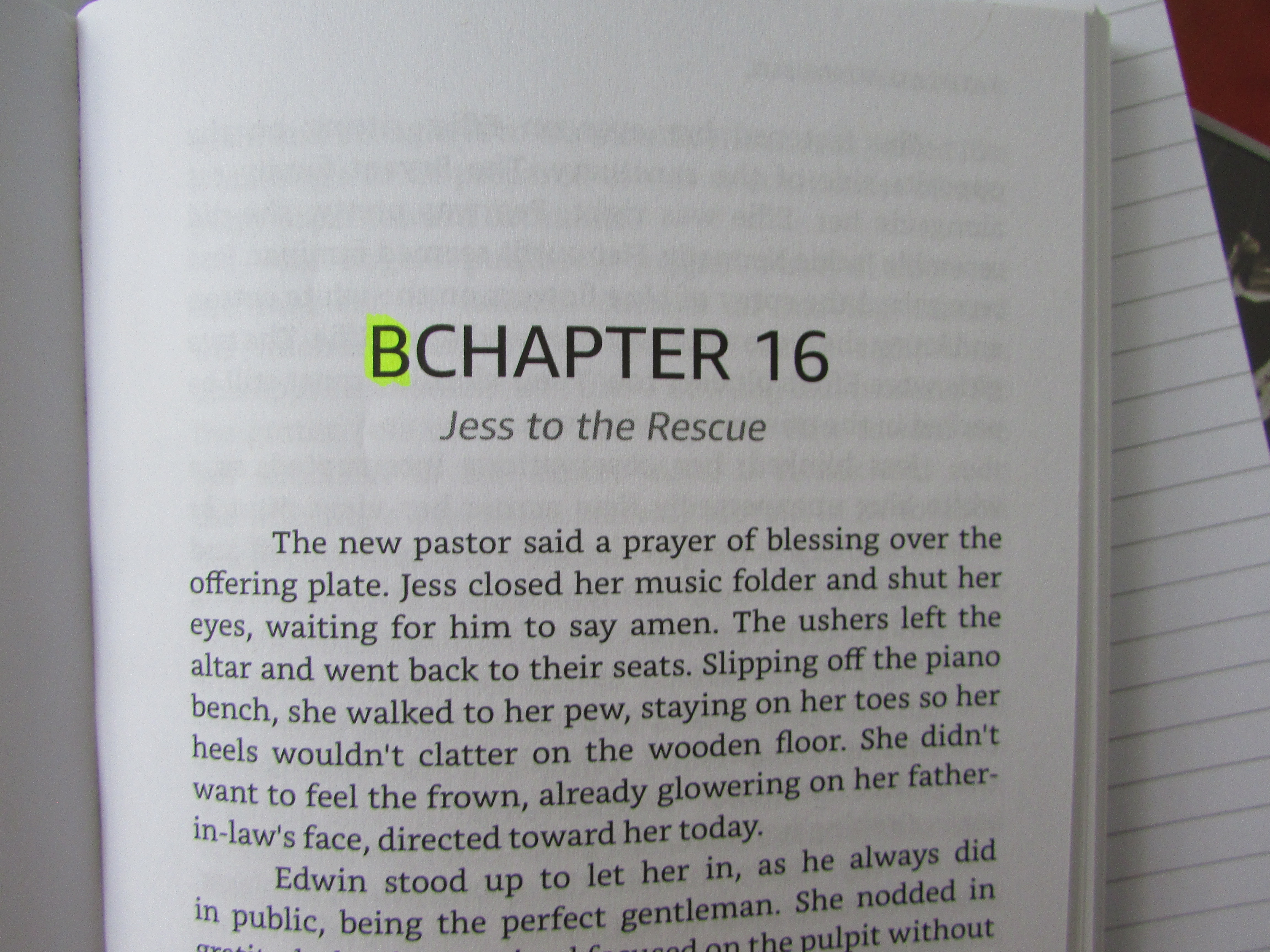
How I placed a B in front of Chapter 16 in this version I have yet to figure out!
3.The biggest meltdown. Never publish until you have read through the book many times and found your mistakes. Instead of jumping into publishing, order proof, after proof, after proof, until the book is as perfect as you can make it. Why, you may ask since the KDP app allows me to correct my manuscript as often as I like and upload the corrected copy?
Here is the easy answer. You may not know more than one book is printed out when you order a published copy. Printing additional copies saves money for Amazon. Amazon warehouses do not throw these versions away, even if you upload a new version in the future. I have eight versions of my book. Unfortunately, they have not destroyed the copies of the earlier versions. I had yet to learn of this practice before I published Birch Run. If earlier versions of my book are on the shelf and an order arrives, they send out what they have on hand.
I know this for a fact because after receiving a newer version with the right cover, I ordered again and received an earlier version. When I say this is the one time, I almost lost it, I am not making an understatement. So, lesson learned and advice given: read the book, get proof of the book, and read the book again and again until you are certain you have everything correct.
You must also create a cover if you offer the book in paperback format. KDP has an excellent paperback formatter, and I had no problem creating my book cover. I love its look. I used a photo from the ’60s of my parents in front of a church they pastored. The book is not about them, although there are little things about their characters and things that happened within the book, but they fit the mold perfectly for what I thought Gordon and Peg would appear like in real life.
As you can see, I made many mistakes, but I recently ordered six author copies, and they all seem perfect. Hallelujah! This concludes my posts on my experiences with KDP, but I will be happy to answer any question you might have in the comment section. Thanks so much!
A Postscript
I am sure there are experiences I missed relating as I tried to recall writing/publishing Birch Run. I sincerely hope that in being honest about the problems I encountered I did not discourage anyone from trying to write/publish a book.
I have mentioned in past posts that I freely used moments from my own life and family history and fictionalized them. The key word is fictionalized. Although many of the happenings in the book were gleaned from my life and stories I heard from family, Birch Run is, in essence, a work of fiction and does not portray any real-life person.
I understand best the three sisters, Grace, Effie, Jess, and Peg, the pastor’s wife. Why? Though entirely different in character traits, each one has aspects of my personality within them. I am many-sided, as are we all, and I used that to my advantage in crafting their characters. Perhaps I’ve always been a bit of a chameleon, but one thing holds true in each lady: They all love and serve God, as do I.
Here is an oddity, and it may happen to other authors, but there is one chapter where I dislike and disagree with the events and conclusion.
I struggled mightily and still do with Chapter 17. Why? I struggle because I 100% believe in keeping Sunday a Holy Day, doing as little work as possible, attending church, and only purchasing what is necessary, if at all. I might be going where I tread on some toes. Still, along with banning school prayer, retracting the Blue Laws (laws restricting or prohibiting certain activities on specified days, usually Sunday – Wikipedia) has harmed the country and other regions of the World.
So, why did I keep this chapter in the book? First, it is a pivotal point in the story, and second, it also shows how hypocritical people manipulate others and situations by quoting Scripture to bring about their own ends. Woodrow Vandervelt, a character in the book, is just such a person, and I have seen his ilk many times in my life.

