I have good luck with my white and blue nigella plants self-seeding in the front of the butterfly border. Each year, the initial sowing of plants brings forth a new generation. Today, at half price, I was thrilled to find seeds for a pink variety called Mulberry Rose. It’s always exciting to procure a new variety of a plant you love.
This small flower creates quite a dynamic seedpod. It blooms the size of a quarter, is low-growing, and has delicate foliage. Beautifully rounded and loaded with seeds, the pod dries beautifully for indoor winter arrangements.
The seed packet suggests making successive sowings for continuous bloom. My new Nigella seeds are from Renee’s Garden. I am content in the knowledge that this small blossom will grace my garden for years to come.
The beautiful moss spores are my choice for The Cosmic Photo Challenge/What’s Flowering Where You Are? Before the recent snowstorm, I grabbed my camera and took a woodland walk. I was amazed at the vivid green of the mosses and lichens. In places where the sun shone through the branches, I noticed some of the mosses had already sent up spore capsules. I’m going to stretch and say these are a type of bloom.
If I had to rate these moss spores for beauty between 1-10, they would receive a 10+ from me.
Skunk cabbage has also emerged in the dead of winter. Here are some of the ‘knobs’ before the snow covered them. I read an amazing fact on the PFEIFFER NATURE CENTER site: some skunk cabbage plants can be over 100 years old. Wow, I will feel a bit more awe over them when I take my next woods walk.
Next time when I become a bit winter-worn and weary over the cold weather, I’ll remind myself of those skunk cabbages never giving up.
As always, lichen on fallen branches are a welcome touch of green.
Whatsoever is Lovely? Definitely the small and delicate bits of green I found in the woods. I wish I could have a large garden plot filled with mosses and lichens in the winter.
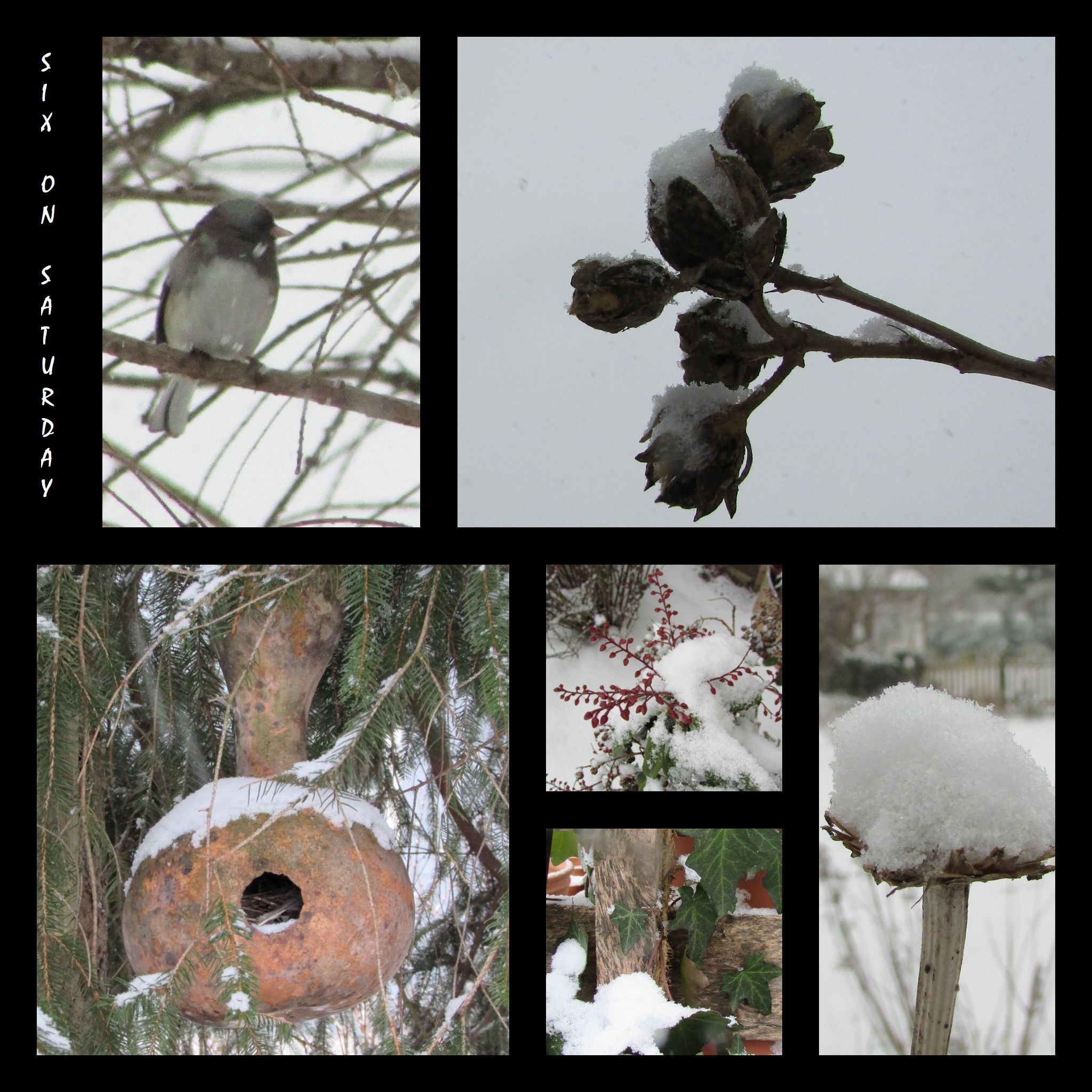
My area of Southern New Jersey went over 700 days without accumulating snowfall. Yesterday, we had a beautiful snowstorm throughout the day. What a lovely sense of peace the quiet flakes instill into the atmosphere. Early in the morning, I couldn’t resist grabbing my camera and taking photos as I fed the birds.
A Junco, one of a large flock that visits my yard, seemed to wait patiently for me to scatter birdseed.
The Rose of Sharon pods were the perfect resting place for snowflakes. Looking closely, you can see a few of the sharp points of individual flakes.
The gourd birdhouse, crafted several years ago, looked lovely with a coating of snow.
The Japonica, colorful with new growth, wore a blanket of snowflakes.
English Ivy, indestructible, seemed impervious to the cold.
A stem of a zinnia, left in place as cover for birds, held a mound of crystal snowflakes…beautiful.
The flying pig who holds court over the sideyard couldn’t escape the snowfall. A natural monochromatic setting with the grey sky behind him and the bird bath pedestal beneath him seems a good choice for Skywatch Friday.
I love this quote from my Farmer’s Almanac Daily Calendar:
When oak trees bend with snow in January, good crops may be expected.
Brightly hued-flowers surround me at any venue I visit this time of year. I love them but also enjoy the simplicity of Paperwhite blooms. The fragrance is authentic Spring at the beginning of Winter. The flowers are small, the size of a half-dollar, but they have a strong and resilient scent. Mine have been blooming for several days and they still are very fragrant.
It is gratifying that all the work involved in forcing the bulb was done for me. I purchased the plant already growing, near bloom, and anchored in a sturdy bulb vase. My responsibility has been nothing more than enjoying the beautiful scent.
In another room, I have a Hyacinth bulb beginning to grow. I have done some tweaking to bring this flower into bloom. In early September I bought the bulbs. There are five in all, and I placed them in their package in my refrigerator produce drawer. When I put the bulb in a vase with the water level just touching the bottom, the roots quickly began to grow. I’ll update the blog when the plant blooms.
Whatsoever is lovely in my life this week is flowers blooming in November, filling my home with sweet fragrance.
Writers have written many an eloquent word and quote about the beauty of fragrant flowers, and although the quote below doesn’t specifically mention fragrance, I like the image it suggests. How fragrant life would be if we looked at the whole world as a garden.
“If you look the right way, you can see that the whole world is a garden.” — Frances Hodgson Burnett, The Secret Garden
The ‘phlutters’ on my porch have been magnificent. While I write this post, I am thinking of eleven empty and transparent chrysalides. Each is the evidence left behind of a successful eclose of the Monarch butterfly that developed inside. The brief sojourn of the caterpillar becoming a butterfly is complete. Below is a description with photos of how the day of “The Magnificent Seven” evolved.
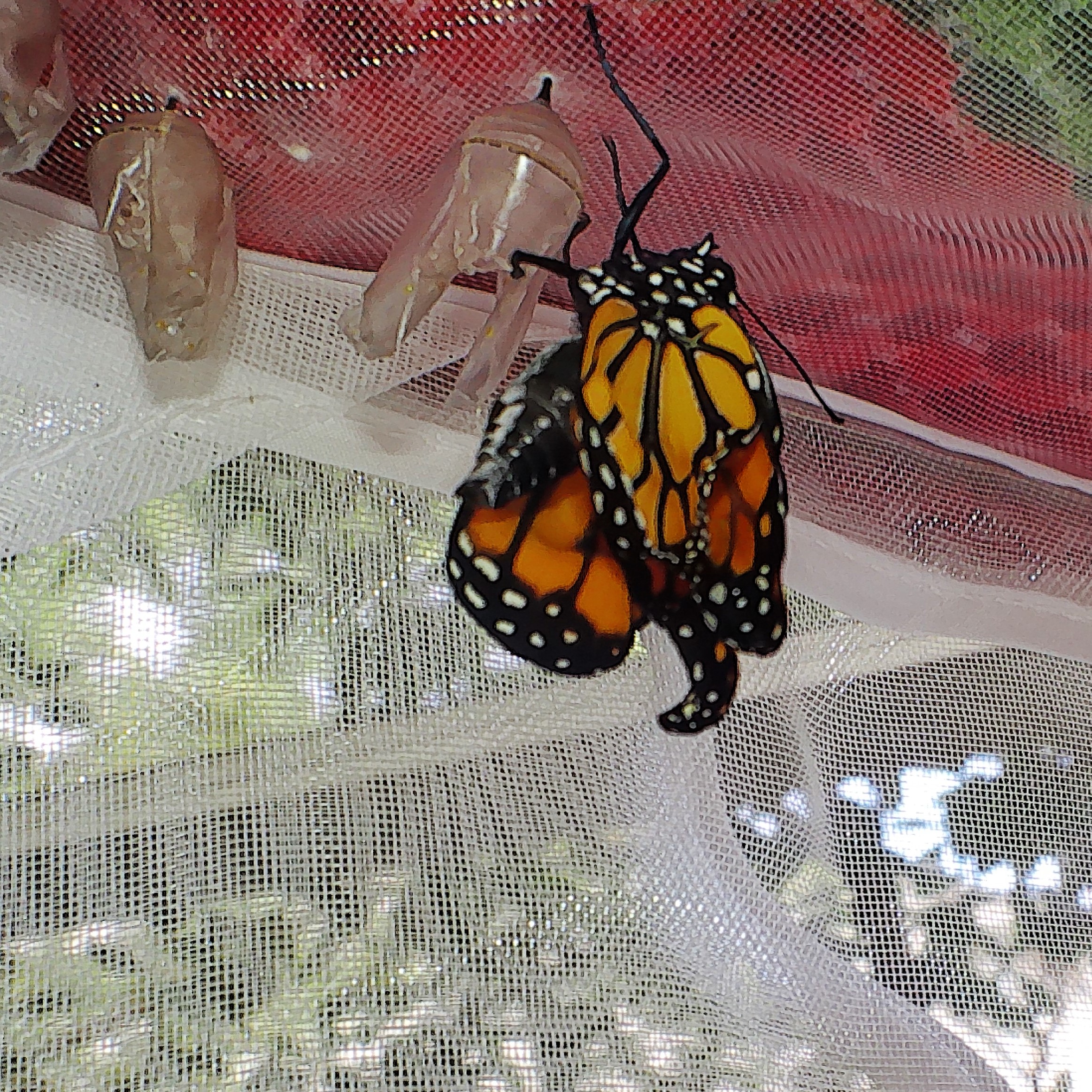
Raindrops started falling early but then tapered off; the weather became a concern since seven chrysalides turned black and were ready to emerge over the span of twenty -four hours. Morning light revealed the markings of each butterfly through the walls of its chrysalis. After a few hours of daylight, they began to eclose.
First to break free was the only Monarch who formed its chrysalis on a milkweed stem.
The remaining chrysalides clustered along the top edges and corners of the butterfly house. Throughout late morning/early afternoon all seven eclosed at varying times. All emerged perfect, no malformation or problems breaking free from the chrysalis.
Two to four hours after eclose the butterflies began to flutter within the confines of the butterfly house, I gently coaxed them onto my fingers and carried them to the open door. Several took to the air and flew out of sight over the rooftops, others seemed tentative, and these I rested upon a hanging basket. Later in the day, when I returned, they too had taken wing.
A sense of elation filled me when I realized a lucky seven eclosed in one day. This brings the successful ecloses to a total of eleven.
Today, as I post this, six newly hatched, ultra-small Monarch caterpillars are starting the cycle all over again. Will I ever grow weary of this miracle? Never.
After spotting the vermilion orange flash of a Monarch butterfly laying eggs on my milkweed, I kept watch by tying a string on each leaf that had an egg on it. I was surprised, monarch eggs hatch quicker than the black swallowtails. Within a few days I spotted a small hole on one of the leaves. Sure enough, underneath I found an almost microscopic monarch butterfly caterpillar.
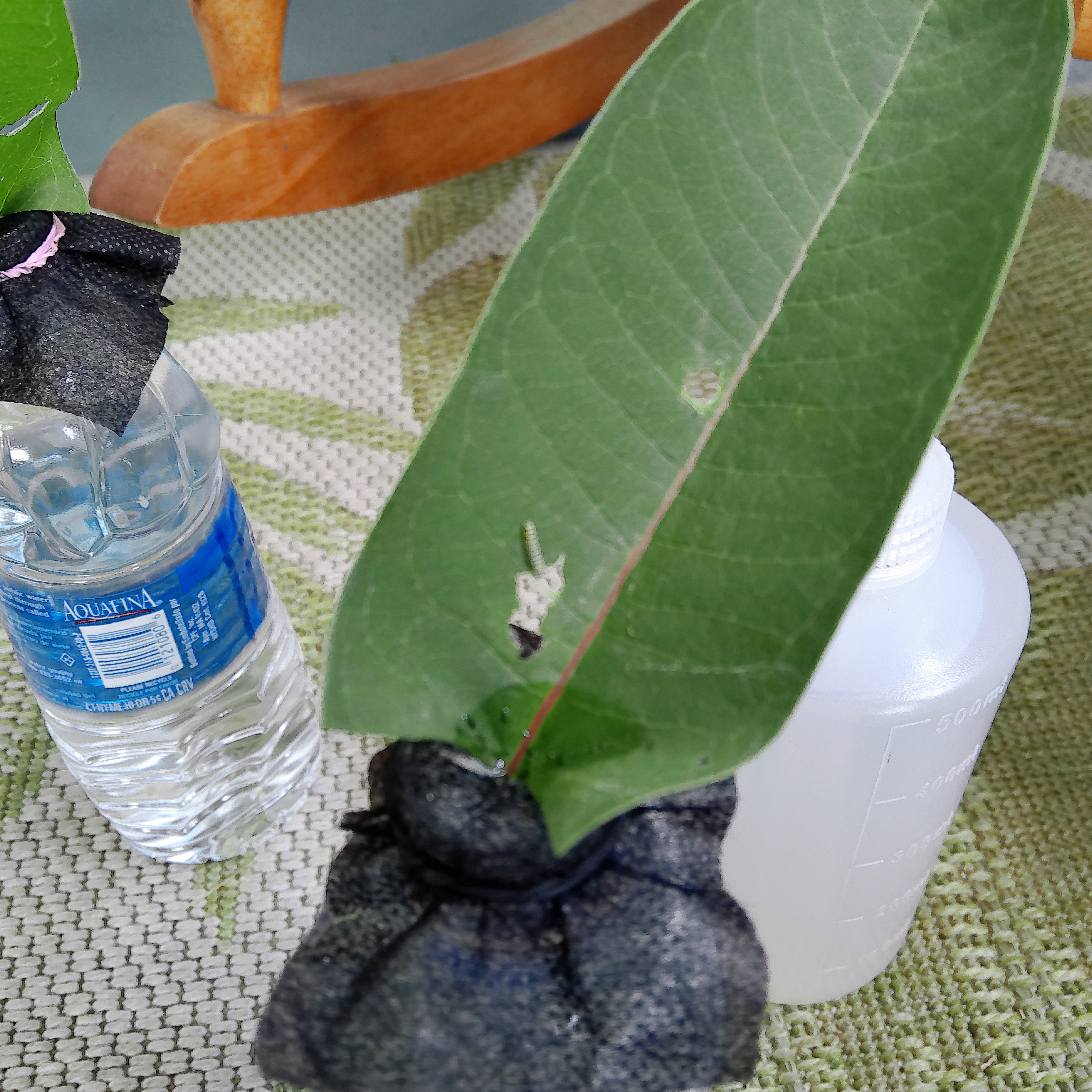
Because I’ve experienced the dilemma of monarch caterpilla cannibalism, I needed to find a better way to raise them this year. I brought one of the monarch caterpillars in on its leaf and using an old water bottle, garden cloth, and a rubber band I created a standalone leaf holder for the small caterpillar. Besides working at keeping the caterpillar separated, the bottle added a benefit; the leaves have stayed pliable and fresh for days.
To create more stem for the leaf to absorb water, I cut up along the edge of the stem, always careful to be aware of where the caterpillar is on the underside, next remove a v-shape portion by cutting away the leaf to form a stabilizing appendage to grip the garden cloth. I could go on with an explanation, but I think the photos tell the story better.
The caterpillars are thriving. They are now big enough for me to be able to see their spiky anthers.
In the course of adding water to the bottles, one caterpillar fell off on the rug, which is the same color as the caterpillar and even the same texture. I couldn’t find the small cat anywhere. I felt terrible. There was no sense in looking for the fallen caterpillar because I might squash it with my knee or foot while I searched. Instead, I laid a few leaves in the area where I thought it fell. The strategy worked, and today I found the wayward caterpillar on the leaf I laid on the floor. It is safely back on the rearing bottle now.
You can tell, by the holes in the leaves, and the freshness they’ve retained, that the single bottles work much better than leaving all the caterpillars in the bottom of the butterfly cage. Unfortunately, last year that is what I did, and I had seven caterpillars at one time on the bottom of the enclosure, eating the leaves. Overnight, my number was down to one. Yes, caterpillars of the monarch butterflies, although they are beautiful and delicate, are voracious cannibals of each other.
I might run into some trouble when they are big enough to loop themselves from one leaf to another. Maybe the problem will never present itself, but at least I am on the lookout for it.
I am grateful that I have a whole garden bed filled with milkweed. I checked some of the wild areas and the milkweed is in horrible condition. I found no caterpillars, only aphids spiders, ants and other bugs that prey on the monarch caterpillars. The leaves were leathery and dry from all the hot weather in our area. I have the advantage with my garden bed since I keep it well watered and stay on pest alert at all times.
This has been longer than my normal posts, but I wanted to share how to keep the leaves fresh, and the caterpillars away from each other. One note, they do like to be shaded. I keep them shielded from the Sun with dish towels over the sides. So far none have attempted to reach the other leaves. They are thriving and growing. I’m looking forward to watching the process over the next few weeks.
Asclepias syriaca, common milkweed, is now firmly established in my butterfly garden. Started from a seed, the plant piddled around for a year or two before growing tall last summer. It has naturalized during the time in between then and now, and there are several large clumps of it throughout the bed.
Don’t hesitate to try some common milkweed in your garden if you want to help Monarch butterflies thrive. Milkweed is also a great flower/plant to grow for pollinators too. The bumblebees were enraptured by the bloom, and I was pleasantly surprised by the fragrance of the flowers.
The pollinators did a good job and a few of the flowers have become small pods.
You can see how conditions have been almost perfect this year for growing milkweed. That’s me, standing beside the milkweed about a week ago. Since the photo was taken, the milkweed has grown at least another six inches. My husband estimates it is near seven feet tall.
Grow milkweed in full sun if possible. My garden bed gets a bit of morning shade, but in the afternoon the area is sunny. If you grow from a seed as I did, be patient, it takes a year or two for the plant to become established.
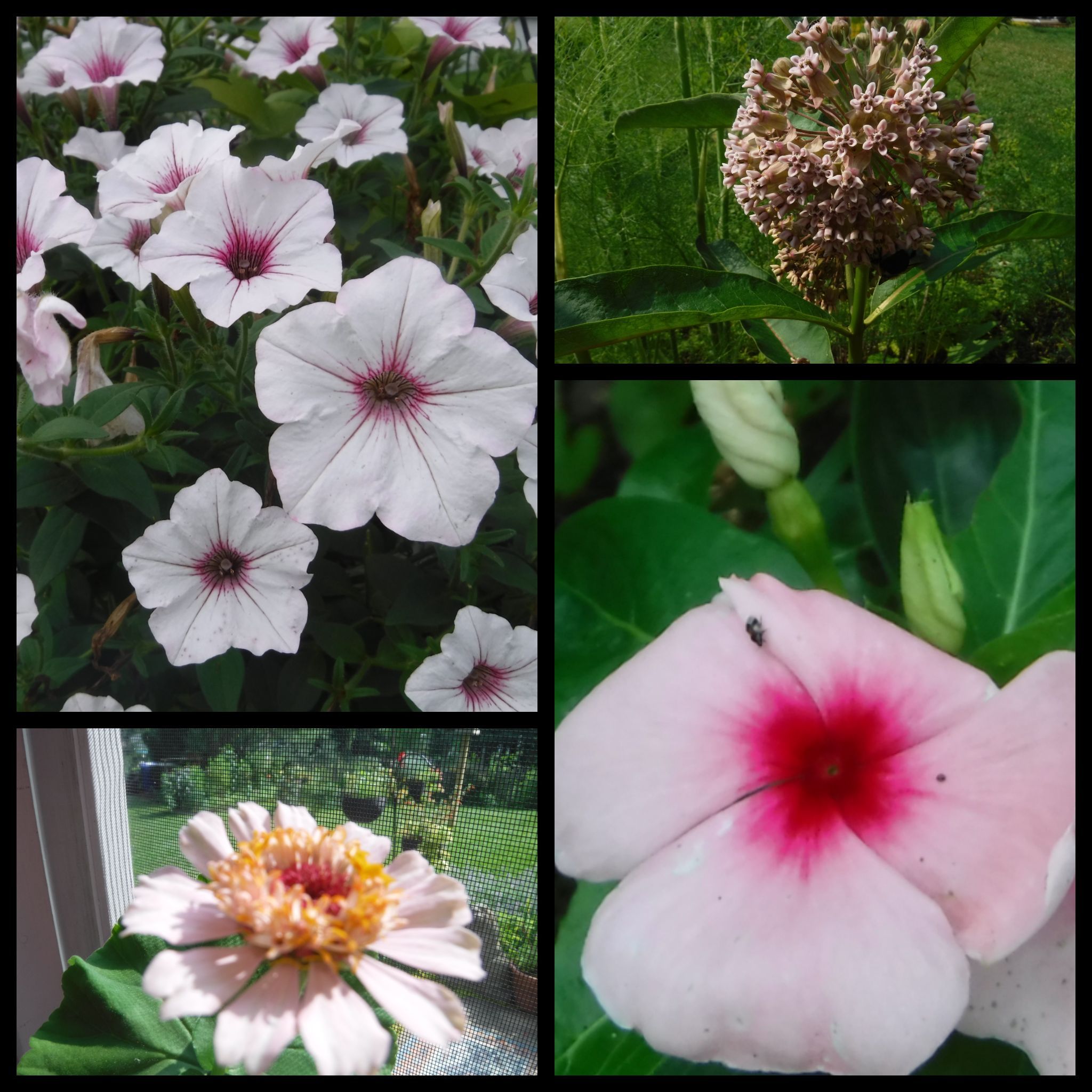
I’m taking part today, before time runs out, in June’s Sunday Stills Monthly Color Challenge. This month the challenge is: #Pink in the Great Outdoors. I have quite a few pinks growing in my gardens, from the silvery hue of soft blush to deep magenta/fuschia. I stumbled upon the challenge today, grabbed camera and went out to galumph around the garden to capture some pink in my day.
Silver pinks include: Silver Petunias, Zinnia, Vinca and Milkweed.
Medium Pinks include: Spirea, Nicotiana, Rosebuds, and Hydrangea.
Magentas include: Petunia, Zinnia, Torenia and Balsam.
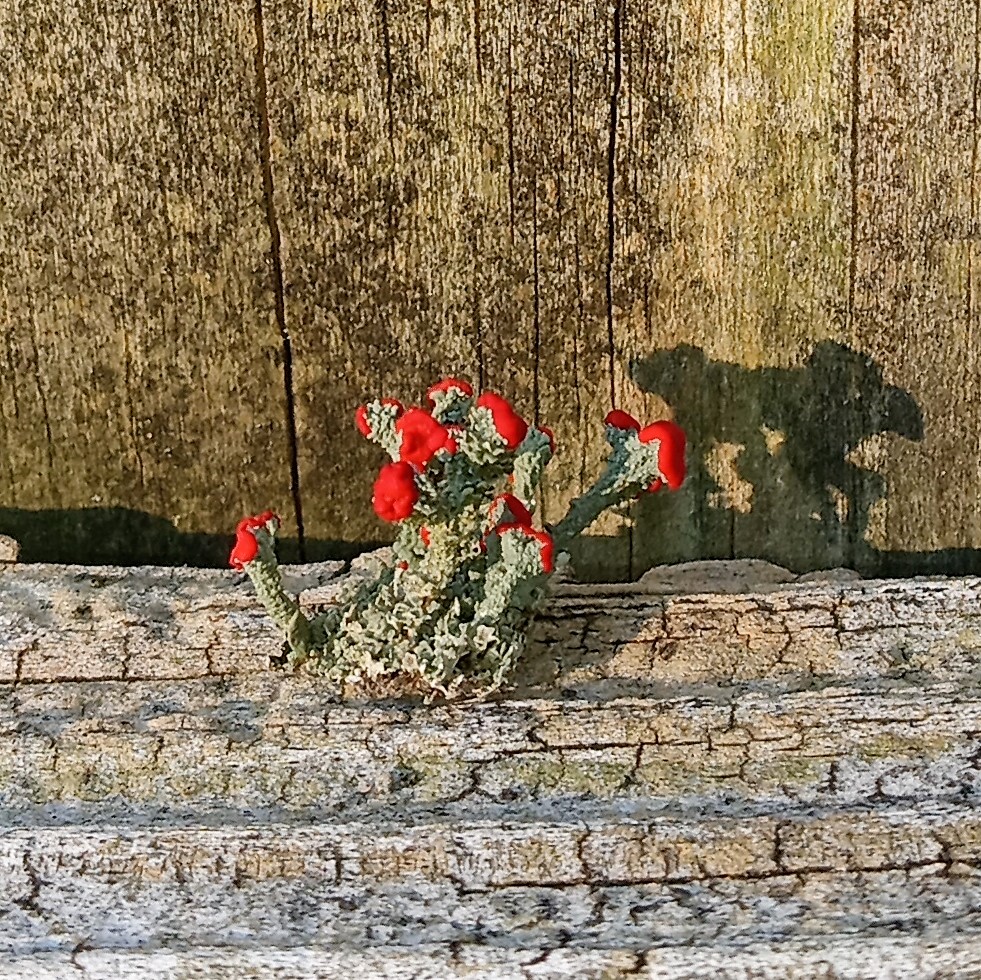
Would it seem odd if I labeled this post Throwback Thursday? Probably. I made my acquaintance with this small red lichen, Cladonia cristatella, better known as British Soldiers, years ago. In childhood, my friend Sherry, sister Susan, and I, would roam the fields near Sherry’s home in search of this small lichen to grow in terrariums. The lichen is a throwback to memories of earlier days.
I’ve been on quite a hunt for this plant, searching for it for weeks on end, I even know the date I began, August 31st. On that day we took Sherry, we’ve been friends for sixty years now, to the airport in Philadelphia, for her return trip home to the Dallas/Fort Worth area of Texas. I wanted to find a way to commemorate her trip to visit us, and also wanted a reminder of our decades of friendship. I envisioned an idea to use British Soldier Lichen, but oh my, what a time I have had finding it.
British soldier lichen, with its brilliant red caps, is named for the army of British “redcoats” who invaded colonial America. FloraFinder
I will write more about the use I am going to make of the lichen in Part II, this post is more about my search and where I finally found the lichen. I remembered as children we found the ‘soldiers’ growing along an abandoned roadway. I visited the same area and found nothing. I also rummaged around a broken-down fence that bordered a park near our home, I spotted the lichen there in the past, but nothing was found. I was near giving up, telling myself perhaps the lichen was seasonal and not growing in the area in late summer.
I had almost given up my great idea for a gift when on a bike ride, along the Glassboro-Williamstown bike trail, whizzing by a decaying split-rail fence, I spied a spark of red from the corner of my eye. I braked, threw down the kickstand, and shouted to my husband, “I found them!”
There were hundreds, more likely thousands, of the British Soldiers growing on the length of the railings. Need I say I was thrilled? I gathered a few, some for my project/gift, a few others to attempt growing over the winter. Parts II and III the blog posts on the British Soldiers will follow over the course of the next week.