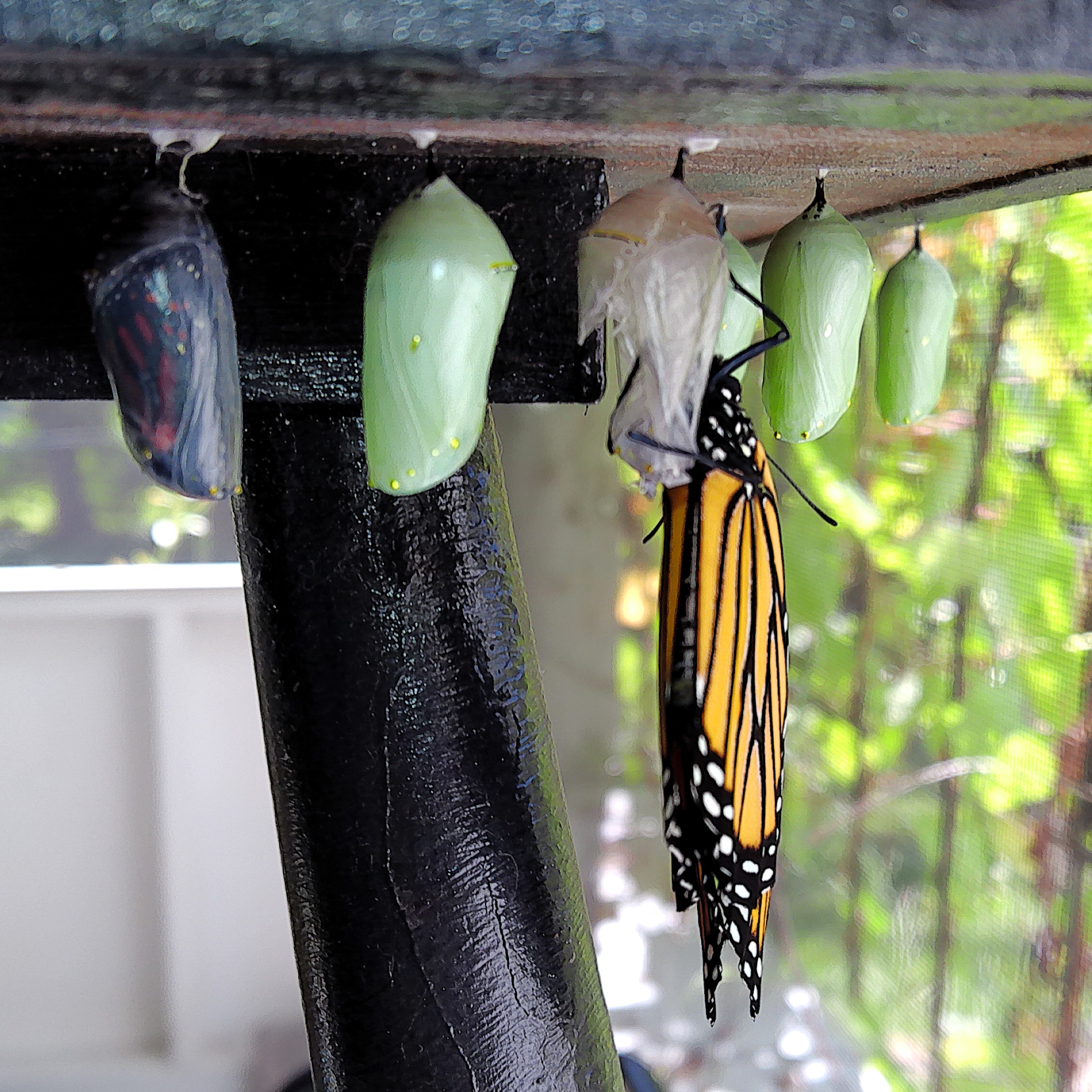
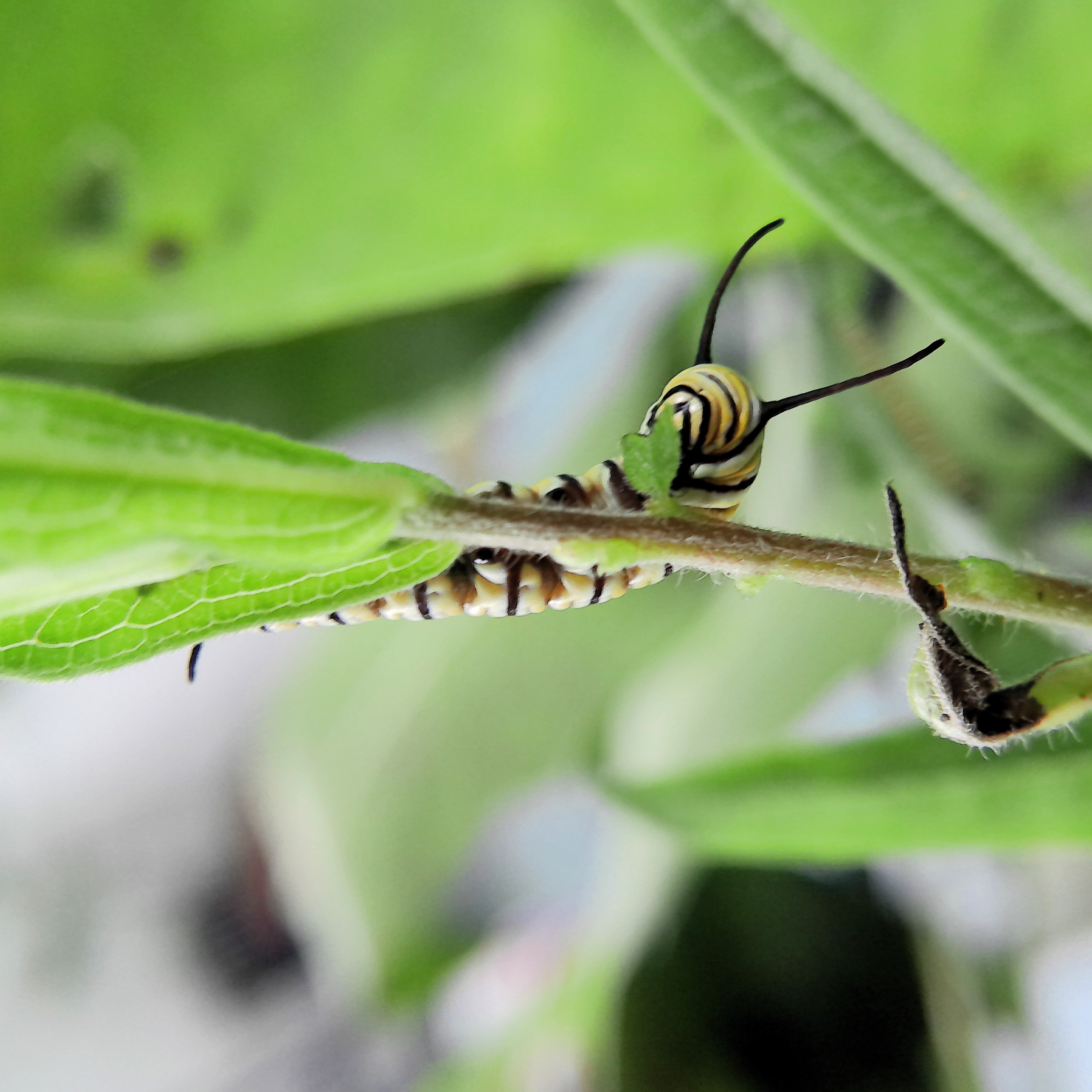
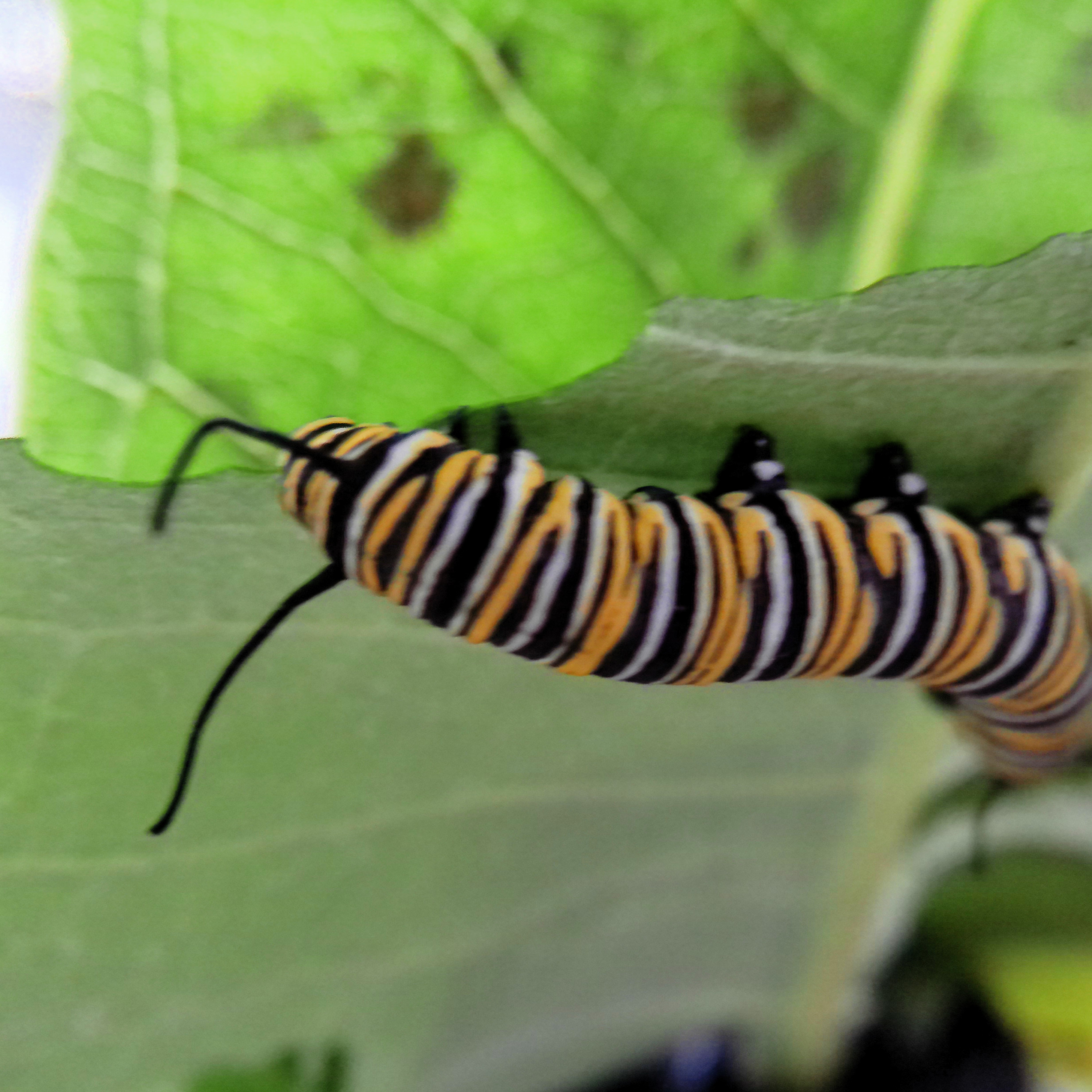
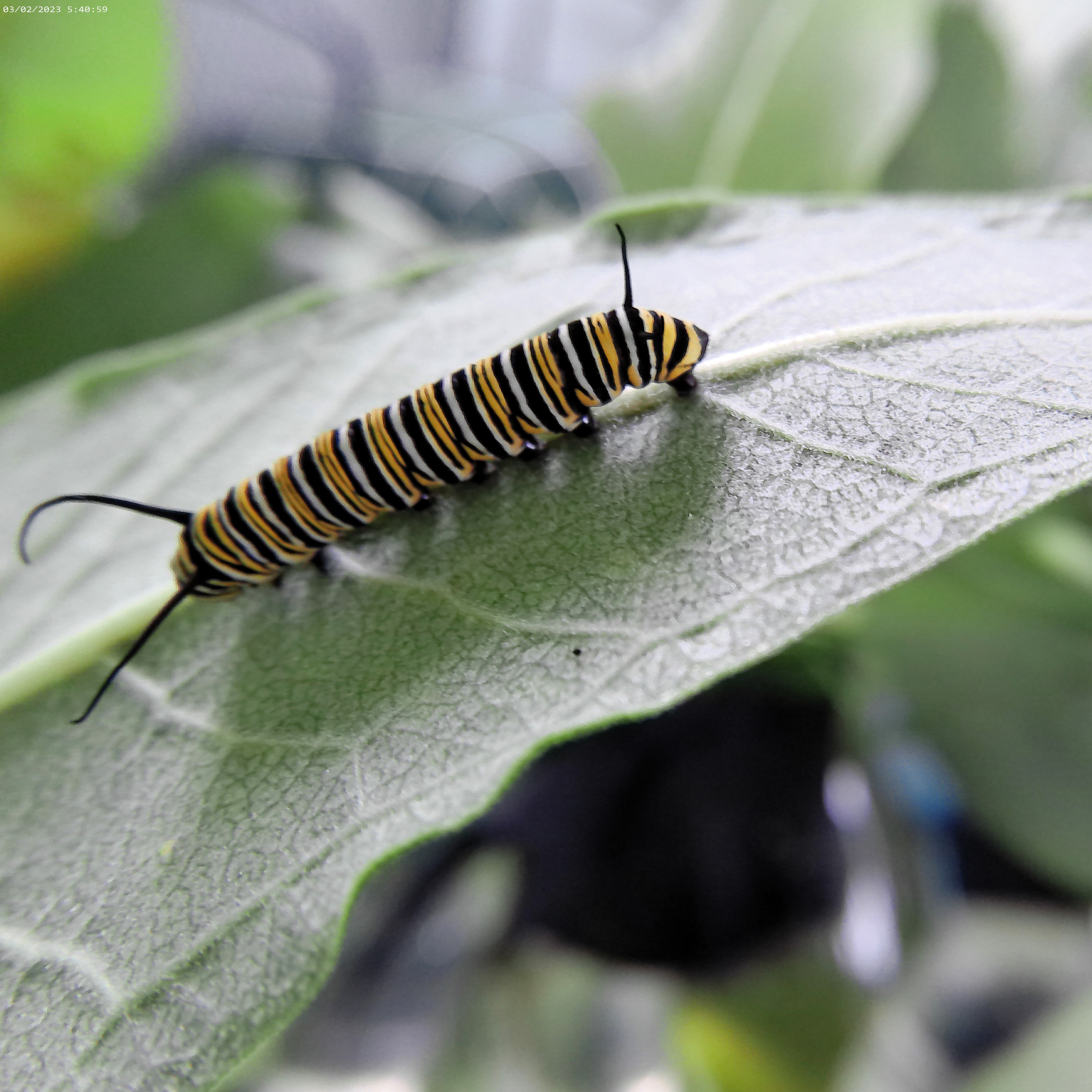
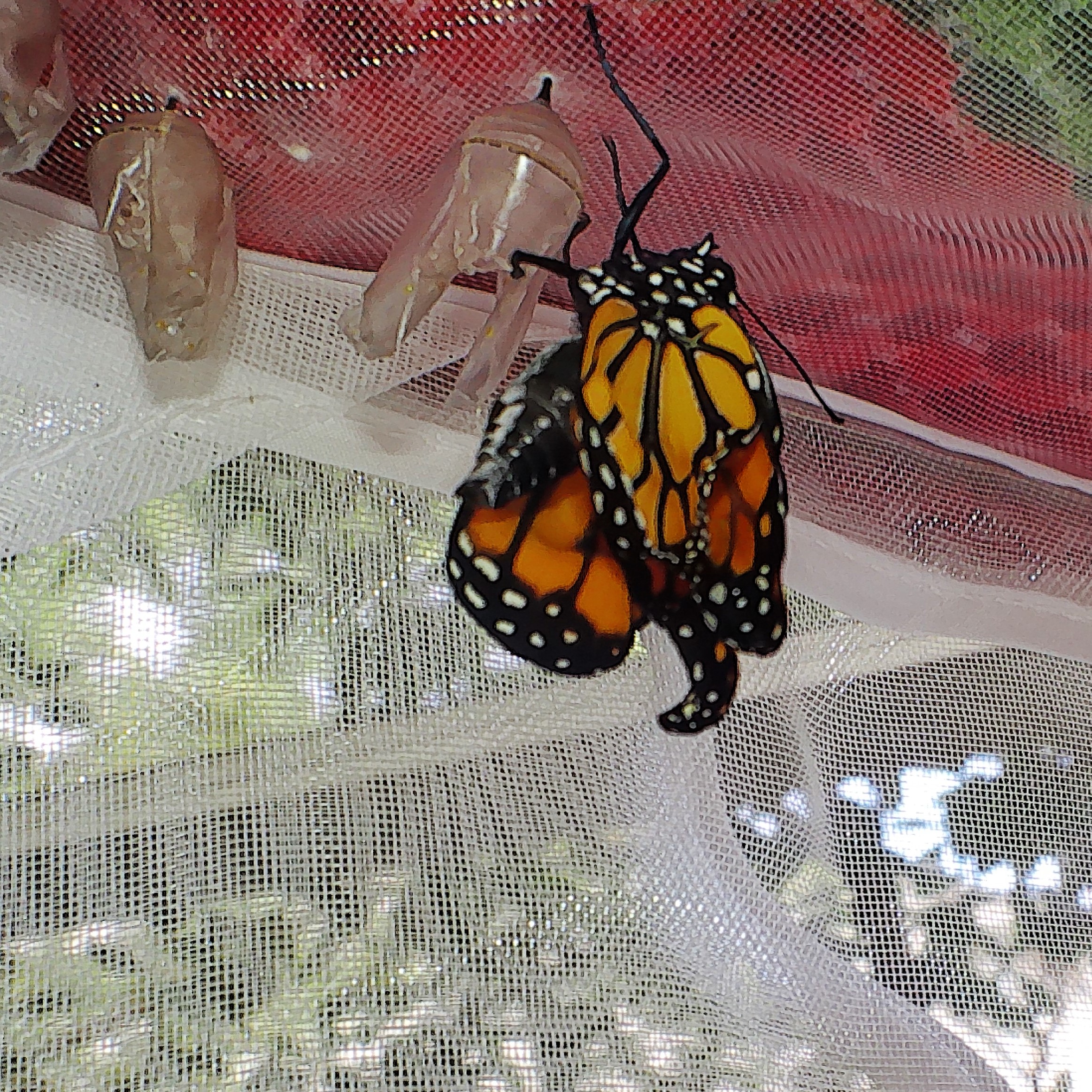
Photographed today, Monarch Butterflies in different stages of development. The one who eclosed today is ready to begin its adventure of flying to Mexico for overwintering. Later in the morning, the one on the left also emerged.
I nurtured the caterpillars on my screened porch rather than leaving them outdoors because they fall victim to predatory bugs that are not affected by their poison. Many created their chrysalis beneath the coffee table that held the milkweed they fed upon.
I am taking part in XingfuMama’s Whatsoever is Lovely Challenge this week. I was able to raise six Monarch Caterpillars from the egg stage on a Milkweed leaf to full-size caterpillars. They are developing in their chrysalis now. I genuinely find their chrysalis stage beautiful. The amazing and luminescent green is adorned with gold that looks like metal.
In years past, during the hotter months of summer, I saw Monarch Butterflies almost daily. However, all butterflies and many insects seem scarce this year, which is worrisome. I’m hoping they rebound and are back in large numbers next year.
This beautiful moth is my choice for the “Whatsoever is Lovely” challenge hosted by Xingfu Mama. I got several good captures of it feeding on the flowers of the Butterfly Bush. The plant lives up to its name, although it resembles a tree instead of a bush. We cut it back, and it grows even taller.
The multiple blossoms of the flower sprays make it a perfect setting for photographing butterflies and bees. They are usually so intent on moving from flower to flower they ignore the trespass of my camera into their space. I love the way the photograph captures the face of the moth and the blurry whirr of its quickly fluttering wings.
There is hope! The Monarch butterflies have finally made some appearances, although not in large numbers. This one flew in for a landing and cooperated with my camera’s intrusion, allowing me to capture several photos.
Today, I had strange companions along for the ride as I drove to Red Bank Battlefield. Ten caterpillars, mid-sized in their cycle, rode along to become residents of the Butterfly House. The fennel plants collapsed a bit in the heat, but the caterpillars did well.
The house has many butterflies, chrysalis, and caterpillars. The interior is filled with dozens of nectar and host plants.
The volunteers (Butterfly Whisperers) were pleased to welcome and make room for the new residents. The jar holding the fennel sprigs they were feasting on was placed beside a beautiful fennel plant growing in the house.
It gives me great joy to think of all the visitors receiving a bit of pleasure as they watch the butterflies throughout their life cycle.
The Revolutionary War Battlefield, now a historic park, is located on the banks of the Delaware River. Philadelphia’s skyline is in view to the right of the park.
In my part of Southern New Jersey, the temperature is in the 90s. AccuWeather says the real-feel temperature is around 104°. The hot weather is helping the caterpillars thrive. I have an abundance of them in the Butterfly House and each is born with a ravenous appetite.
Inside the houses, I have Rue, a host plant, and a few sprigs of parsley. The dill in the garden is still only in the small sprout stage since I planted it late. The fennel is suffering a bit in the heat, and since that is where most of the eggs for the Black Swallowtail Butterflies are laid, I don’t want to use it all. My goal is to concoct the perfect caterpillar feast for strong butterflies.
Queen Anne’s Lace, a host plant, is in bloom now, and the tall umbrella spires grow in hedgerows near my home. I took a walk with my cutting sheers in the hottest part of the day in hopes of collecting the wildflowers.
Unfortunately, the Queen Anne’s lace was not where I expected it to be. The sprigs I had seen a week or two earlier had bloomed and gone, and my walk became longer than I had planned. I did find more growing along the edge of the woods and cut several stems. By the time I got home, they were significantly wilted, and I wondered if I could use them as I had planned for the IAVOM challenge and afterward as food for the caterpillars. The Queen Anne’s Lace stems drew up water and eventually recovered. I used a Coca-Cola bottle as a vase.
Butterfly tip: The Queen Anne’s Lace, though the blossoms become frail, has stems that stay firm even after drying out. They are perfect for a caterpillar to use to form its chrysalis.
Yes, you are correct if you think this blog becomes inundated with butterflies at this time of year.
Today’s photographs are part of the Cosmic Photo Challenge, Contrast. The markings on the butterfly are an excellent example of contrasting colors. The butterfly contrasts nicely with the garden plants he rests upon as he finishes drying off his wings.
Another good contrast is the natural support of the butterfly chrysalis on the left compared to the one on the right. I save so many caterpillars; they sometimes bump finished chrysalises right off their mooring of spun web. I found the chrysalis in the papoose-like sling of string lying on the floor of the butterfly house. I am hoping it will develop properly and emerge perfectly.
When I use string to repair a chrysalis resting place, I separate garden twine into single pieces. This is as close as I can come to mimicking the web they spin. It doesn’t harm the developing butterfly. I’ve had two emerge and fly off into the wide world after being put back into place with garden string.
The first Black Swallowtail butterfly was ‘born’ today. The high heat, present even in the morning, sped up the drying process, and the butterfly was ready to fly within two and a half hours. I took the butterfly enclosure outside, and the new butterfly easily flew into the world and quickly disappeared. Success!
I like the way the photo shows the web they spin to anchor themselves in place. Due to the number of caterpillars I was able to save, I’ve had a few mishaps. I’ll post some of the solutions later in the week.
I had a rude awakening to one of the perils butterflies and caterpillars face. In mid-spring, expecting the butterfly chrysalis to hatch at some point, I brought the butterfly houses out to the porch and hung them from the ceiling. One day, checking them, I saw a delicate wasp of some sort had gotten inside the house and was trapped. Being a bit of a bleeding heart, I shooed the wasp out and felt I had done my good deed for the day. Wrong.
Two more wasps, surprisingly to me, also found a way into the house. I let these out also. Afterwards, I looked at the seven chrysalis on the sides. What! There was some type of hole in the sides of a few. I knew some parasite had attacked them.
When another wasp suddenly appeared in the house, I knew that it would not appeal to my softheartedness; I squashed it.
Trogus Pennator Wasps eat the swallowtail caterpillars from the inside out and emerge from the chrysalis. I can attest to the truth of this remark. Three overwintered chrysalis have opened in the past week or two, and beautiful Black Swallowtails have taken wing after the long wait. I have seen them fluttering over the fennel plants, and sure enough, I found several of the tiny eggs on inspection.
This weekend, small caterpillars appeared. I have twelve safely in one of two, new butterfly houses. I have also kept the older one from last year. Now that I have seen one of the parasitical threats they face firsthand, I will redouble my efforts and save as many as I can manage.
I will be keeping a 2024 Butterfly Diary. The link is here: Butterfly Diary 2024. It can also be found at the top of the blog page in the bar beneath the title. I will try to create a sidebar link too. Thanks so much for following the butterflies with me.
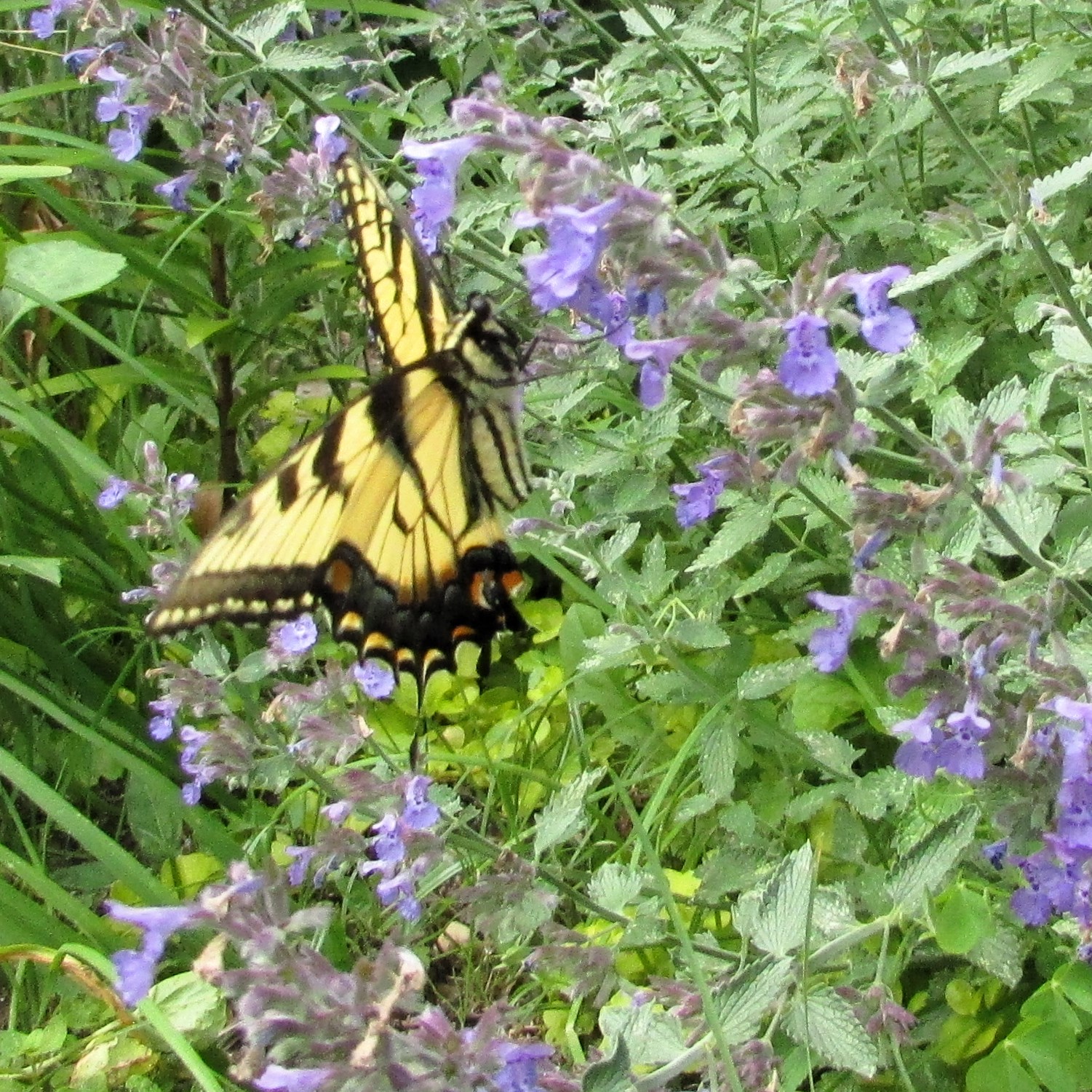
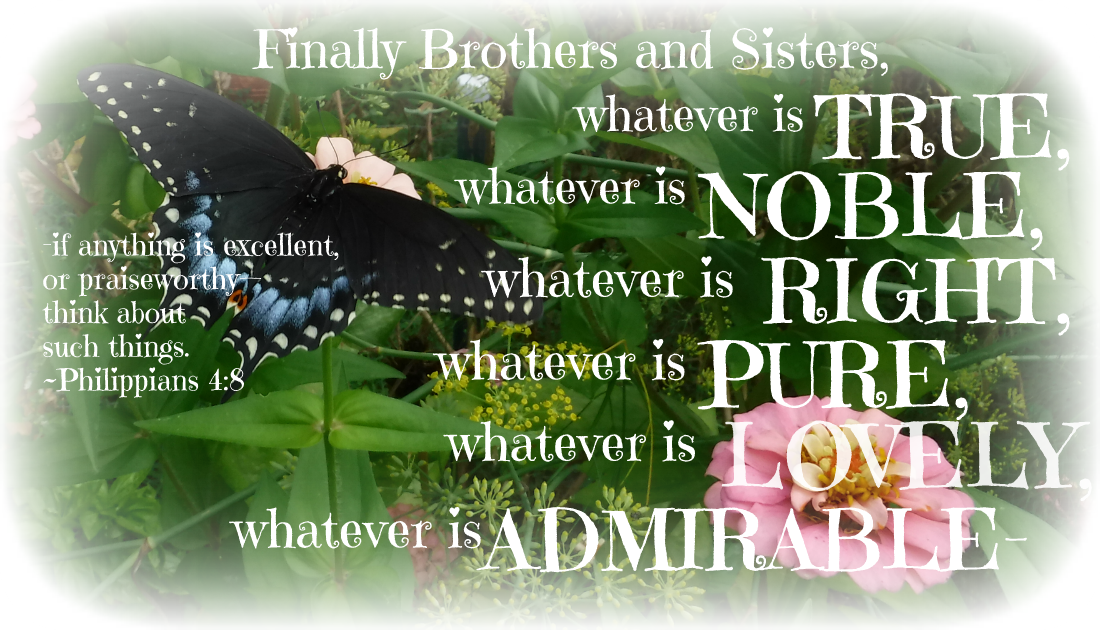
A yellow swallowtail visited my Catmint yesterday.
The beautiful butterfly floated above the flowers, giving me time to capture a photo of its yellow wings against the bluest skies and fluffiest clouds.
The butterfly had newly emerged from its chrysalis. Its vibrant colors and details are a dazzling display of our Creator’s love. Unafraid, it allowed me to capture its beauty as it visited the blossoms, sipping the nectar from each small floret. At that moment, I was truly blessed.
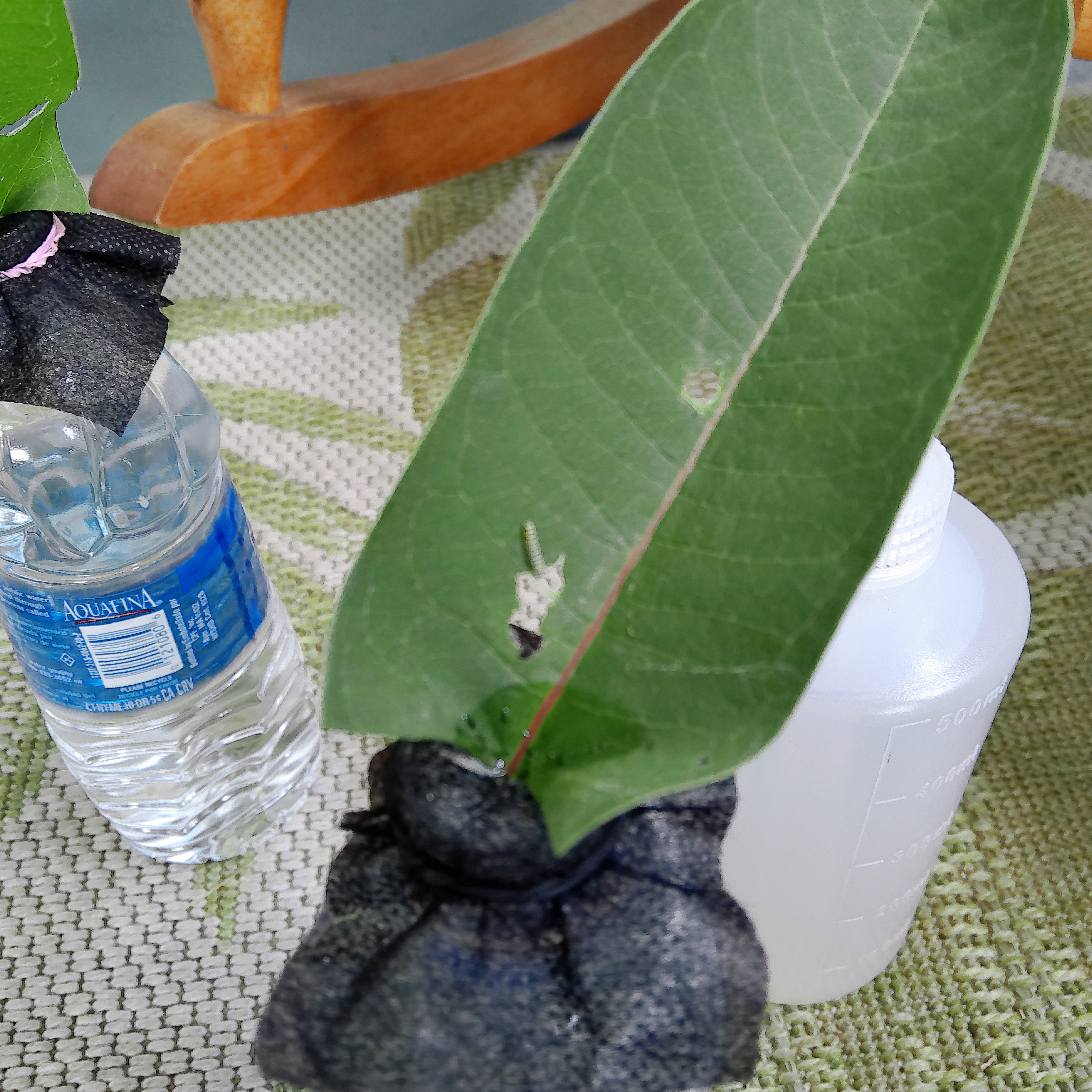
Cannibalism fix – When I found two newly hatched caterpillars on the same leaf, I knew I could not let the pair continue sharing the space. The dilemma: how to move one to another leaf without causing injury by touching it? I prepared another leaf by making two small cuts in the flesh. I then cut away one of the caterpillars with the leaf intact and inserted the ends of this piece into the cuts on the other. I’m sure my explanation sounds a bit convoluted, so I’m glad to have a photograph too. Success! You can see the caterpillar adjusted and moved on to the surface of the new leaf.
Another problem is how to clean the butterfly house. The bottom becomes discolored due to water spills and caterpillar frass (waste). I purchased another house to have a switch-out option. After all the caterpillars/butterflies completed their cycles, I washed the dirty house with a heavy stream of water from the hose and then hung it on the clothesline to be sanitized by bright sunshine. I didn’t use any type of soap or cleaner, only fresh water; butterfly feet are ultra-sensitive and chemicals of any kind can be detrimental to their thriving.
At some point milkweed leaves will begin to dry up when separated from the main plant. When this begins to happen I place a fresh leaf beside the one beginning to dry and the caterpillars move to the fresher food source.
To thwart the flies that prey on caterpillars I concocted these fly traps. Many recipes can be found on the Internet. I used water, with a bit of vinegar, sugar and soap. My solution did work. Unfortunately, foliage beneath it died when it overturned. I have some bare spots on my grass where I set the traps. I think an animal knocked them over. Parasitic wasps prey on caterpillars too, but since I bring them in before they are big enough to be of interest to the wasps, so far at least, I haven’t had a caterpillar in the butterfly house afflicted by wasp eggs.
The ‘phlutters’ on my porch have been magnificent. While I write this post, I am thinking of eleven empty and transparent chrysalides. Each is the evidence left behind of a successful eclose of the Monarch butterfly that developed inside. The brief sojourn of the caterpillar becoming a butterfly is complete. Below is a description with photos of how the day of “The Magnificent Seven” evolved.
Raindrops started falling early but then tapered off; the weather became a concern since seven chrysalides turned black and were ready to emerge over the span of twenty -four hours. Morning light revealed the markings of each butterfly through the walls of its chrysalis. After a few hours of daylight, they began to eclose.
First to break free was the only Monarch who formed its chrysalis on a milkweed stem.
The remaining chrysalides clustered along the top edges and corners of the butterfly house. Throughout late morning/early afternoon all seven eclosed at varying times. All emerged perfect, no malformation or problems breaking free from the chrysalis.
Two to four hours after eclose the butterflies began to flutter within the confines of the butterfly house, I gently coaxed them onto my fingers and carried them to the open door. Several took to the air and flew out of sight over the rooftops, others seemed tentative, and these I rested upon a hanging basket. Later in the day, when I returned, they too had taken wing.
A sense of elation filled me when I realized a lucky seven eclosed in one day. This brings the successful ecloses to a total of eleven.
Today, as I post this, six newly hatched, ultra-small Monarch caterpillars are starting the cycle all over again. Will I ever grow weary of this miracle? Never.
After spotting the vermilion orange flash of a Monarch butterfly laying eggs on my milkweed, I kept watch by tying a string on each leaf that had an egg on it. I was surprised, monarch eggs hatch quicker than the black swallowtails. Within a few days I spotted a small hole on one of the leaves. Sure enough, underneath I found an almost microscopic monarch butterfly caterpillar.
Because I’ve experienced the dilemma of monarch caterpilla cannibalism, I needed to find a better way to raise them this year. I brought one of the monarch caterpillars in on its leaf and using an old water bottle, garden cloth, and a rubber band I created a standalone leaf holder for the small caterpillar. Besides working at keeping the caterpillar separated, the bottle added a benefit; the leaves have stayed pliable and fresh for days.
To create more stem for the leaf to absorb water, I cut up along the edge of the stem, always careful to be aware of where the caterpillar is on the underside, next remove a v-shape portion by cutting away the leaf to form a stabilizing appendage to grip the garden cloth. I could go on with an explanation, but I think the photos tell the story better.
The caterpillars are thriving. They are now big enough for me to be able to see their spiky anthers.
In the course of adding water to the bottles, one caterpillar fell off on the rug, which is the same color as the caterpillar and even the same texture. I couldn’t find the small cat anywhere. I felt terrible. There was no sense in looking for the fallen caterpillar because I might squash it with my knee or foot while I searched. Instead, I laid a few leaves in the area where I thought it fell. The strategy worked, and today I found the wayward caterpillar on the leaf I laid on the floor. It is safely back on the rearing bottle now.
You can tell, by the holes in the leaves, and the freshness they’ve retained, that the single bottles work much better than leaving all the caterpillars in the bottom of the butterfly cage. Unfortunately, last year that is what I did, and I had seven caterpillars at one time on the bottom of the enclosure, eating the leaves. Overnight, my number was down to one. Yes, caterpillars of the monarch butterflies, although they are beautiful and delicate, are voracious cannibals of each other.
I might run into some trouble when they are big enough to loop themselves from one leaf to another. Maybe the problem will never present itself, but at least I am on the lookout for it.
I am grateful that I have a whole garden bed filled with milkweed. I checked some of the wild areas and the milkweed is in horrible condition. I found no caterpillars, only aphids spiders, ants and other bugs that prey on the monarch caterpillars. The leaves were leathery and dry from all the hot weather in our area. I have the advantage with my garden bed since I keep it well watered and stay on pest alert at all times.
This has been longer than my normal posts, but I wanted to share how to keep the leaves fresh, and the caterpillars away from each other. One note, they do like to be shaded. I keep them shielded from the Sun with dish towels over the sides. So far none have attempted to reach the other leaves. They are thriving and growing. I’m looking forward to watching the process over the next few weeks.
The large butterflies are finally showing up in my backyard. We’ve also seen many Yellow Swallowtails on daytrips as we drive toward the ocean shoreline. I am relieved. They are late, but they are here. Today I saw two Yellow Swallowtails, the largest butterfly in this area, on my butterfly bush at the same time.
Late last week, a bronze Monarch laid eggs on the underside of Milkweed leaves as I watched. Today, I went in search of the small dome-like eggs and marked each leaf with a string when I found one. I know the small caterpillars are poisonous, but that does not stop other insects from eating them. Ants, mantids, wasps, spiders are a few of the insects that will eat Monarch caterpillars. You can find solutions for combatting this problem on the Monarch Butterfly Garden site.
This caterpillar decided to form its chrysalis almost on top of another chrysalis. This is a view of the top corner of the smaller butterfly house.
I’m encouraged that the big butterflies are returning. I am peering out the windows constantly, camera ready, prepared to instantly run out in the yard to record their arrival and feeding.
I had the finest of dreams, or was it a vision of sorts? One recent afternoon, while I was about my daily routines, a tiredness fell over me, and I laid down for just a moment, a catnap perhaps, a moment of rest. In that in-between time of sleep and wakefulness, I suddenly saw/dreamt of a woman, a beautiful, lovely woman, wrapped up in gossamer folds of some type, her body covered, but her face and hair fully exposed. Her hair was long, dark and luxurious, it was stirring, as if touched by a breeze. Her eyes were glowing and captivating, and I realized she was familiar to me. Love, pure love, suddenly crossed her face. I have only seen this pure, face-altering love in children, my sons, my grandchildren. They would catch sight of me, sometimes from afar, and love would alter their expression, in a way that is hard to describe, but once you’ve experienced it, you never forget the gift of that moment. I suddenly realized the beautiful woman was my grandmother who ‘fell asleep in the Lord’ several years ago at age ninety-three. She was altered, transformed, but recognizable too. I suddenly realized the perfect reality of the verse in the Bible—
For this we say to you by the word of the Lord, that we who are alive and remain until the coming of the Lord, will not precede those who have fallen asleep. For the Lord Himself will descend from heaven with a shout, with the voice of the archangel and with the trumpet of God, and the dead in Christ will rise first. Then we who are alive and remain will be caught up together with them in the clouds to meet the Lord in the air, and so we shall always be with the Lord. Therefore comfort one another with these words. I Thessalonians 4:15-18
When those who have ‘fallen asleep’ rise again, when the Lord wakens them, when the trumpet of God sounds, they shall rise first. We who are alive will then be caught up with them and meet our Lord in the air…we shall be with the Lord through eternity.
Did I dream of my grandmother transformed because of watching the butterflies transforming? I think it factored into it. I was concentrating on what was admirable and lovely by watching caterpillars transform and fly away with the beautiful blue of sky as a backdrop. God gives us a clue, I think, of how perfect his transforming power is in the metamorphosis of a caterpillar. I feel blessed to have witnessed these beautiful moments, the transforming of the butterflies, and a blessed reminder of the Rapture in a dream
As in all aspects of life sometimes things don’t go according to plan. Now and then, a problem arises, and I’ve had a few with this latest batch of butterflies. I related a bad choice a caterpillar made in Part III of Raising Black Swallowtail Butterflies, a chrysalis on a screen door spring is a terrible place to go through a metamorphosis. Sure enough, my prediction proved true, and after a storm shook the door, after several slams, the girdle of the chrysalis broke loose.
I knew that if left alone, further shaking, wind, and door slams would shake loose the silken pad too. I knew I needed to attach it in an unobtrusive way so that when the butterfly emerged, the surroundings would be as lifelike as possible. I had garden string at hand, and knowing it is six strands twisted together, unwound a few inches, and used one strand to tie the chrysalis back to the door spring. It worked. I was relieved and elated when a perfect butterfly emerged.
One problem I can’t fix is a butterfly that emerges with a twisted wing. In this case the best thing I can do is place it on some nectar flowers and hope for the best.
Another problem is vacationing and raising butterflies in the same span of time. When vacation is two weeks off I stop collecting the caterpillars and concentrate on finding a way to get them to attach to something I can move outside. I found two solutions, one quite by accident.
On Father’s Day this year we had quite a few people over, and I knew that the vase of fennel and caterpillars would be a problem. The caterpillars had been dropping off and creating their chrysalis for several days, but there were quite a few that would most likely drop off on the day we had company. I placed the caterpillars in a tall box and shut the lid, keeping them safe from the many feet that would pass through the porch to the backyard. The next day I found the caterpillars had indeed dropped off the fennel. Finding nowhere to go, two of them had attached themselves to the side of the corrugated cardboard box. I was pleased, and also elated, I was able to cut off a square of this and share it with a friend who needed a magical moment. If you want to share the magic with a child or friend, this is the way to achieve it.
Vacation time arrived, I knew several mature caterpillars would be ready to drop and form their chrysalis, and most likely would emerge while we were gone. Not wanting them to starve on the screened in porch, or be eaten before they had a chance to develop if I set them free outdoors, I crafted an enclosure out of a tomato cage. I used wide crafting mesh I had left over from Halloween, and a few clothespins. It was easy to do, and I expected to find all the caterpillars forming chrysalis on the mesh. I was surprised when most chose the steel of the tomato cage instead. After metamorphosis had begun I removed the mesh and placed the cage outdoors.
While on vacation the butterflies did hatch. I was so happy when I arrived home to find all had emerged from the chrysalis and flown away, leaving just the empty shell behind.
Why do I do this you might ask. Because every time the caterpillar transforms into a butterfly I am amazed…and…if I chose to just walk away and leave them where they first hatch most get eaten by predators. Also…
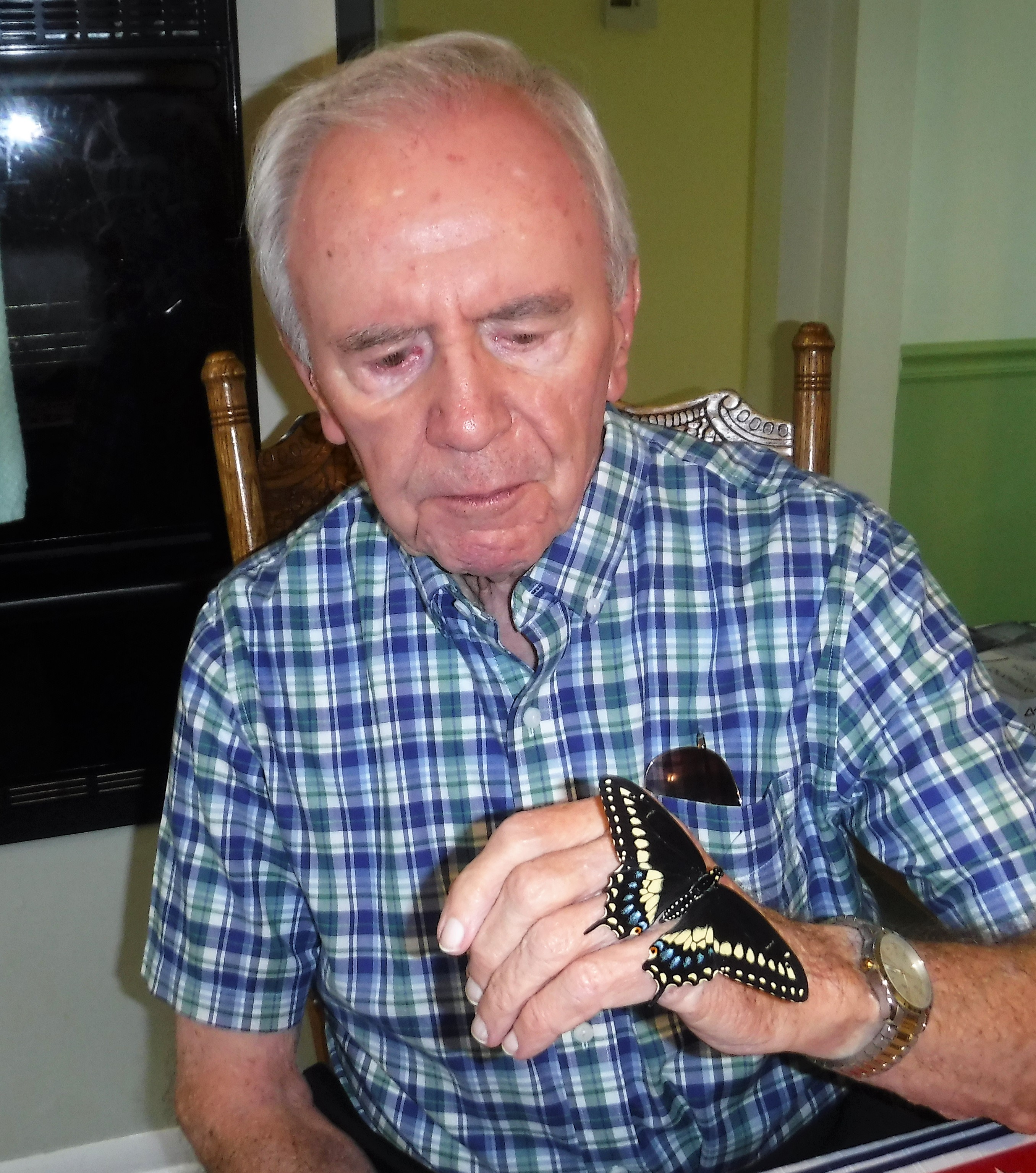
If I hadn’t hatched the butterflies this year I would have missed this extra special moment…my father holding a Black Swallowtail butterfly as it was getting ready to fly. Priceless!
When the caterpillars reach their final size they tend to slow down and rest a bit. At this point they need to get rid of any food left in their bodies, and to do so means a purge. After the discharge of stomach contents, the caterpillars will be ready for the next step in life, what I call a walkabout.
The caterpillar will drop off the host plant after purging, (be prepared for a gooey mess beneath the plant) and then travel the area to find a suitable place to form a chrysalis. Don’t worry if the caterpillar climbs several feet up a wall or other tall object. Also, don’t be alarmed if they drop all the way down to the floor from their high perch. My porch is cement, and this terrible drop never seems to even stun the caterpillar. They just go on walking, searching, climbing, and exploring any object in their way.
Finally, they find a spot to transform. They spin a silken pad to secure their tail, and then spin a silken thread called a girdle to hold them steady. The Black Swallowtail caterpillars I raise harden up at this point, forming a strange, striped comma-like appearance. This stage usually lasts several hours or overnight. Suddenly, without warning, a slight thrashing motion will begin and the outer skin will be sluffed off. I’ve only managed to see this happen once or twice. Underneath the skin is a beautiful green or tan chrysalis. The color will depend on what the caterpillar has formed its chrysalis upon. I usually find the butterflies emerge within two weeks of forming the chrysalis unless they are late Autumn butterflies, in that case they will winter over and emerge in the late Spring.
Most of the caterpillars choose the window/screen area of the back porch to form a chrysalis upon. Sometimes, I lose track of their whereabouts, and then I will be surprised to suddenly find a chrysalis in a very strange place, or one outside the porch door, (there is a small opening beneath the door where they can exit if they choose) or they will completely disappear in a hidden spot and suddenly I will have an unexpected butterfly flying on the porch. I’ve included a few photos below of this year’s strange resting spots for the metamorphosis.
This one was a music lover and chose the spot to form a chrysalis beneath a window chime. When the time came, he left his melodious resting place, climbed out, dried off, and spread his wings before he flew away.
Once in a while a caterpillar will choose poorly, such as this terrible resting spot on a screen door spring. A bad choice can mean big problems, and that is a bit of a tease for Part IV.