Phlutters – Butterfly House/Red Bank Avenue

Today, I had strange companions along for the ride as I drove to Red Bank Battlefield. Ten caterpillars, mid-sized in their cycle, rode along to become residents of the Butterfly House. The fennel plants collapsed a bit in the heat, but the caterpillars did well.

The house has many butterflies, chrysalis, and caterpillars. The interior is filled with dozens of nectar and host plants.

The volunteers (Butterfly Whisperers) were pleased to welcome and make room for the new residents. The jar holding the fennel sprigs they were feasting on was placed beside a beautiful fennel plant growing in the house.

It gives me great joy to think of all the visitors receiving a bit of pleasure as they watch the butterflies throughout their life cycle.

The Revolutionary War Battlefield, now a historic park, is located on the banks of the Delaware River. Philadelphia’s skyline is in view to the right of the park.

Phlutters & Phloral – IAVOM/Queen Anne’s Lace

In my part of Southern New Jersey, the temperature is in the 90s. AccuWeather says the real-feel temperature is around 104°. The hot weather is helping the caterpillars thrive. I have an abundance of them in the Butterfly House and each is born with a ravenous appetite.

Inside the houses, I have Rue, a host plant, and a few sprigs of parsley. The dill in the garden is still only in the small sprout stage since I planted it late. The fennel is suffering a bit in the heat, and since that is where most of the eggs for the Black Swallowtail Butterflies are laid, I don’t want to use it all. My goal is to concoct the perfect caterpillar feast for strong butterflies.

Queen Anne’s Lace, a host plant, is in bloom now, and the tall umbrella spires grow in hedgerows near my home. I took a walk with my cutting sheers in the hottest part of the day in hopes of collecting the wildflowers.

Unfortunately, the Queen Anne’s lace was not where I expected it to be. The sprigs I had seen a week or two earlier had bloomed and gone, and my walk became longer than I had planned. I did find more growing along the edge of the woods and cut several stems. By the time I got home, they were significantly wilted, and I wondered if I could use them as I had planned for the IAVOM challenge and afterward as food for the caterpillars. The Queen Anne’s Lace stems drew up water and eventually recovered. I used a Coca-Cola bottle as a vase.

Butterfly tip: The Queen Anne’s Lace, though the blossoms become frail, has stems that stay firm even after drying out. They are perfect for a caterpillar to use to form its chrysalis.

Phlutters – A Tragic Tale/Butterflies Part I

I had a rude awakening to one of the perils butterflies and caterpillars face. In mid-spring, expecting the butterfly chrysalis to hatch at some point, I brought the butterfly houses out to the porch and hung them from the ceiling. One day, checking them, I saw a delicate wasp of some sort had gotten inside the house and was trapped. Being a bit of a bleeding heart, I shooed the wasp out and felt I had done my good deed for the day. Wrong.

Two more wasps, surprisingly to me, also found a way into the house. I let these out also. Afterwards, I looked at the seven chrysalis on the sides. What! There was some type of hole in the sides of a few. I knew some parasite had attacked them.

When another wasp suddenly appeared in the house, I knew that it would not appeal to my softheartedness; I squashed it.

Trogus Pennator Wasps eat the swallowtail caterpillars from the inside out and emerge from the chrysalis. I can attest to the truth of this remark. Three overwintered chrysalis have opened in the past week or two, and beautiful Black Swallowtails have taken wing after the long wait. I have seen them fluttering over the fennel plants, and sure enough, I found several of the tiny eggs on inspection.

This weekend, small caterpillars appeared. I have twelve safely in one of two, new butterfly houses. I have also kept the older one from last year. Now that I have seen one of the parasitical threats they face firsthand, I will redouble my efforts and save as many as I can manage.

I will be keeping a 2024 Butterfly Diary. The link is here: Butterfly Diary 2024. It can also be found at the top of the blog page in the bar beneath the title. I will try to create a sidebar link too. Thanks so much for following the butterflies with me.

Phlutters – Problem Solving in Raising Butterflies

Cannibalism fix – When I found two newly hatched caterpillars on the same leaf, I knew I could not let the pair continue sharing the space. The dilemma: how to move one to another leaf without causing injury by touching it? I prepared another leaf by making two small cuts in the flesh. I then cut away one of the caterpillars with the leaf intact and inserted the ends of this piece into the cuts on the other. I’m sure my explanation sounds a bit convoluted, so I’m glad to have a photograph too. Success! You can see the caterpillar adjusted and moved on to the surface of the new leaf.

Another problem is how to clean the butterfly house. The bottom becomes discolored due to water spills and caterpillar frass (waste). I purchased another house to have a switch-out option. After all the caterpillars/butterflies completed their cycles, I washed the dirty house with a heavy stream of water from the hose and then hung it on the clothesline to be sanitized by bright sunshine. I didn’t use any type of soap or cleaner, only fresh water; butterfly feet are ultra-sensitive and chemicals of any kind can be detrimental to their thriving.

At some point milkweed leaves will begin to dry up when separated from the main plant. When this begins to happen I place a fresh leaf beside the one beginning to dry and the caterpillars move to the fresher food source.

To thwart the flies that prey on caterpillars I concocted these fly traps. Many recipes can be found on the Internet. I used water, with a bit of vinegar, sugar and soap. My solution did work. Unfortunately, foliage beneath it died when it overturned. I have some bare spots on my grass where I set the traps. I think an animal knocked them over. Parasitic wasps prey on caterpillars too, but since I bring them in before they are big enough to be of interest to the wasps, so far at least, I haven’t had a caterpillar in the butterfly house afflicted by wasp eggs.

Phlutters – The Magnificent Seven

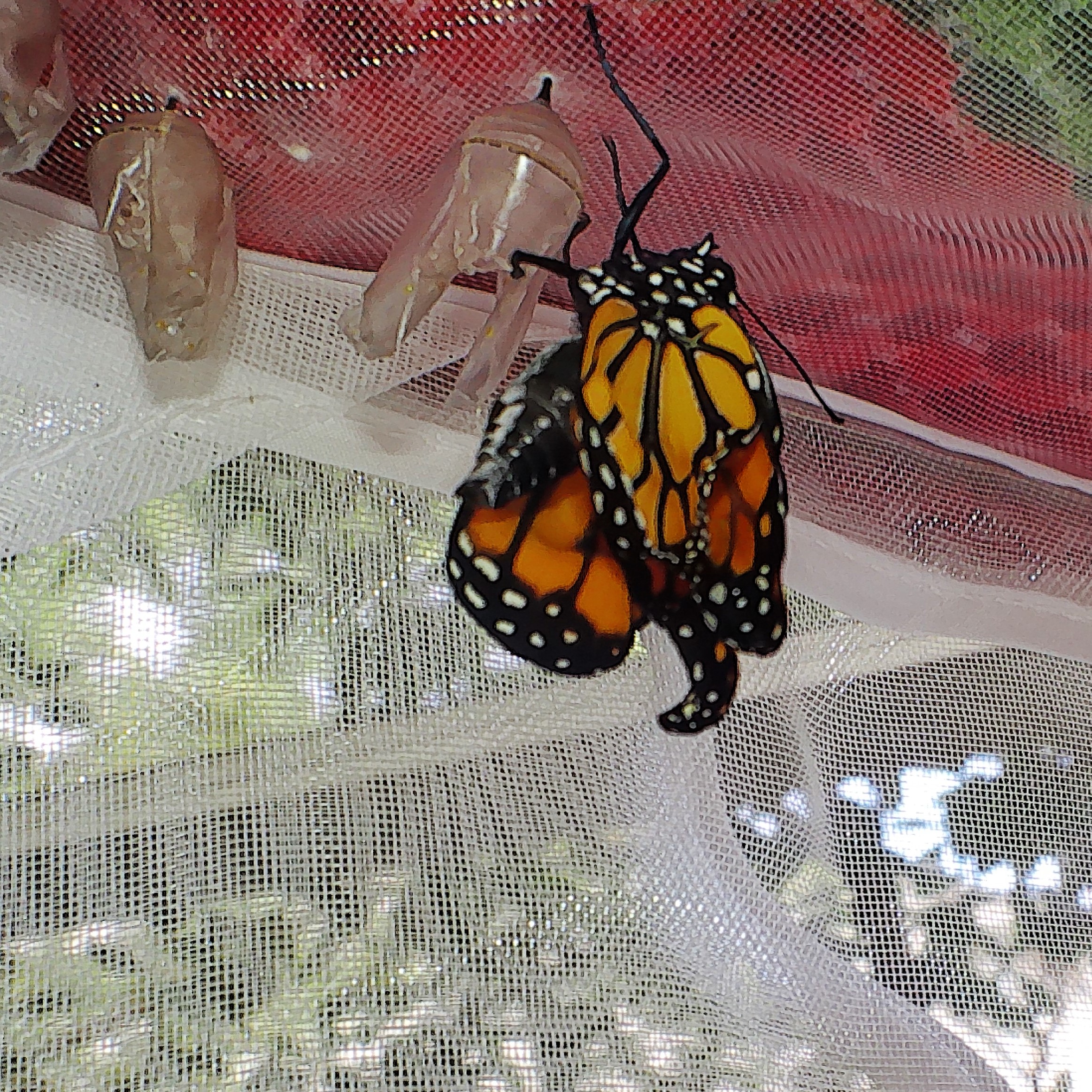
The ‘phlutters’ on my porch have been magnificent. While I write this post, I am thinking of eleven empty and transparent chrysalides. Each is the evidence left behind of a successful eclose of the Monarch butterfly that developed inside. The brief sojourn of the caterpillar becoming a butterfly is complete. Below is a description with photos of how the day of “The Magnificent Seven” evolved.

Raindrops started falling early but then tapered off; the weather became a concern since seven chrysalides turned black and were ready to emerge over the span of twenty -four hours. Morning light revealed the markings of each butterfly through the walls of its chrysalis. After a few hours of daylight, they began to eclose.

First to break free was the only Monarch who formed its chrysalis on a milkweed stem.

The remaining chrysalides clustered along the top edges and corners of the butterfly house. Throughout late morning/early afternoon all seven eclosed at varying times. All emerged perfect, no malformation or problems breaking free from the chrysalis. 

Two to four hours after eclose the butterflies began to flutter within the confines of the butterfly house, I gently coaxed them onto my fingers and carried them to the open door. Several took to the air and flew out of sight over the rooftops, others seemed tentative, and these I rested upon a hanging basket. Later in the day, when I returned, they too had taken wing. 

A sense of elation filled me when I realized a lucky seven eclosed in one day. This brings the successful ecloses to a total of eleven. 

Today, as I post this, six newly hatched, ultra-small Monarch caterpillars are starting the cycle all over again. Will I ever grow weary of this miracle? Never.

This post is part of Skywatch Friday.

Place – Philadelphia Museum of Natural Science

My husband I recently took our grandsons to the Philadelphia Museum of Natural Science. We had a grand time. My only complaint…it’s a little dark inside.

My favorite exhibit was the butterfly house. It’s amazing to feel butterflies flitting right by your head.

The museum has a dinosaur hall too…quite a few dinosaur skeletons on display.

There is even an Egyptian mummy on display.

On the way home we said “Hello!” to William Penn. It was a perfect day in the City of Philadelphia.