Today, I had strange companions along for the ride as I drove to Red Bank Battlefield. Ten caterpillars, mid-sized in their cycle, rode along to become residents of the Butterfly House. The fennel plants collapsed a bit in the heat, but the caterpillars did well.
The house has many butterflies, chrysalis, and caterpillars. The interior is filled with dozens of nectar and host plants.
The volunteers (Butterfly Whisperers) were pleased to welcome and make room for the new residents. The jar holding the fennel sprigs they were feasting on was placed beside a beautiful fennel plant growing in the house.
It gives me great joy to think of all the visitors receiving a bit of pleasure as they watch the butterflies throughout their life cycle.
The Revolutionary War Battlefield, now a historic park, is located on the banks of the Delaware River. Philadelphia’s skyline is in view to the right of the park.
In my part of Southern New Jersey, the temperature is in the 90s. AccuWeather says the real-feel temperature is around 104°. The hot weather is helping the caterpillars thrive. I have an abundance of them in the Butterfly House and each is born with a ravenous appetite.
Inside the houses, I have Rue, a host plant, and a few sprigs of parsley. The dill in the garden is still only in the small sprout stage since I planted it late. The fennel is suffering a bit in the heat, and since that is where most of the eggs for the Black Swallowtail Butterflies are laid, I don’t want to use it all. My goal is to concoct the perfect caterpillar feast for strong butterflies.
Queen Anne’s Lace, a host plant, is in bloom now, and the tall umbrella spires grow in hedgerows near my home. I took a walk with my cutting sheers in the hottest part of the day in hopes of collecting the wildflowers.
Unfortunately, the Queen Anne’s lace was not where I expected it to be. The sprigs I had seen a week or two earlier had bloomed and gone, and my walk became longer than I had planned. I did find more growing along the edge of the woods and cut several stems. By the time I got home, they were significantly wilted, and I wondered if I could use them as I had planned for the IAVOM challenge and afterward as food for the caterpillars. The Queen Anne’s Lace stems drew up water and eventually recovered. I used a Coca-Cola bottle as a vase.
Butterfly tip: The Queen Anne’s Lace, though the blossoms become frail, has stems that stay firm even after drying out. They are perfect for a caterpillar to use to form its chrysalis.
We had a hard freeze last night. The white frosting was still visible on the zinnias after the sun came up. It’s time to put the garden to bed.
The hardiest butterflies were cabbage whites and the skippers, but even those are gone now. Hopefully, the offspring they left behind are in their chrysalises over-wintering in sheltered spots.
Ten Black Swallowtail caterpillars, within the butterfly house, formed their chrysalis in late summer. We had a couple cold nights in August and this set off diapause, a state of hibernation, in the butterflies. Three of the caterpillars formed their chrysalis on objects within the butterfly house. Seven of them formed on the screening. Those who chose the screens were easy. I checked on them, tied a string to the top, and hung them from the garage ceiling, quite an exclusive high-rise to rest in for the winter. They are far enough up that they would be hard to find by a wandering rodent. When it rains I will climb a ladder and spray a little bit of misty water into the house to mimic what’s going on outdoors.
Three of the caterpillars formed their chrysalis on other items. Two of them on a piece of landscaping stone I had at the bottom of the house to keep it secure when storms struck.
The other formed on a stem. These also need to be in the garage but must have some kind of protective covering. Recently, in the grocery store, I picked up several mesh bags sold for fruit; the perfect solution. I placed them around the objects holding the chrysalis and put them on a garage shelf for the winter.
The raising of butterflies has never become commonplace to me. I enjoy seeing the butterfly house hanging in the garage. It reminds me Spring will come again and hopefully a bevy of butterflies will emerge.
“Butterflies that go through diapause enter into a hibernation-like state, where physiological processes are suspended. After adverse weather conditions clear, they will come out of this state of suspended animation and return to normal functioning.”
As in all aspects of life sometimes things don’t go according to plan. Now and then, a problem arises, and I’ve had a few with this latest batch of butterflies. I related a bad choice a caterpillar made in Part III of Raising Black Swallowtail Butterflies, a chrysalis on a screen door spring is a terrible place to go through a metamorphosis. Sure enough, my prediction proved true, and after a storm shook the door, after several slams, the girdle of the chrysalis broke loose.
I knew that if left alone, further shaking, wind, and door slams would shake loose the silken pad too. I knew I needed to attach it in an unobtrusive way so that when the butterfly emerged, the surroundings would be as lifelike as possible. I had garden string at hand, and knowing it is six strands twisted together, unwound a few inches, and used one strand to tie the chrysalis back to the door spring. It worked. I was relieved and elated when a perfect butterfly emerged.
One problem I can’t fix is a butterfly that emerges with a twisted wing. In this case the best thing I can do is place it on some nectar flowers and hope for the best.
Another problem is vacationing and raising butterflies in the same span of time. When vacation is two weeks off I stop collecting the caterpillars and concentrate on finding a way to get them to attach to something I can move outside. I found two solutions, one quite by accident.
On Father’s Day this year we had quite a few people over, and I knew that the vase of fennel and caterpillars would be a problem. The caterpillars had been dropping off and creating their chrysalis for several days, but there were quite a few that would most likely drop off on the day we had company. I placed the caterpillars in a tall box and shut the lid, keeping them safe from the many feet that would pass through the porch to the backyard. The next day I found the caterpillars had indeed dropped off the fennel. Finding nowhere to go, two of them had attached themselves to the side of the corrugated cardboard box. I was pleased, and also elated, I was able to cut off a square of this and share it with a friend who needed a magical moment. If you want to share the magic with a child or friend, this is the way to achieve it.
Vacation time arrived, I knew several mature caterpillars would be ready to drop and form their chrysalis, and most likely would emerge while we were gone. Not wanting them to starve on the screened in porch, or be eaten before they had a chance to develop if I set them free outdoors, I crafted an enclosure out of a tomato cage. I used wide crafting mesh I had left over from Halloween, and a few clothespins. It was easy to do, and I expected to find all the caterpillars forming chrysalis on the mesh. I was surprised when most chose the steel of the tomato cage instead. After metamorphosis had begun I removed the mesh and placed the cage outdoors.
While on vacation the butterflies did hatch. I was so happy when I arrived home to find all had emerged from the chrysalis and flown away, leaving just the empty shell behind.
Why do I do this you might ask. Because every time the caterpillar transforms into a butterfly I am amazed…and…if I chose to just walk away and leave them where they first hatch most get eaten by predators. Also…
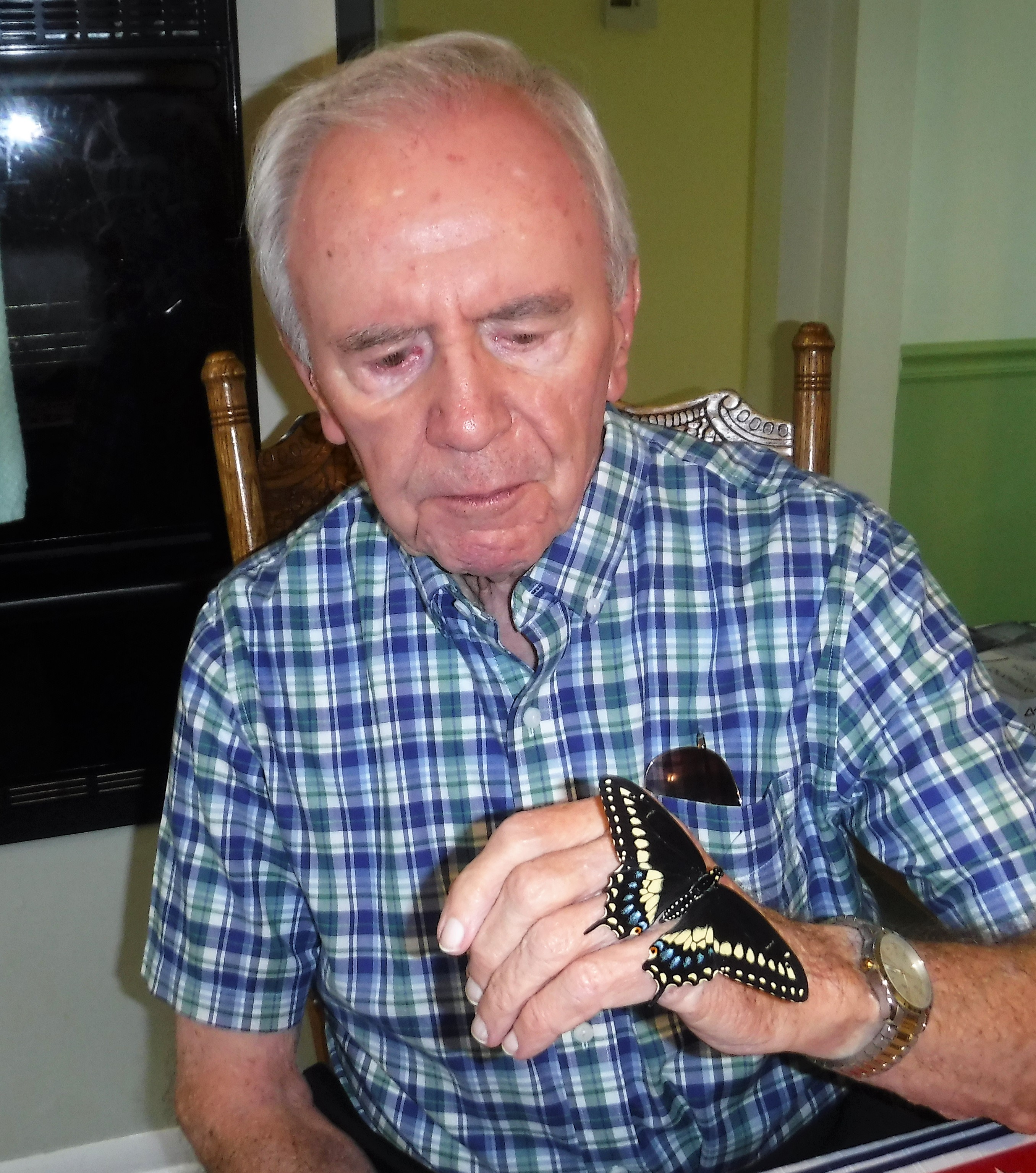
If I hadn’t hatched the butterflies this year I would have missed this extra special moment…my father holding a Black Swallowtail butterfly as it was getting ready to fly. Priceless!
When the caterpillars reach their final size they tend to slow down and rest a bit. At this point they need to get rid of any food left in their bodies, and to do so means a purge. After the discharge of stomach contents, the caterpillars will be ready for the next step in life, what I call a walkabout.
The caterpillar will drop off the host plant after purging, (be prepared for a gooey mess beneath the plant) and then travel the area to find a suitable place to form a chrysalis. Don’t worry if the caterpillar climbs several feet up a wall or other tall object. Also, don’t be alarmed if they drop all the way down to the floor from their high perch. My porch is cement, and this terrible drop never seems to even stun the caterpillar. They just go on walking, searching, climbing, and exploring any object in their way.
Finally, they find a spot to transform. They spin a silken pad to secure their tail, and then spin a silken thread called a girdle to hold them steady. The Black Swallowtail caterpillars I raise harden up at this point, forming a strange, striped comma-like appearance. This stage usually lasts several hours or overnight. Suddenly, without warning, a slight thrashing motion will begin and the outer skin will be sluffed off. I’ve only managed to see this happen once or twice. Underneath the skin is a beautiful green or tan chrysalis. The color will depend on what the caterpillar has formed its chrysalis upon. I usually find the butterflies emerge within two weeks of forming the chrysalis unless they are late Autumn butterflies, in that case they will winter over and emerge in the late Spring.
Most of the caterpillars choose the window/screen area of the back porch to form a chrysalis upon. Sometimes, I lose track of their whereabouts, and then I will be surprised to suddenly find a chrysalis in a very strange place, or one outside the porch door, (there is a small opening beneath the door where they can exit if they choose) or they will completely disappear in a hidden spot and suddenly I will have an unexpected butterfly flying on the porch. I’ve included a few photos below of this year’s strange resting spots for the metamorphosis.
This one was a music lover and chose the spot to form a chrysalis beneath a window chime. When the time came, he left his melodious resting place, climbed out, dried off, and spread his wings before he flew away.
Once in a while a caterpillar will choose poorly, such as this terrible resting spot on a screen door spring. A bad choice can mean big problems, and that is a bit of a tease for Part IV.
As soon as I see the first Black Swallowtail butterfly flitting around the yard I begin to check the fennel plant for eggs.
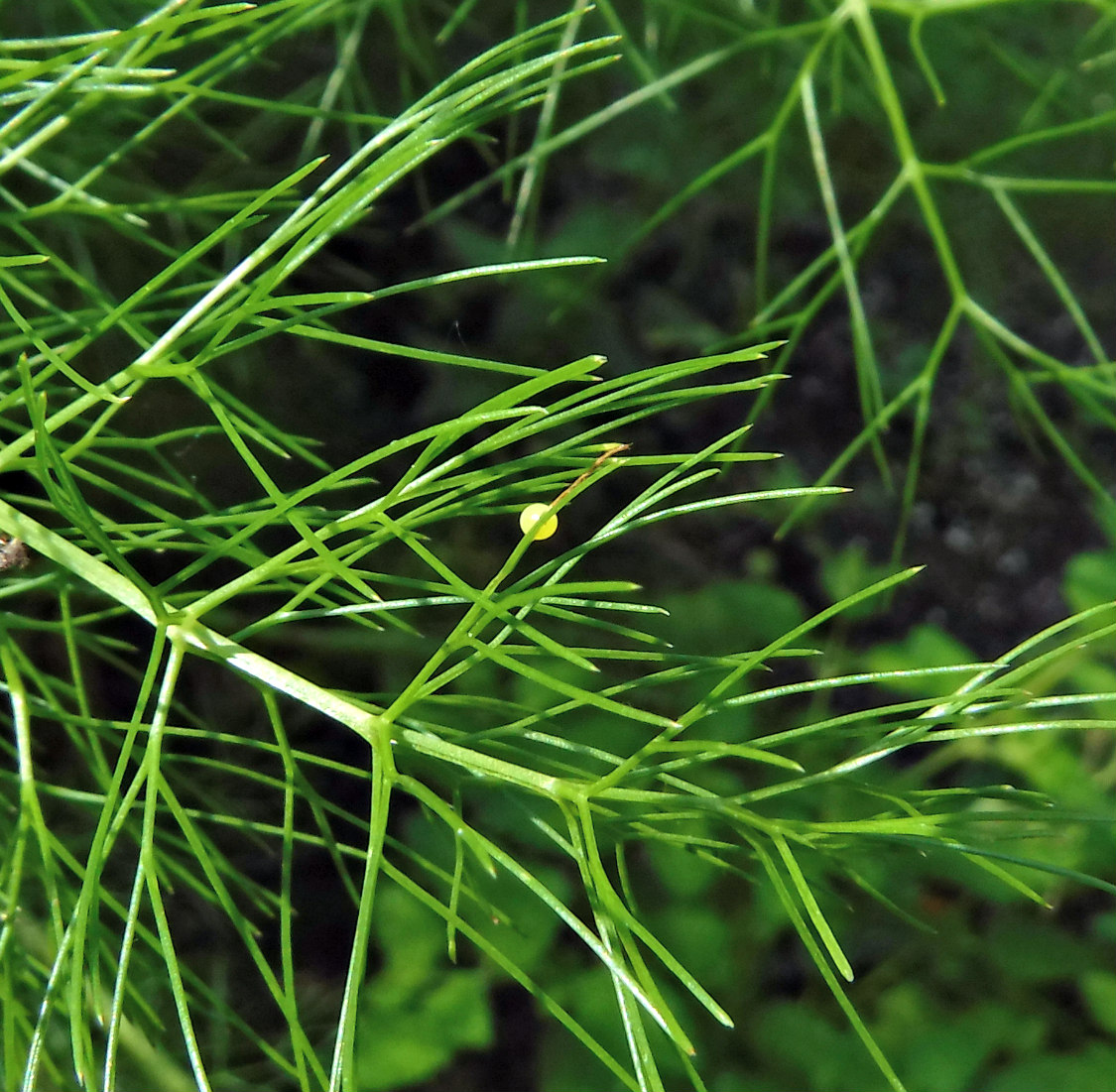
Without my reading glasses on, I would never spy the rounded yellow eggs on the thin fronds of fennel. Dill, Parsley, Rue, and Fennel are a few of my garden plants that are host plants for Black Swallowtails.
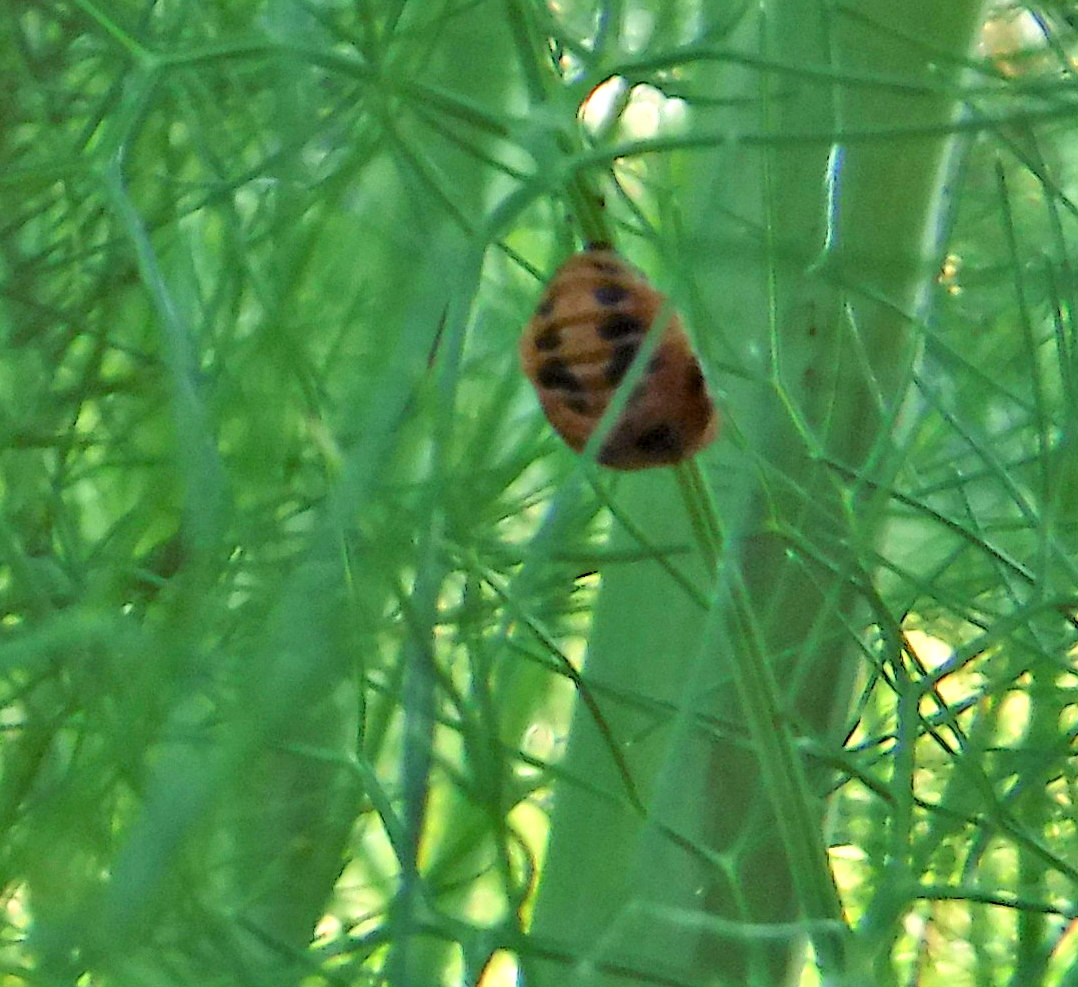
When the eggs hatch, and I find small caterpillars on the plants, I bring them onto the back porch for safekeeping. You might wonder why I don’t leave them on the plant and let nature take its course. The answer is the predator bugs that share the same leafy fennel plant. Ladybug larva coexist and quickly eat anything else they find on the plant. Praying mantis babies also roam the leafy green fronds. Small spiders are a threat to newly hatched caterpillars. I know from experience, if I don’t remove the caterpillars when I first see them, the next day the numbers will be greatly diminished, even to the point of none to be found.
Before I gather the caterpillars, I always have vases of water ready to hold the host plant of fennel. Most importantly, I cover the top of the vase with some sort of barrier to keep the small cats from drowning, Unfortunately, I know from experience, they often wander into the water if the opening is left uncovered. I use garden cloth and a single rubber band. A small hole snipped in the center allows me to insert the fennel. At the start of their feeding, one frond of fennel will be enough. They will soon need several stems a day as they progress through their instars: a period of time between the caterpillar molting.
To water the fennel without removing the covering, I use a spouted water bottle that easily adds a few inches of water. The fennel is a very thirsty plant. It will stay fresh for days if the water level in the vase is kept near the top.
I never pick the small caterpillars up with my fingers when transporting them to the vased fennel. They are extremely small and easily crushed. Instead, I pull the strand of fennel they are munching on away from the plant and place it amongst the fronds of vased fennel on the porch. I check back several times a day to make sure the caterpillar has transferred to the fresher fronds.
The caterpillars will go through several instar phases on this first piece of fennel. When the fennel begins to get dry or is eaten away by the caterpillars, I fill a second, sometimes also a third vase, and place it close beside the first so that the fennel mixes into the first bunch. As they eat, and the first fennel dries up, the caterpillars move onto the fresher plants.
A great resource for Black Swallowtail Butterflies can be found on the site: Butterfly Fun Facts.
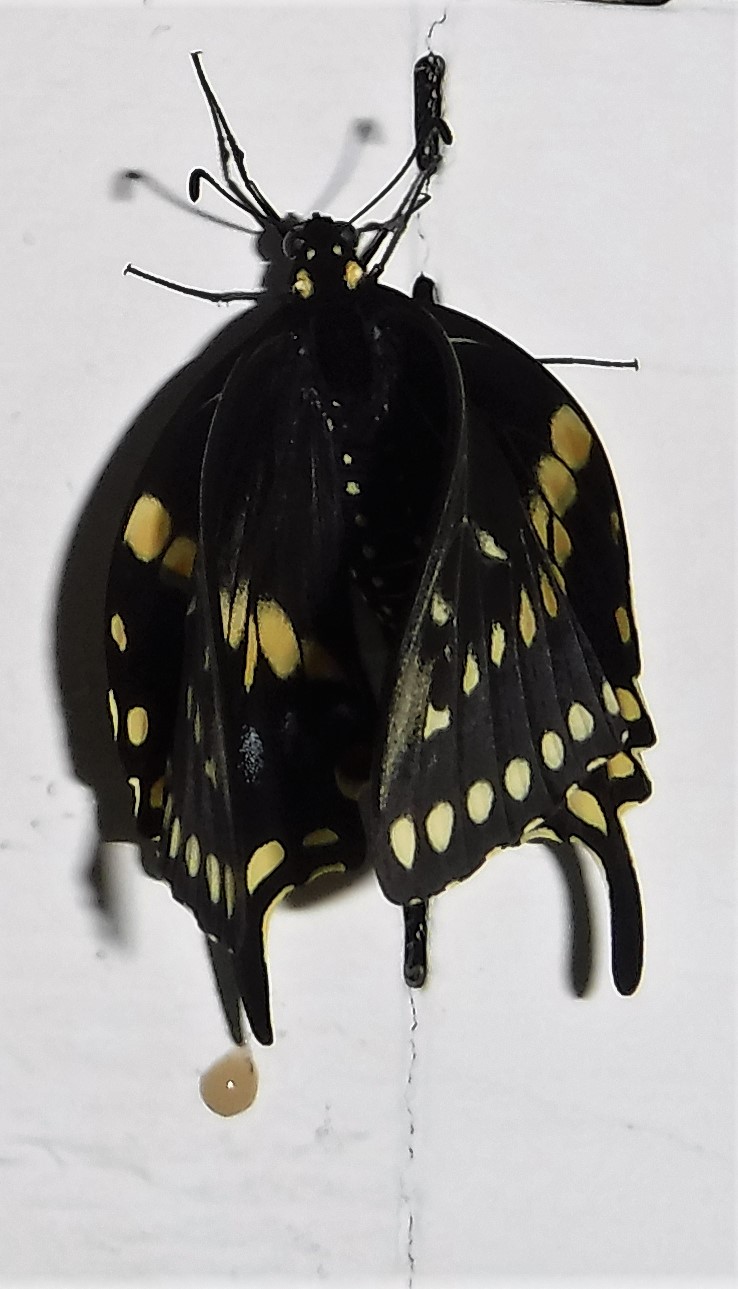
The final three chrysalis opened today. Each butterfly emerged while I wasn’t looking.
I think I just missed this one crawling out of his tight confines into the light; his wings still had a slight curve.
They have all flown out into the yard and are now seeking nectar. My crusade to add to the butterfly population isn’t over. I have a large pot of dill on my back porch and there are eleven caterpillars on its tender fronds eating and growing rapidly. What fun!