I have chosen everlasting flowers today as my post for Cee’s Flower of the Day. A heart of Maple Keys seems appropriate to send to Cee and Chris. Blue Violets also mean Love and Faithfulness, and I send that to Cee. I believe in Life Everlasting. God bless us all.
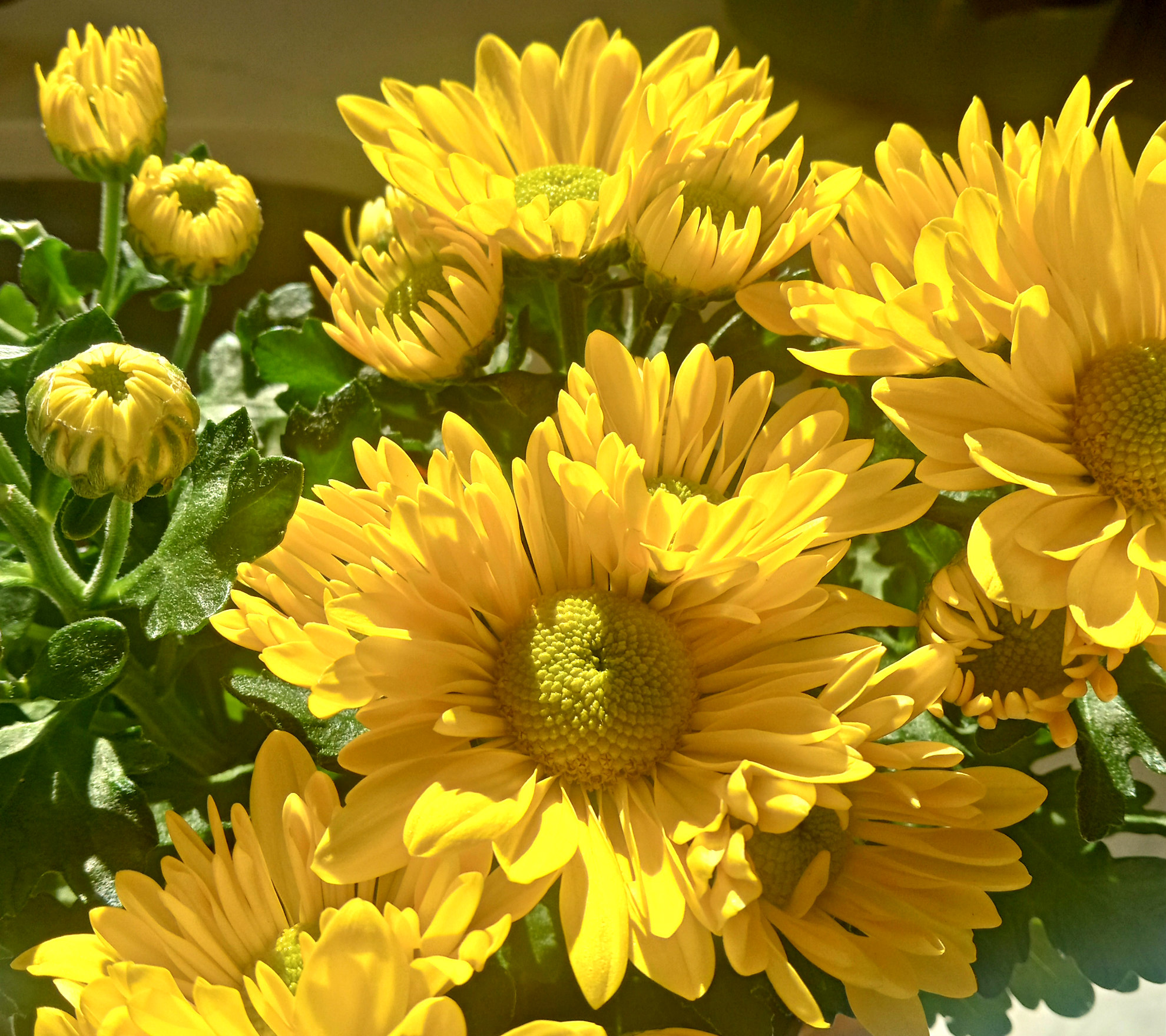
Today, I bought a small pot of yellow daisies, which is, in reality, a daisy-like chrysanthemum, to place on my kitchen table for a few weeks. I love the shape of daisies, the colors, the variety. Other similar daisy-shaped flowers are gerberas, the common field daisy, aster daisies, echinaceas, and some dahlias. Horticulture Magazine has a list of 40 Daisy-Like Flowers with Growing Tips, I favorited the link.
I’ve blogged several times about daisies. Here is a poster, or as the new tech age calls them, a meme using a daisy as a backdrop. For me, my first memory of daisies is this well-known rhyme. Did you know the rhyme originated in France and was originally a game? Wikipedia has a bit of its history.
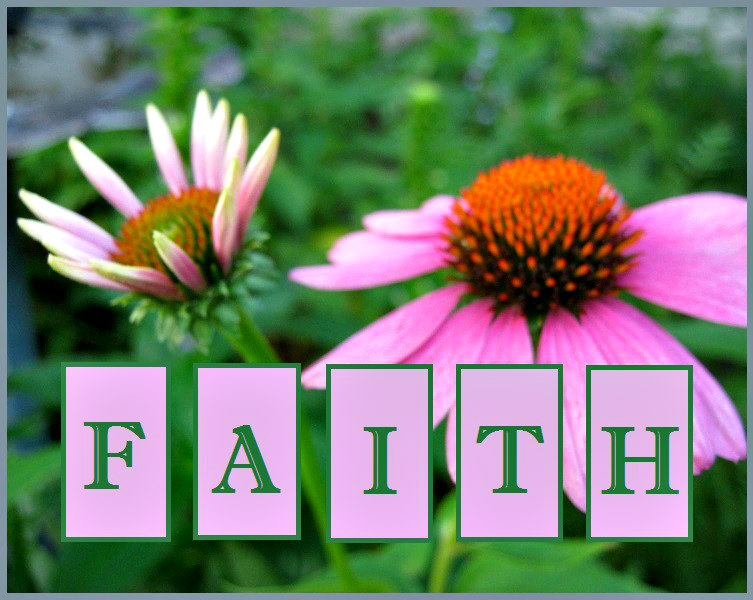
Another Echinacea Daisy seemed a perfect backdrop for the word FAITH.
My family had two dogs named Daisy, and my grandmother had a goat of the same name. The little black poodle adding her blessing to my wedding party forty-seven years ago this month was named after the flower. I still miss her. What a sweetheart.
One Daisy I never met was Daisy McCormack. I found her watercolor either in a shop or at a yard sale. I’ve had it so long I can’t remember the origin. The painting is delicate and sweet, 4 ½ by 3 ½. It is beautifully framed. The writing on the back is neat and straight, describing the flowers and where they were found and ending with hand-painted by Daisy M. McCormack. Since I watercolor and have painted many flowers, I treasure her work even though I will never know her in this life. Judging by the color of the backing paper, the work is decades old.
The Daisy in the photograph, top row, third from the left, is someone I met only once. She was Aunt Daisy to my grandfather. When his mother passed away in the Spanish Flu epidemic, she left behind four children under nine. Aunt Daisy took my grandfather in during this terrible time. Once, when I was small, he took me to her home in the hills near Martinsville, Virginia. I am forever grateful to this kind aunt for nurturing my grandfather when he was only six. She lived to be 94, and I hope she was blessed her whole life for her kindness.
P.S. My great-grandfather is the young gentleman on the lower left.
Lastly, I include a favorite oldie of mine. Somehow, I know a lot of the words. Perhaps from listening so often as a child to Bing Crosby and Mitch Miller Sing-A-Long Records. (Yes, I do mean vinyl records.) My mother loved the voice of Nat King Cole, so this is for her.
I usually write short posts, but this one kept growing, as I hope my love for daisies will grow throughout my lifetime.
Cardinal Climber Vine ((Ipomoea × multifida) is my post for Cee’s Flower of the Day. These vines and the beautiful trumpet-shaped flowers blooming on them are some of the best flowers for a hummingbird garden.
Most of my garden plants have blooms that are waning. I don’t obsess over the lack of bloom because I see few bees, butterflies, and hummingbirds in October. The Cardinal Climber Vines bloomed late for me this year. I thought they were in a slump until a few weeks ago when they burst into dozens of blossoms. There is nothing timid about these flowers when they bloom; they are brilliant in color, and the stamen almost seems to glow like a spotlight beckoning hummingbirds to dive in for the nectar they contain.
Yesterday, I had an experience that I hope will stay a treasure in my spirit forever. I was bent down, turning off the hose nozzle, and when I stood, inches from me, a hummingbird was sipping nectar from the Cardinal Climber blooms. It seemed unaware of me, or perhaps in fueling up to return to warmer climates, was willing to risk my presence. I stood for several minutes, holding my breath, wanting to jump for joy as I listened to the buzz of the small bird’s wings and had the closest view ever of a hummingbird sipping nectar. I will never forget that magical moment in the garden.
We went to Longwood this week. The walk alongside the Meadow was golden and glorious. Spectacular wildflowers called Common Cup-Flowers lined the path. Goldfinches, butterflies, bumble and honeybees, gathered nectar and seeds.
Common cup-plant is a native wildflower in the Asteraceae (daisy) family. It may self-seed. It typically grows to around 6′, however, can grow to reach 9′ tall. ~North Carolina Extension Gardener.
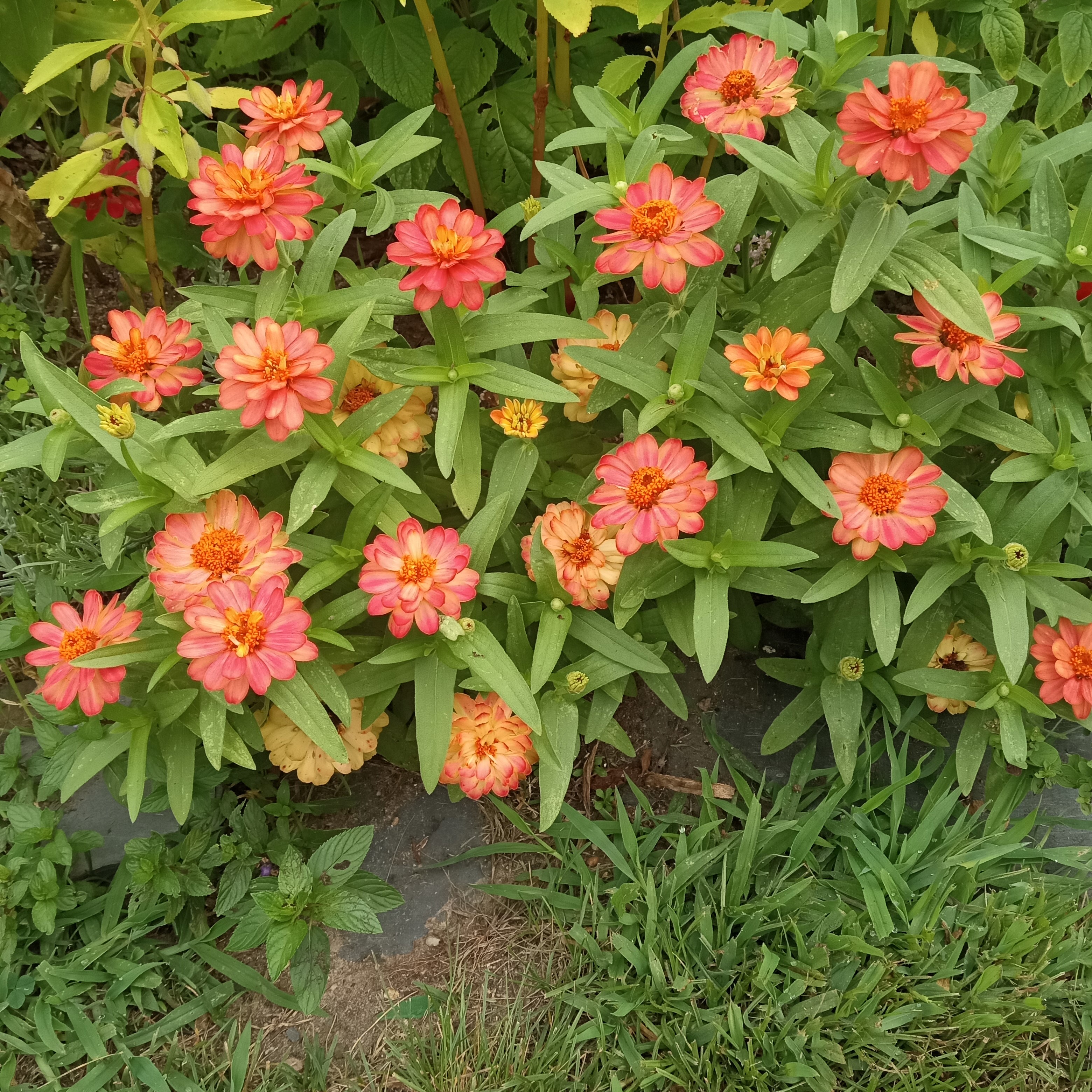
We grew this lively mix in the front beds of our old farmhouse porch and discovered it is one impressive zinnia, forming mounds of continuous color that were adored by the butterflies. ~Pinetree Garden Seeds
I am in love with this low-growing zinnia. Perfect for the front of my backyard patio border, the color is luscious, a brilliant coral pink.
The plants have been blooming for several weeks. They were available through Pinetree Garden Seeds, a reliable seed company. Next year, I will do the same and plant two side by side. This creates a mesmerizing display of color.
There is a plethora of flowers, and they last quite a long time. The color is beautiful even as they near the end of their bloom time. These zinnias fade to a lovely creamy yellow before they need to be cut away.
My one complaint is the small number of seeds in the packet. Although, the description does include the seed count so there was ample warning.
We have a beautiful and very large Photinia planted beside our back porch. I am in love with this bush, although it has grown so large that it might be considered a tree.
I sit beside the bush on the opposite side of the porch screen and admire the foliage, gazing also at the gorgeous white blooms adorning it. Unfortunately, relaxing on the porch has been marred for several days by my search for the dead animal filling the air around me with the scent of rotting flesh.
Today, I suddenly remembered reading that Photinia blooms have an unpleasant smell. No! Could it be? I went outside and took a whiff of a lower blooming flower cluster, and oh my…instantly knew I had found what I had thought was a ‘dead’ animal. To say the flowers smell bad is an understatement. Thankfully, we are not having company in the next few weeks, and the flowers will drop off…but not soon enough.
Seeing them on the tree is glorious; however, the joke is on me. This Spring, we needed to fill in a spot close to the original, and since we like our Photinia so much, we purchased another one. Next year, the smell will be doubled. Still, the tree is beautiful, and I even use the evergreen branches for floral arrangements. Live and learn…and next time, do better research about the characteristics of the trees before I buy. Seriously, folks, the terrible smell fills the whole yard. I giggle a bit when I imagine the neighbors searching their yards for the dead animal.
This beautiful Torenia is also known as the Wishbone Flower. I have an easy time growing them. Plop them in the earth or a hanging basket, keep them watered when dry, and you will have blooms all summer. Once every few weeks, I cut away stems forming seeds. They don’t need as much deadheading as many other annuals. I’ve never been disappointed in my Torenia plants. I made one mistake last year: I put one plant in full afternoon sun. The flowers did fine, but the foliage burnt a bit.
The poem complements the plucky sunshine yellow of the flowers. Isaac Watts, (1674 -1748) is the author of this and hundreds of hymns still being sung around the world.
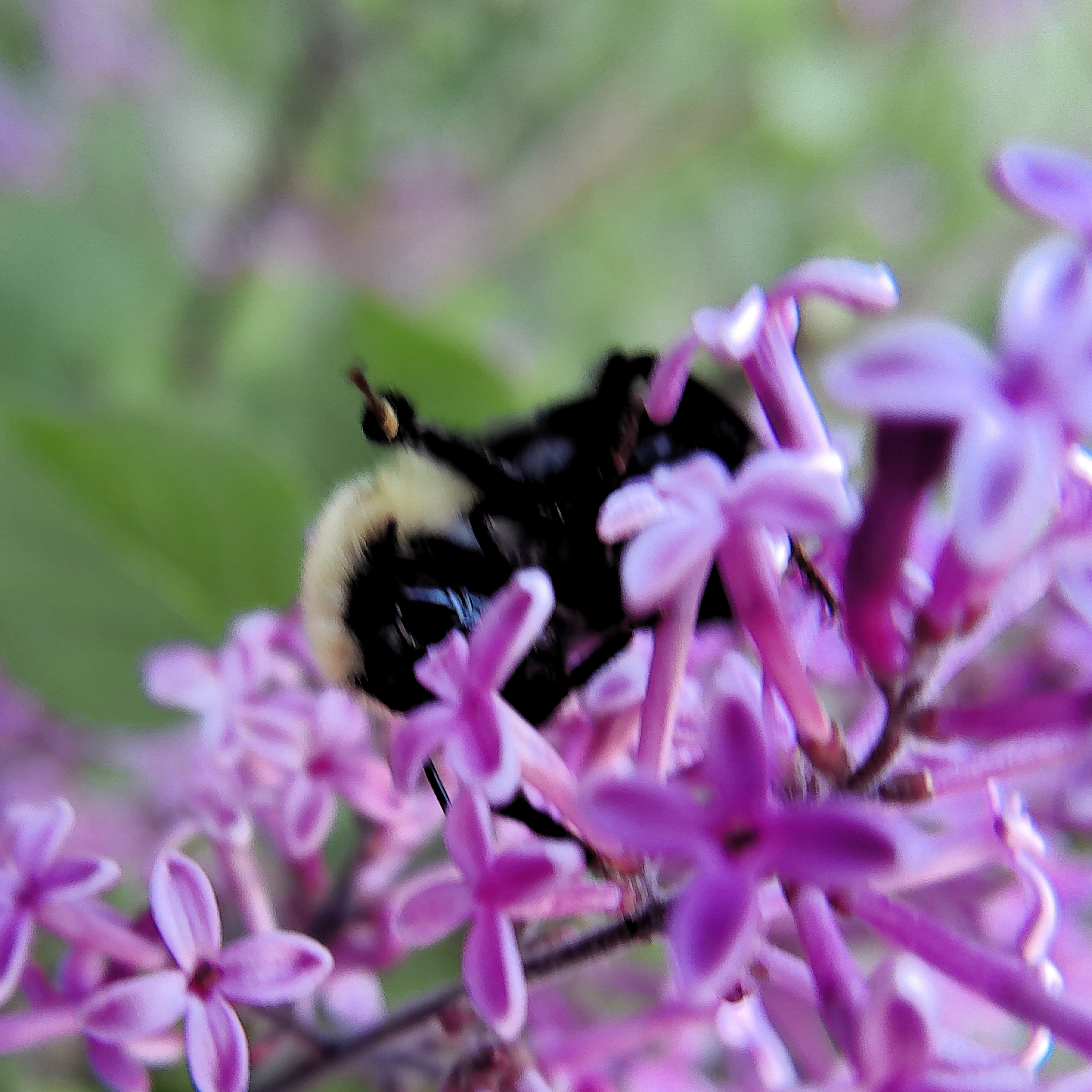
I spied this bumblebee early in the morning. It seemed he had slept the night away in a bed of the Boomerang Lilac flowers. When I came near to take a photo with my camera, he flung up a leg as if to say, “Leave me alone, or you’ll be sorry…”
We planted a new lilac bush in our side yard a few weeks ago. It is called Yankee Doodle. It appeared ordinary until the buds opened. What a surprise! The fragrance is divine, and the flowers are the size of a quarter. I’ve never seen a lilac with such large blooms.
The yard is dreary beneath rainy March skies, but the gardens are ablaze with the captured sunshine of daffodils.
I couldn’t leave so many of them to droop beneath the raindrops, so I cut them to create a bouquet to enjoy in the house. A break in the clouds enabled sunshine to pour through the window, backlighting the daffodils perfectly for their portrait.
“Daffodils with sunlit petals all ablaze, Will ever create in me words of praise.”
Forgive me, my amateur poetical nod to William Wordsworth’s beautiful poem about daffodils. You can find his excellent poem below.
I Wandered Lonely as a Cloud
By WILLIAM WORDSWORTH (1770 – 1850)
I wandered lonely as a cloud
That floats on high o’er vales and hills,
When all at once I saw a crowd,
A host, of golden daffodils;
Beside the lake, beneath the trees,
Fluttering and dancing in the breeze.
Continuous as the stars that shine
And twinkle on the milky way,
They stretched in never-ending line
Along the margin of a bay:
Ten thousand saw I at a glance,
Tossing their heads in sprightly dance.
The waves beside them danced; but they
Out-did the sparkling waves in glee:
A poet could not but be gay,
In such a jocund company:
I gazed—and gazed—but little thought
What wealth the show to me had brought:
For oft, when on my couch I lie
In vacant or in pensive mood,
They flash upon that inward eye
Which is the bliss of solitude;
And then my heart with pleasure fills,
And dances with the daffodils.
**************************************
Daffodils are a part of Cee’s Flower of the Day Challenge.
Definitely the daffodils are my “Whatsoever is Lovely” moment for Xingfu Mama’s Challenge.
The daffodils are definitely the dancers of Springtime. They move to the rain, the wind, and face the sunshine, dwelling in the music of nature.
Yesterday, I was able to text my son a photo of this beautiful puff of salmon. I told him it was a cutting grown from a Geranium he gave me on Mother’s Day two years ago. Plants given as gifts are especially dear to me.
Before frost arrived last year, I dipped a cutting of the geranium in honey and placed it in loose soil with a Ziplock bag over the plant to keep it humid. Not every cutting works, so I usually grow three for every plant I want to save.
I also tried bagging/boxing up a few bare-root geraniums, and the photo shows what I found just an hour ago when I opened the bag. I will continue to grow cuttings and, in the future, leave bare root storage to the experts.
A few of the many shades of blue pansies and violas I have grown in my gardens over the years.
Pansy and Johnny-Jump-Up are a variety of seeds I will be sowing this week. It seems early, but I should have sown them four weeks sooner. I don’t follow the recommended dates on the back of the packets. Earlier is always better if I want to have larger-sized plants for the Spring Garden. If my seedlings are pitifully small, I fall victim to the lure of lusher-appearing plants in the local nurseries.
I purchased several interesting varieties from Baker Creek Heirloom Seeds at the end of Autumn, and I can’t wait to see if they are as lovely as the photograph on the package. (Dilemma: I don’t remember the ‘safe’ spot I stored them in.)
The seeds of Pansy and Johnny-Jump-Ups sprout with some bottom warmth and humidity but also have one crucial requirement: they must have total darkness. I will put a plastic tray over the top of my flat and also cover that with a dark, wet washcloth. This will seal out any light rays that might interfere with sprouting.
Organic seed starter and sterile organic potting soil are what I use to start my seeds. The plants develop robustly if I fill the bottom 3/4 of the flats or pots with soil and the top quarter with seed starter. The foliage sits against the quick-draining starter, and the roots reach down into the richer soil. Two types of grow-lights work well for me: overhead and adjustable surround wands. A sunny window provides natural light and is also a good choice.
One variety I loved, purchased from Baker Creek last year, was Laeta Fire, a viola with dime-sized blooms perfect for flower pressing. I have a few seeds left in the packet and will grow them again. You can see how small this flower is in comparison to the normal-sized geranium leaf alongside it. When I persevere in my gardening throughout the winter, the process brings me a sense of peace and renewal.
I don’t have much growing in the garden, but my IAVOM arrangement for the first day of 2024 contains the few flowers and pieces of foliage still blooming.
Contained in the vase is a Bidens blossom. This tiny flower is about the size of a quarter. It is inconspicuous in the garden border during the summer, overtaken by plants that grow exuberantly. After these plants die back in the cold temperatures, the Bidens thrive for several months. The Spruce has a great article on how to grow Bidens perennials in the garden.
One pansy was blooming brilliantly in a terracotta pot in the backyard. Hurrah! It is bedraggled in a few places, but on the whole, it is still lovely and perfect for Cee’s Flower of the Day.
Dandelions are within the vase but opened after I took the photograph. There will be more to come on dandelions tomorrow. I love the spent seedhead. It’s done its job, and the umbrella-like pappus dispersed all the seeds into the air.
Fennel is still filling the garden beds in various heights and sizes. When I picked a few sprigs for the vase I momentarily smelled that distinctive licorice fragrance the foliage puts out. This wonderful herb is one of my major host plants for butterflies. I imagine many Black Swallowtail caterpillars on the fennel come to Spring when I daydream about my 2024 gardens.
Lastly, I picked a few pieces of Butterfly Bush foliage, still glowing blue-green in the grip of winter weather, and used those leaves as a base for the flowers.
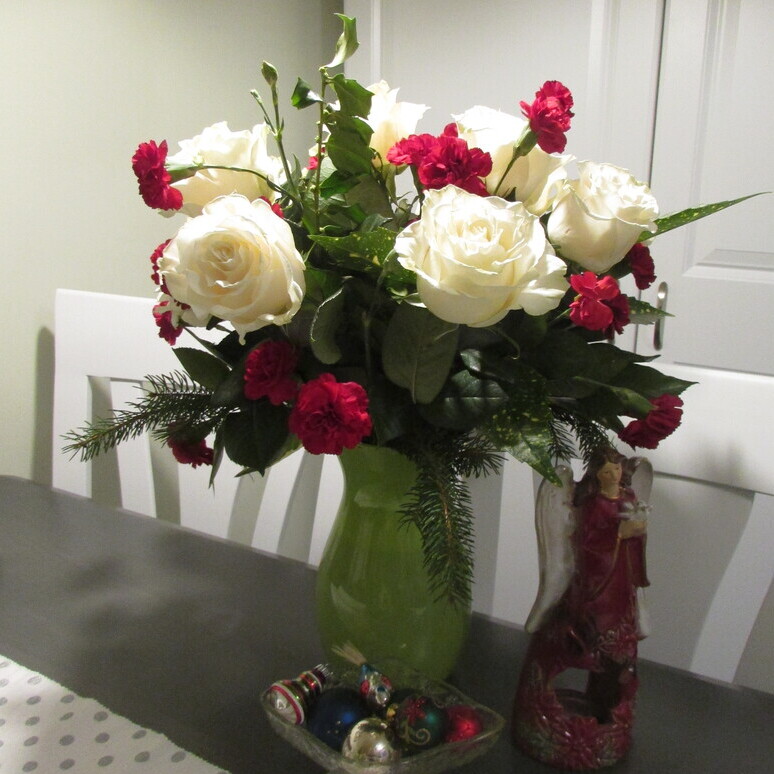
My IAVOM (In A Vase on Monday) this week contains half garden/half purchased flowers. The foliage from my garden is Pine, Holly, and Aucuba leaves. The arrangement is my revolving Christmas table decoration. As the flowers fade, I remove them and add new stems.
The greenery will last for the entire month and even longer if I keep it. The Aucuba stem has rooted for me in the past, but the bush takes years to become full size, and it is easier to purchase a nursery plant if you want to include it in your garden beds. I love Aucuba greens. They are lovely for arranging flowers. The sturdy, long stems are like a grid inside the vase and will help separate your flowers and hold them steady.
A Christmas Angel and an old antique crystal dish holding extra ornaments are alongside the vase. I have many empty vases and bowls filled with baubles in dark areas around the house. They speckle the dark corners in the house with Christmas cheer.
The red mini-carnations are over a week old and still blooming nicely. They have a mild cinnamon fragrance. The white roses were a lucky find, purchased in the supermarket; it is rare to find roses with such a high petal count and without browning for under $10.00.
Flower Arranging Tip: To choose a bunch of roses that will last, gently squeeze the base of the rose where it joins the stem. If it is squishy, it won’t last. If the feel is firm, the roses are fresh. Slightly open Roses will continue to bloom. Flowers that end in a sharp point are unlikely to unfurl. Cut the stems underwater at a diagonal to make roses last even longer in an arrangement. This technique keeps the stem from forming an air bubble and allows the water to flow into the entire stem.
Are you like me? Sometimes, I gift myself with computer programs that enable me to blog more easily, write with better grammar, and listen to my words read back to me. I thought it would be a good idea to share throughout this week, along with some other reposts, the computer apps I use that make life easier and help me move toward completing goals.
Today’s app is Ribbet.com. The program helps me create beautiful photos with some tweaking for fun. I feel like a child again when I decorate my favorite garden photos with this app. The photo above is tweaked with Ribbet.
Here is my original photograph, a summer capture of Verbena blossoms. It’s very pretty on its own, but I love to play around with overlays to take images from normal to showy.
I uploaded the Verbena photograph to Ribbet.com. Square photos work best on my blogs, so I cropped the image first and Auto-fixed the colors. My computer shows content on the left side and a work area on the right.
To read the symbols on the toolbar, hover over them, and you will see the name appear. I used Effects to add a matte border to my photograph. You can strengthen the matte effect by sliding the strength bar to the right. You can use the same effect twice on the photo to create a strong image. There is also a Text symbol that enables me to add words.
I added some Bokeh lights using the Overlay filter. I did the opposite with the lights and diminished their effect so that they would only lightly highlight the photo. At this point, I was satisfied with the image and saved it to my computer.
Brightly hued-flowers surround me at any venue I visit this time of year. I love them but also enjoy the simplicity of Paperwhite blooms. The fragrance is authentic Spring at the beginning of Winter. The flowers are small, the size of a half-dollar, but they have a strong and resilient scent. Mine have been blooming for several days and they still are very fragrant.
It is gratifying that all the work involved in forcing the bulb was done for me. I purchased the plant already growing, near bloom, and anchored in a sturdy bulb vase. My responsibility has been nothing more than enjoying the beautiful scent.
In another room, I have a Hyacinth bulb beginning to grow. I have done some tweaking to bring this flower into bloom. In early September I bought the bulbs. There are five in all, and I placed them in their package in my refrigerator produce drawer. When I put the bulb in a vase with the water level just touching the bottom, the roots quickly began to grow. I’ll update the blog when the plant blooms.
Whatsoever is lovely in my life this week is flowers blooming in November, filling my home with sweet fragrance.
Writers have written many an eloquent word and quote about the beauty of fragrant flowers, and although the quote below doesn’t specifically mention fragrance, I like the image it suggests. How fragrant life would be if we looked at the whole world as a garden.
“If you look the right way, you can see that the whole world is a garden.” — Frances Hodgson Burnett, The Secret Garden
Sometimes, much like today, I need to focus momentarily on something simple and beautiful, and set aside every nuance that might darken my day. Ralph Waldo Emerson’s quote, this flower, both do me good during a day of running around, cleaning, and cooking. God bless you all on Thanksgiving Eve.
The roses are a mirage of my memory now. Photographed a few years ago in the Longwood Conservatory, the rose hall has been torn down and is being replaced by a new, more modern structure. I will miss walking alongside the beautiful bushes, and hope rebuilding will not be a protracted project.
We’ve had a hard frost and there’s not much left alive in the garden. Happily for me, there are still several roses blooming. They are rewarding me now after a summer slump. It’s easy to decide on what to use when your choices are limited.
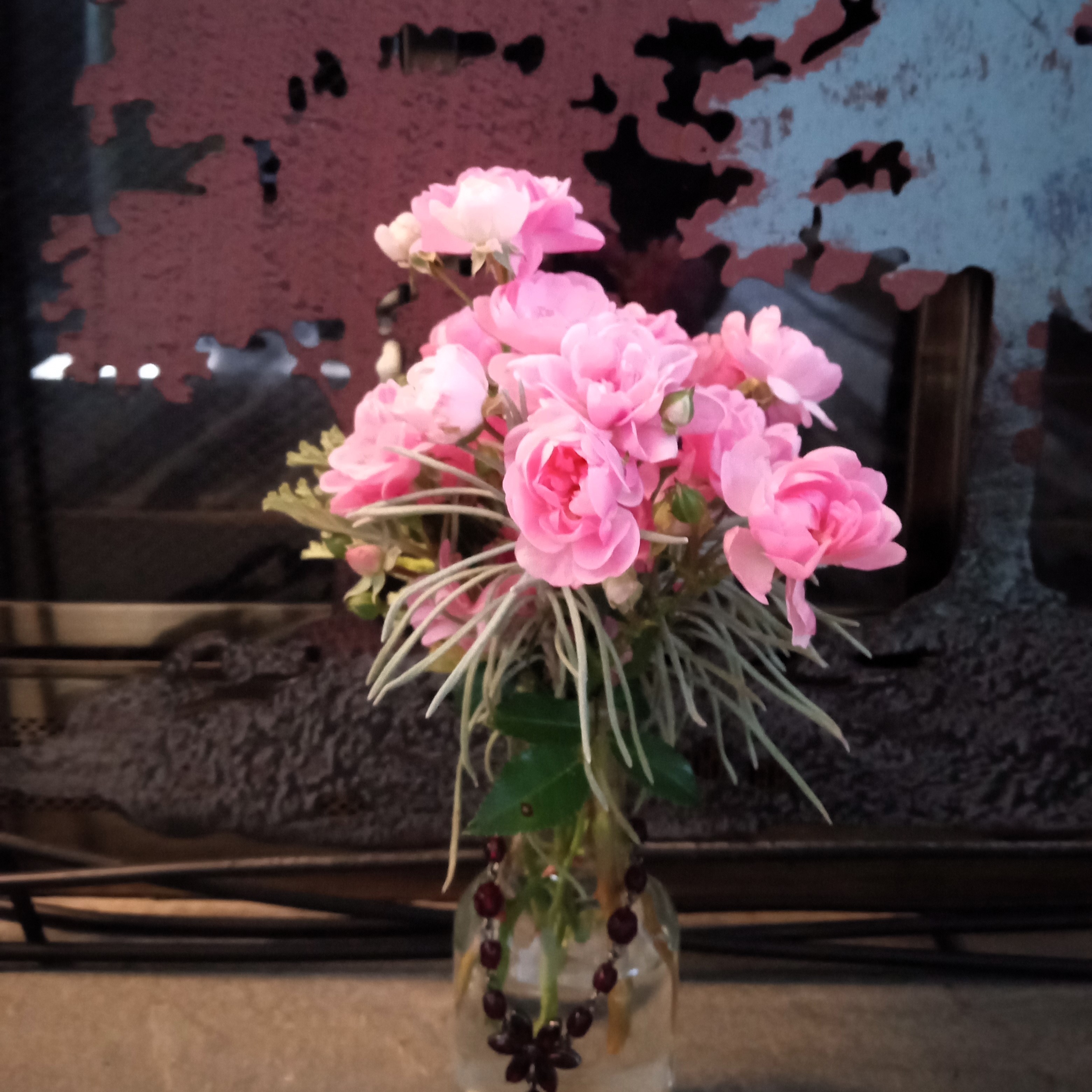
Roses are some of the first bright blooms of spring after the pansies, daffodils and tulips. One of my best varieties is a brilliant pink miniature rose called Fairy. In the beginning days of November, it is loaded with pink blossoms. I almost hate to cut them, but since I don’t go out as frequently now that the weather has turned chilly, bringing flowers in will give me more time to enjoy them.
They are my IAVOM selection, and also a part of Cee’s FOTD. Included in the vase, a bottle I use for rooting cuttings, are pieces of foliage that are still surviving: Helichrysum Icicles and scented geranium sprigs. The vase itself looked a little plain so I dressed it up a bit with one of my necklaces.
The tip might be a little late for this year’s gardens, but keep it in mind for Spring planting. The red zinnia below is my photo for Cee’s Flower of the Day.
It’s always fun to traipse around the garden beds eye-level to the zinnias. Their height presents a problem though; how to support them? If you’ve ever grown these beauties, the taller varieties, you most likely know a heavy rainstorm will drive them to the ground if they are not staked. This year, quite by accident, I grew a natural staking plant nearby.
In the patio garden I planted zinnias, the State Fair variety that grows near four feet tall for me. Beside it I planted blue salvia since both flowers are hummingbird favorites. As the zinnias grew tall, and the salvia spread out in width, the zinnia grew up between the branches of the salvia and rested upon the natural support. No staking required. The plants look lovely growing together. Their roots have plenty of room. I can’t extol this combination enough; the hummingbirds are happy and so am I.
The growing season is almost over. We have had heavy rain along the Atlantic coast for days. The zinnias are now as tall as I am, and still, despite the downpours they are held aloft by the salvia plants. What a beautiful combination.
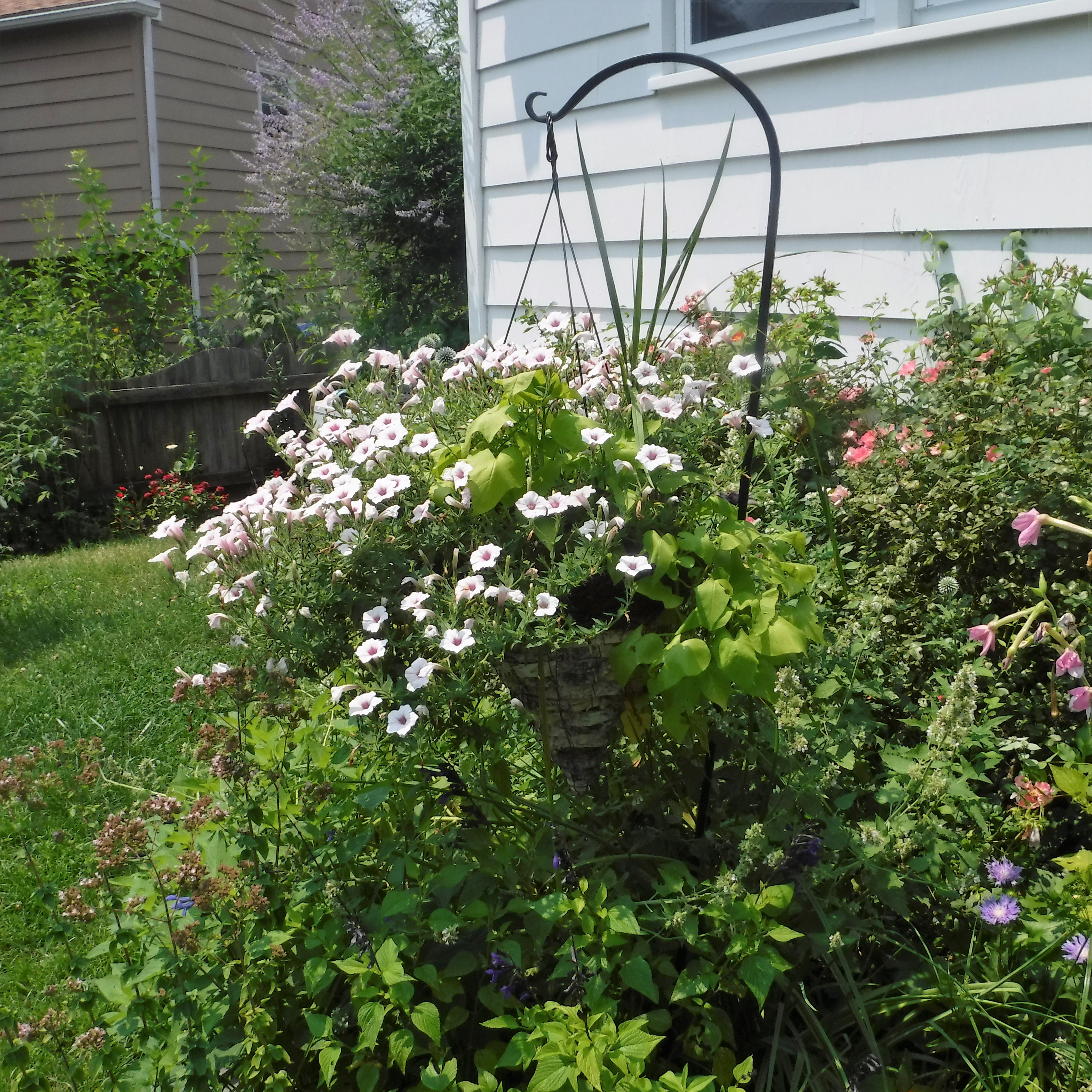
I can’t remember the source for this beautiful petunia, but oh my, am I glad I found it. I planted it up in Spring with some Sweet Potato Vine and have been in love with it ever since. It really lives up to the Proven Winners Brand description of fillers and spillers, for it certainly fills the basket and spills over the side. Beyond that, the color of the plant is extraordinary, truly a silvery pink. The flowers are small and compact, and even though I try to deadhead them, they don’t seem to need it to continue to bloom in abundance. I highly recommend this lovely flower. It is worth every penny you pay for it.
Only one plant, potted up in a hanging basket in the Spring, has expanded in every direction. Amazing! It’s still growing strong and fast.
Supertunia Vista petunias are very vigorous, with mounding habits that can reach up to 2 feet in height in the landscape and will trail over the edges of baskets and containers up to 4 feet by the end of the season. They are fantastic landscape plants and are great in large containers, where they function as both fillers and spillers. In garden beds, they will work either in the front or middle of the bed. They have medium-sized flowers.
A bonus for those who press flowers…usually petunias are iffy for successful pressing. If I gather these blossoms when they first open, although very fragile and thin, they retain their color and veining. Because the blooms are not as large as a standard petunia, they work in smaller-sized pressed flower settings too. Beautiful.