Yes, you are correct if you think this blog becomes inundated with butterflies at this time of year.
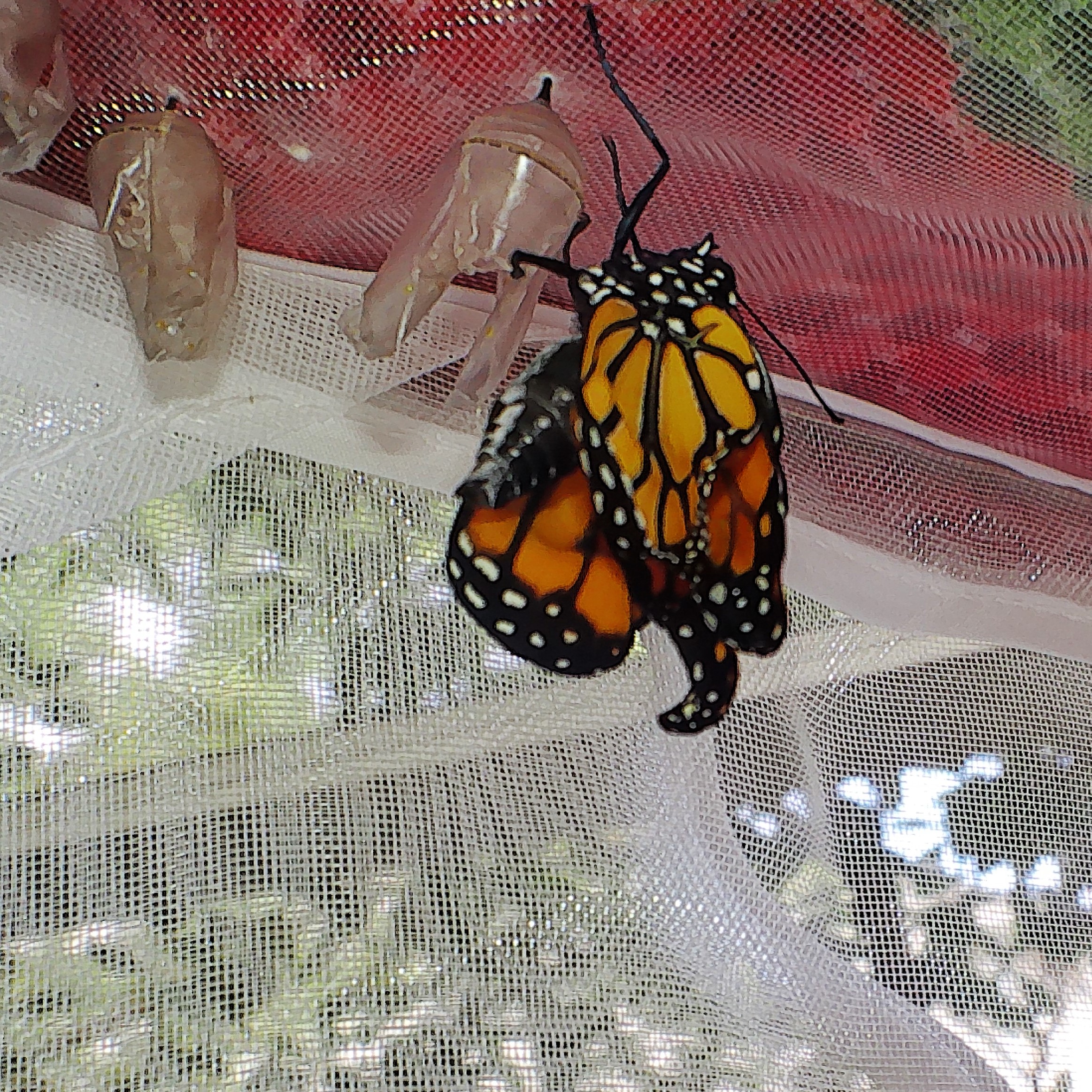
Today’s photographs are part of the Cosmic Photo Challenge, Contrast. The markings on the butterfly are an excellent example of contrasting colors. The butterfly contrasts nicely with the garden plants he rests upon as he finishes drying off his wings.
Another good contrast is the natural support of the butterfly chrysalis on the left compared to the one on the right. I save so many caterpillars; they sometimes bump finished chrysalises right off their mooring of spun web. I found the chrysalis in the papoose-like sling of string lying on the floor of the butterfly house. I am hoping it will develop properly and emerge perfectly.
When I use string to repair a chrysalis resting place, I separate garden twine into single pieces. This is as close as I can come to mimicking the web they spin. It doesn’t harm the developing butterfly. I’ve had two emerge and fly off into the wide world after being put back into place with garden string.
The first Black Swallowtail butterfly was ‘born’ today. The high heat, present even in the morning, sped up the drying process, and the butterfly was ready to fly within two and a half hours. I took the butterfly enclosure outside, and the new butterfly easily flew into the world and quickly disappeared. Success!
I like the way the photo shows the web they spin to anchor themselves in place. Due to the number of caterpillars I was able to save, I’ve had a few mishaps. I’ll post some of the solutions later in the week.
The ‘phlutters’ on my porch have been magnificent. While I write this post, I am thinking of eleven empty and transparent chrysalides. Each is the evidence left behind of a successful eclose of the Monarch butterfly that developed inside. The brief sojourn of the caterpillar becoming a butterfly is complete. Below is a description with photos of how the day of “The Magnificent Seven” evolved.
Raindrops started falling early but then tapered off; the weather became a concern since seven chrysalides turned black and were ready to emerge over the span of twenty -four hours. Morning light revealed the markings of each butterfly through the walls of its chrysalis. After a few hours of daylight, they began to eclose.
First to break free was the only Monarch who formed its chrysalis on a milkweed stem.
The remaining chrysalides clustered along the top edges and corners of the butterfly house. Throughout late morning/early afternoon all seven eclosed at varying times. All emerged perfect, no malformation or problems breaking free from the chrysalis.
Two to four hours after eclose the butterflies began to flutter within the confines of the butterfly house, I gently coaxed them onto my fingers and carried them to the open door. Several took to the air and flew out of sight over the rooftops, others seemed tentative, and these I rested upon a hanging basket. Later in the day, when I returned, they too had taken wing.
A sense of elation filled me when I realized a lucky seven eclosed in one day. This brings the successful ecloses to a total of eleven.
Today, as I post this, six newly hatched, ultra-small Monarch caterpillars are starting the cycle all over again. Will I ever grow weary of this miracle? Never.
After spotting the vermilion orange flash of a Monarch butterfly laying eggs on my milkweed, I kept watch by tying a string on each leaf that had an egg on it. I was surprised, monarch eggs hatch quicker than the black swallowtails. Within a few days I spotted a small hole on one of the leaves. Sure enough, underneath I found an almost microscopic monarch butterfly caterpillar.
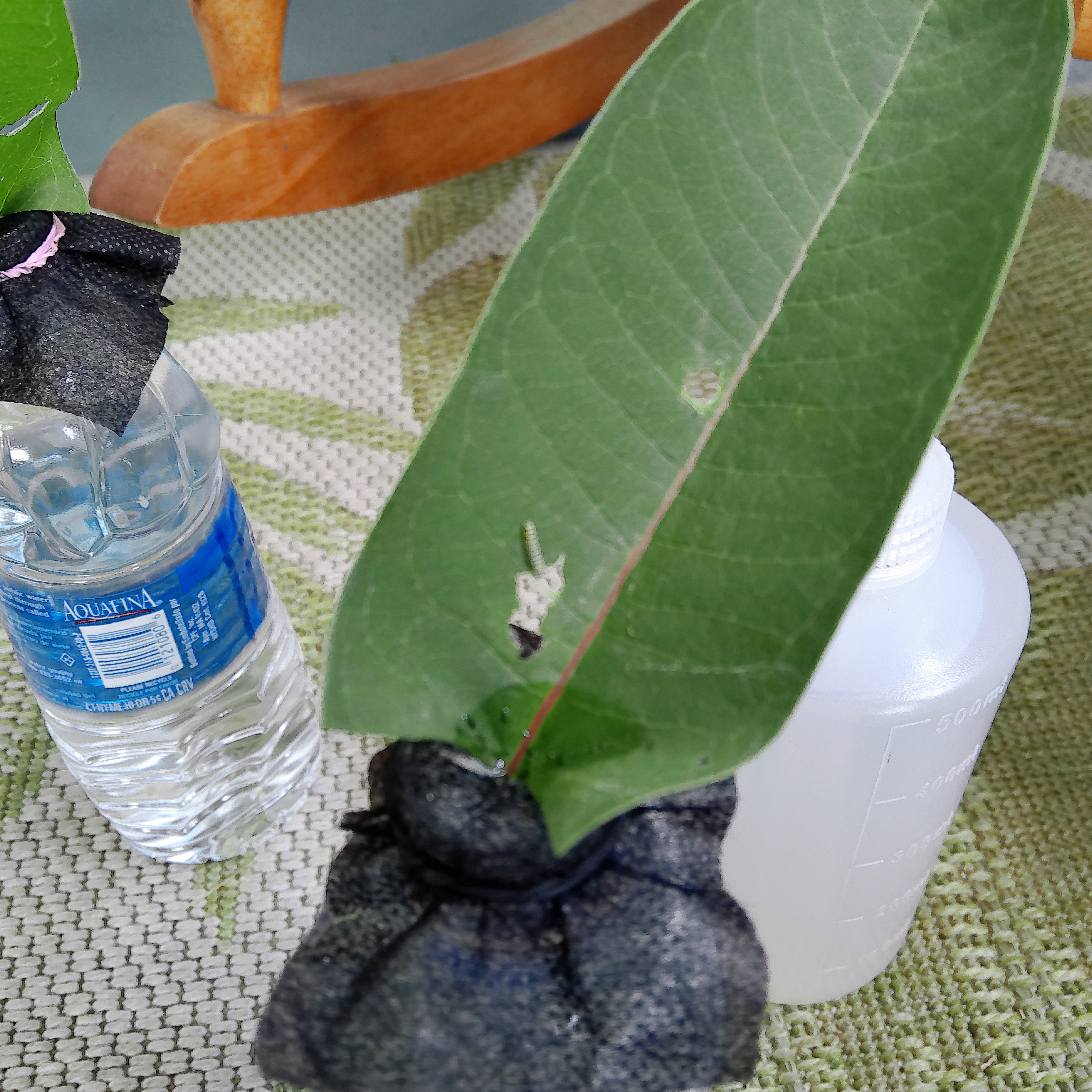
Because I’ve experienced the dilemma of monarch caterpilla cannibalism, I needed to find a better way to raise them this year. I brought one of the monarch caterpillars in on its leaf and using an old water bottle, garden cloth, and a rubber band I created a standalone leaf holder for the small caterpillar. Besides working at keeping the caterpillar separated, the bottle added a benefit; the leaves have stayed pliable and fresh for days.
To create more stem for the leaf to absorb water, I cut up along the edge of the stem, always careful to be aware of where the caterpillar is on the underside, next remove a v-shape portion by cutting away the leaf to form a stabilizing appendage to grip the garden cloth. I could go on with an explanation, but I think the photos tell the story better.
The caterpillars are thriving. They are now big enough for me to be able to see their spiky anthers.
In the course of adding water to the bottles, one caterpillar fell off on the rug, which is the same color as the caterpillar and even the same texture. I couldn’t find the small cat anywhere. I felt terrible. There was no sense in looking for the fallen caterpillar because I might squash it with my knee or foot while I searched. Instead, I laid a few leaves in the area where I thought it fell. The strategy worked, and today I found the wayward caterpillar on the leaf I laid on the floor. It is safely back on the rearing bottle now.
You can tell, by the holes in the leaves, and the freshness they’ve retained, that the single bottles work much better than leaving all the caterpillars in the bottom of the butterfly cage. Unfortunately, last year that is what I did, and I had seven caterpillars at one time on the bottom of the enclosure, eating the leaves. Overnight, my number was down to one. Yes, caterpillars of the monarch butterflies, although they are beautiful and delicate, are voracious cannibals of each other.
I might run into some trouble when they are big enough to loop themselves from one leaf to another. Maybe the problem will never present itself, but at least I am on the lookout for it.
I am grateful that I have a whole garden bed filled with milkweed. I checked some of the wild areas and the milkweed is in horrible condition. I found no caterpillars, only aphids spiders, ants and other bugs that prey on the monarch caterpillars. The leaves were leathery and dry from all the hot weather in our area. I have the advantage with my garden bed since I keep it well watered and stay on pest alert at all times.
This has been longer than my normal posts, but I wanted to share how to keep the leaves fresh, and the caterpillars away from each other. One note, they do like to be shaded. I keep them shielded from the Sun with dish towels over the sides. So far none have attempted to reach the other leaves. They are thriving and growing. I’m looking forward to watching the process over the next few weeks.
When the caterpillars reach their final size they tend to slow down and rest a bit. At this point they need to get rid of any food left in their bodies, and to do so means a purge. After the discharge of stomach contents, the caterpillars will be ready for the next step in life, what I call a walkabout.
The caterpillar will drop off the host plant after purging, (be prepared for a gooey mess beneath the plant) and then travel the area to find a suitable place to form a chrysalis. Don’t worry if the caterpillar climbs several feet up a wall or other tall object. Also, don’t be alarmed if they drop all the way down to the floor from their high perch. My porch is cement, and this terrible drop never seems to even stun the caterpillar. They just go on walking, searching, climbing, and exploring any object in their way.
Finally, they find a spot to transform. They spin a silken pad to secure their tail, and then spin a silken thread called a girdle to hold them steady. The Black Swallowtail caterpillars I raise harden up at this point, forming a strange, striped comma-like appearance. This stage usually lasts several hours or overnight. Suddenly, without warning, a slight thrashing motion will begin and the outer skin will be sluffed off. I’ve only managed to see this happen once or twice. Underneath the skin is a beautiful green or tan chrysalis. The color will depend on what the caterpillar has formed its chrysalis upon. I usually find the butterflies emerge within two weeks of forming the chrysalis unless they are late Autumn butterflies, in that case they will winter over and emerge in the late Spring.
Most of the caterpillars choose the window/screen area of the back porch to form a chrysalis upon. Sometimes, I lose track of their whereabouts, and then I will be surprised to suddenly find a chrysalis in a very strange place, or one outside the porch door, (there is a small opening beneath the door where they can exit if they choose) or they will completely disappear in a hidden spot and suddenly I will have an unexpected butterfly flying on the porch. I’ve included a few photos below of this year’s strange resting spots for the metamorphosis.
This one was a music lover and chose the spot to form a chrysalis beneath a window chime. When the time came, he left his melodious resting place, climbed out, dried off, and spread his wings before he flew away.
Once in a while a caterpillar will choose poorly, such as this terrible resting spot on a screen door spring. A bad choice can mean big problems, and that is a bit of a tease for Part IV.
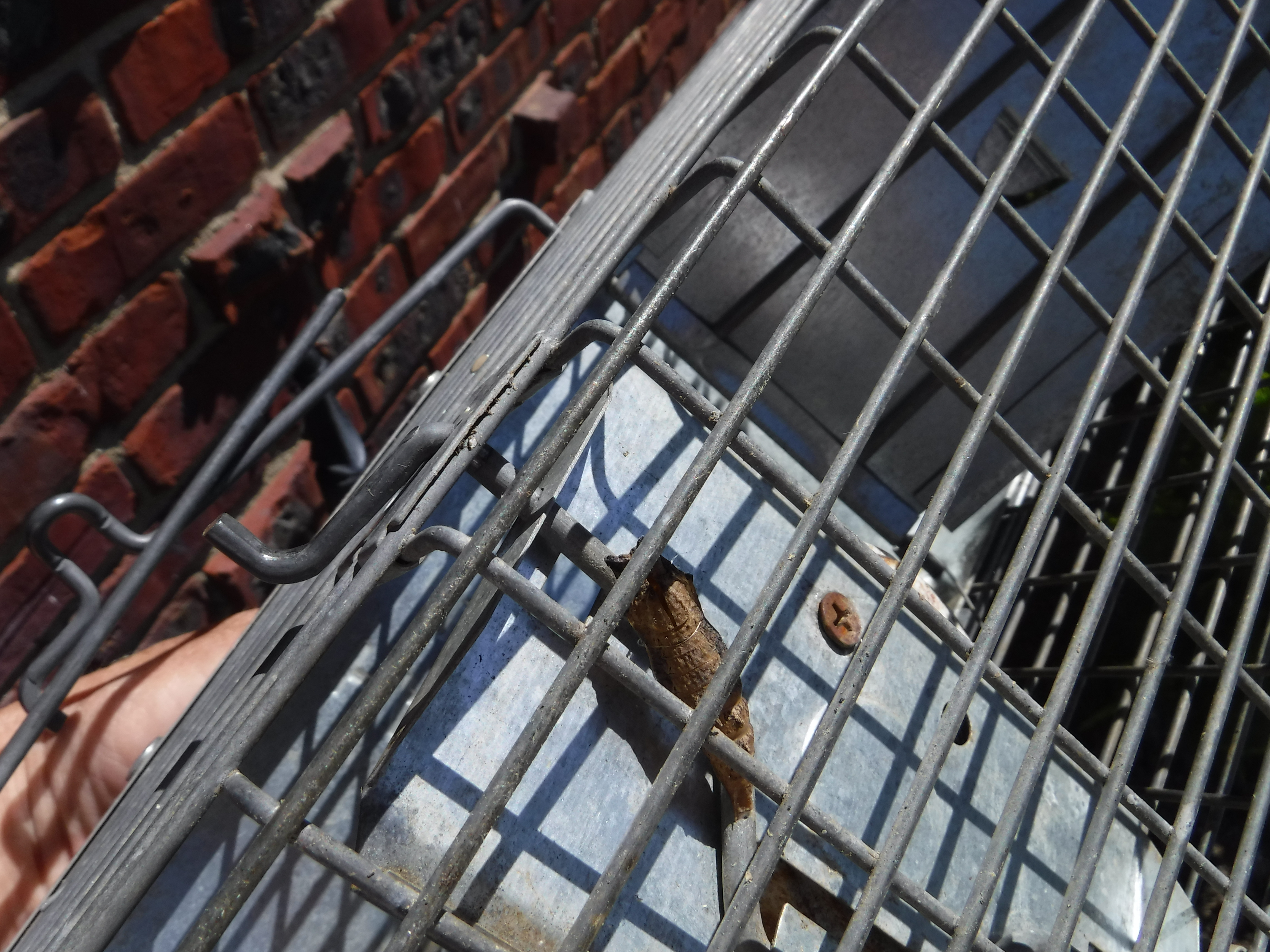
A few days ago my husband called to me, “There’s a butterfly in the chipmunk trap.” When I looked inside the empty trap there sat a butterfly on the bottom grate. We’ve trapped several of the destructive chipmunks in the past few weeks, but a butterfly inside was quite a surprise. I opened the trap, offered my index finger, and the butterfly climbed aboard. I thought it would fly away, but instead it dropped to the ground. The butterfly seemed newly hatched. I let it climb onto my finger again and placed it on a bush, leaving it there to dry its wings.
I went back and checked the trap, turning it upside down. Attached to the roof was the remains of the chrysalis. I have no idea how it survived the chipmunks as they attempted to escape the trap.
I am assuming the lucky butterfly survived. A day later, I saw a black swallowtail flitting about the yard. Amazing! I think, last Autumn, when I was saving late season caterpillars, this one traveled from my porch into the garage. The chrysalis was there all winter inside the trap. A strange beginning for sure!
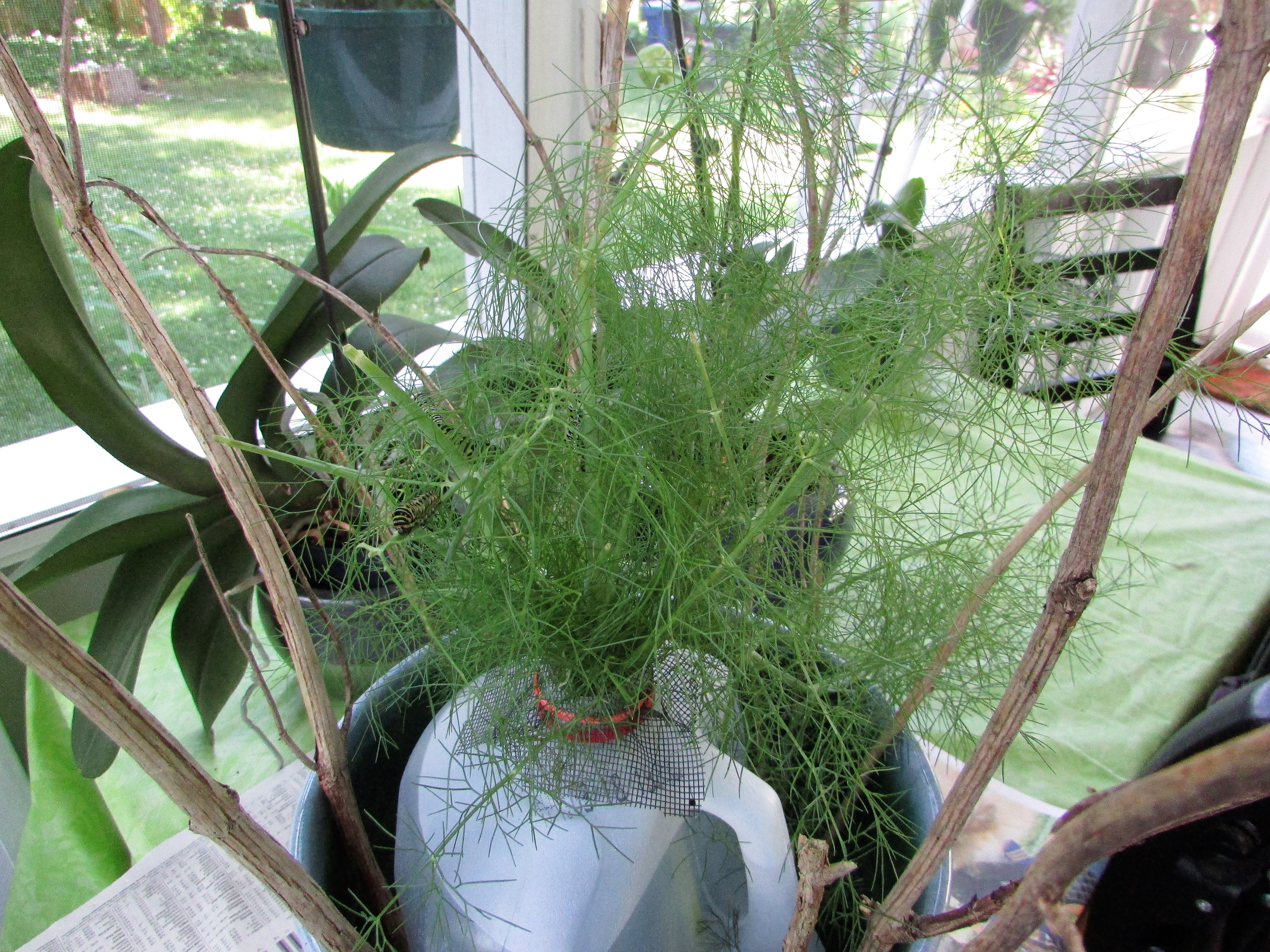
When I checked the fennel plant today all the smaller caterpillars were gone. There was only one still feasting, and he was large and blended in with the green fronds. The smaller black ones are easy to spot and were probably a meal for a hungry bug or bird. Butterfly populations are dwindling and I’m annoyed with myself for leaving so many outdoors for the predators.
Indoors, to keep the caterpillars near the fennel and off the screens of the porch when they form a chrysalis, I placed the milk carton in a tight fitting ceramic pot and created an arrangement of sticks between the two. It works great! The sticks are stable, don’t blow in the wind, and even if knocked they seem to stay in place.
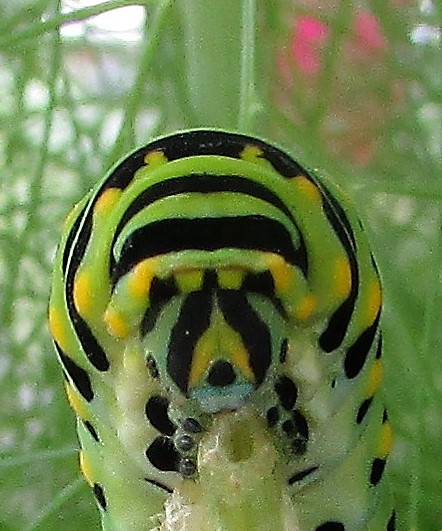
The largest caterpillar appears to be getting close to forming its chrysalis.
Do caterpillars think? Probably not, but this one certainly looks as if its contemplating what to do next.
In a November post, Comminatory Weather and the Big Save, I described how I saved two Swallowtail butterfly caterpillars from a hard freeze in my garden. One didn’t make it, but the other formed a chrysalis which has rested on the soil of a dried out pot of dill for several months.
I left it alone for the most part, only dripping a bit of water on it now and then when I watered my plants. Today when I entered the room and checked on my garden seedlings, something fluttered and flew off the pot; I knew right away the caterpillar had changed into a butterfly.
I extended a finger, nudged his legs, and he walked on. If he had emerged in the midst of cold weather I would have tried to craft several fake flowers connected to jars of sugar water for him to survive on, but since it has warmed up and there are many flowers and trees blooming, I knew outdoors was his best chance.
I took him to the garden and gently let him move onto the edge of a daffodil. He looked happy until I moved and then he flew about twenty feet out into the yard. He flew fine, but it seemed one of his bottom wings was not quite extended all the way. He rested on the grass for quite awhile, flying now and then several feet one way then another. Suddenly, he extended his wings, flew, and was quickly out of sight. I was thrilled. Every day is blessed when it contains a small miracle or two. Part 2 of my small miracle day will be posted tomorrow.