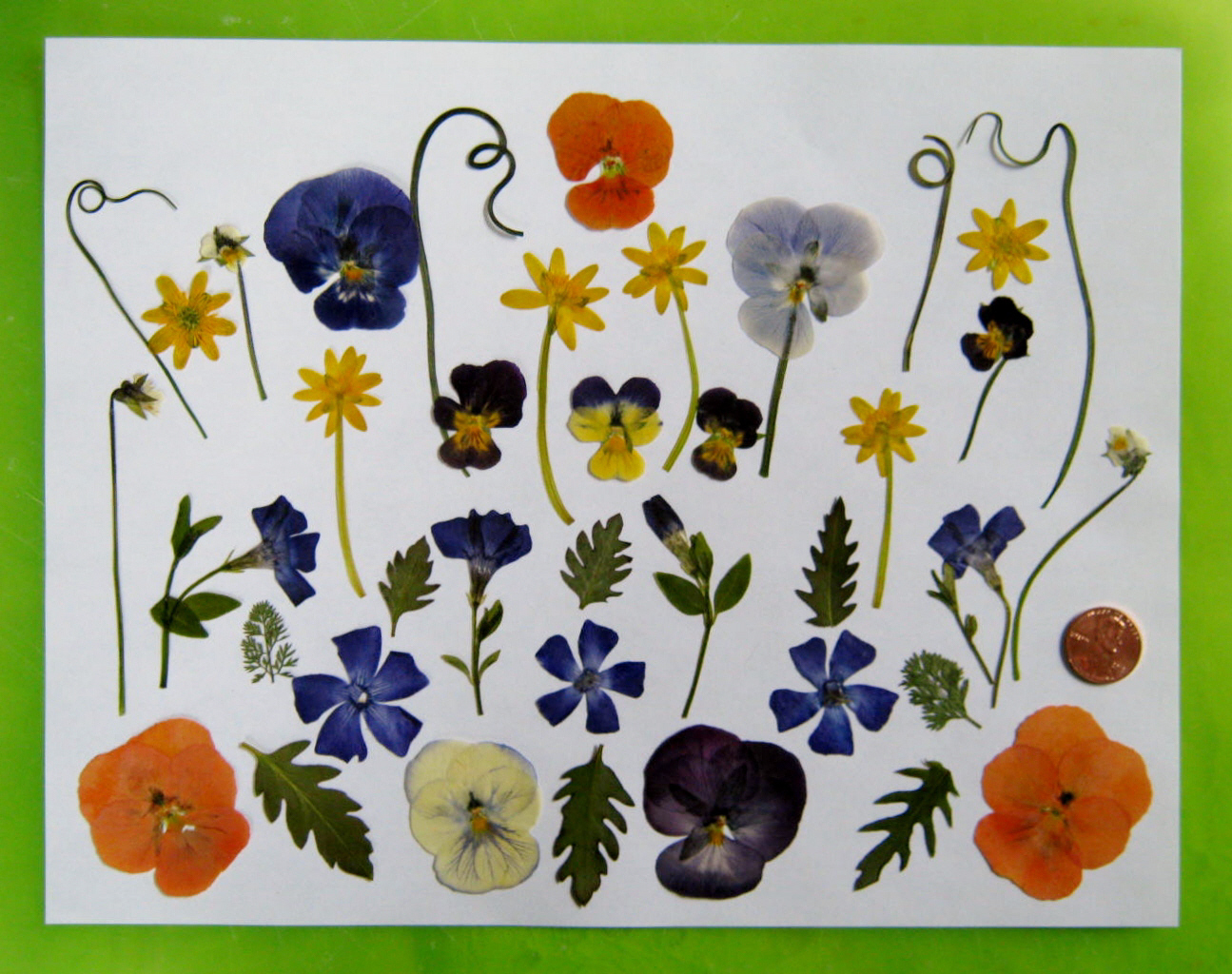
Pressed Flowers – April 2015 Part I

I’m re-blogging what I’ve found to be the best way to process most of the plant material I use for pressed flower artwork. My favorite way to use pressed flowers is in the creation of greeting cards. If you’ve attempted to buy a finely crafted greeting card lately, I’m sure you’ve walked away from the rack in a state of shock…most of these cards are outrageously overpriced. Dollar store greeting cards fill in the void nicely, but there are special events when an inexpensive greeting card isn’t a good choice. A handmade pressed flower card is often the perfect alternative. Throughout the next month or two, I’ll be posting a few of my favorite pressed flower greeting card tips.

It’s time to begin restocking my pressed flower supply. I love using wildflowers, they are often small and airy, perfect for pressed flower compositions. One caution though when using wildflowers, be sure that you are not using a plant that is protected as threatened and endangered in your state. To see a listing of your State’s Protected Wildflowers check out this site: US Government list of Threatened and Endangered Plants.

I have found that the best way to retain the colors of most flowers and foliage is to flash press them in a microwave. I don’t use the expensive microwave presses; I have found the best way is to use an old book. The book must have very porous paper, it must not have gold or silver leafing on the spine or page edges, and a smaller book works best. Most of the books I use are from the 1930’s and 1940’s. You can find books of this age at yard sales and thrift stores. They are usually very inexpensive.

1. Separate your flowers into thinner petaled flowers and foliage, and thicker varieties.

3. Lay the blossoms and foliage on the page. These vincas have a thick stem that will not press well behind the open faced blooms. After I lay them out on the page I cut off that stem. For the side pressed blossoms, I leave the stem intact. I also include several buds of the flower.

4. Shut the book and rubber band the edges. For thin varieties of flowers and foliage I microwave between 15 and 30 seconds. This provides the heat that speeds up the drying process. The book should not be hot, only gently warm to the touch. For thicker varieties of flowers and foliage I heat for 30 – 60 seconds. As with anything microwave temperatures vary, you will have to experiment to see what works best for you. After pressing, clean out any residue left behind in your microwave by heating a cup of water with lemon or citrus peel, and then wiping away the moisture from the sides.

5. Don’t open the book, leave the rubber bands in place and put your book under a heavy weight.

6. Your flowers should be dried and ready to use within 3 – 7 days. To remove them from the pages of the book, gently slide a soft paint brush beneath the edges.

I use large books to store my pressed flowers. I place them on acid free paper and label the sides, leaving the edges hanging over the book pages about 1/2 inch. This helps me find exactly the type of flower I want when I am composing a picture.

The flowers and foliage are ready to use. In coming days and weeks I’ll give more tips on how I compose, glue and use my pressed flower projects.

Pressed Flowers – Tips for Pressed Flower Success Part III

Pressed Flower Tip #9 Wonder Under (fusible web) works great to cut out shapes from pressed autumn leaves and other flowers and foliage. Draw your shape, remember it will reverse itself after ironing, iron the Wonder Under onto the leaf and then cut out along your drawing lines. The fusible web gives stability to the brittle leaf allowing you to cut it without it crumbling. After cutting the shape out, pull off the backing paper leaving the webbing intact on your leaf or flower. You can now iron the shape to your card or project, or as I prefer to do, glue the piece to your composition. (Ironing can sometimes cause wrinkles and discoloration on your pressed flowers and leaves)

Pressed Flower Tip #10 Before working with pressed flowers be sure your hands are completely free of any cream or oils. Excess oil and handcreams will mar the delicate petals.

Pressed Flower Tip #11 A small round paintbrush works great for moving flowers from storage to project. Tweezers are another good option. To remove pressed flowers that are stuck fast to blotting paper or the page of a book, use a flat brush and gently tease the petal edges away from the page.

Pressed Flower Tip #12 Some flowers brown or lose their vivid color when pressed in the traditional way. In that case, I press my foliage and flowers between the pages of old books and microwave. Make sure the book you choose has no gold edges or gold leafing on the title imprint or spine. Rubber band the book and microwave between 15 to 45 seconds. Let the book sit overnight, or better yet 24-48 hours. Check the flowers. If they feel reasonably dry transfer them to a storage book between pieces of acid free paper. If you leave the flowers in the heating book too long they will bind to the pages.

Pressed Flowers – Pressed Flower Tips Part II

In my twenty-plus years of pressing flowers I’ve gathered some good techniques and tips. Here is Part II of my list.

Pressed Flower Tip #5 Pressed Flowers are a natural product and will fade in the sunshine. Keep your displays and supplies out of direct sunlight unless enhanced with UV resistant spray or paint.

Pressed Flower Tip #6 For glueless work, create a composition, then reverse order and drop the pressed flowers and foliage backwards onto the tacky side of contact paper. Work front to back. It’s difficult, and easy to make a mistake, but it is great not to have to use glue.

Pressed Flower Tip #7 Some flowers can take a spray of clear acrylic protection, but very thin petals will disappear into nothingness, so save the acrylic sprays for thicker bodied flowers.

Pressed Flower Tip #8 Lace, tulle, and natural papers mix well with pressed flower compositions.

Pressed Johnny-Jump Ups

Pressed Flowers – Tips for Pressing and Using Pressed Flowers, Part I

I’ve been pressing flowers almost every day. Spring is prime time to collect smaller leaves and flowers. I will be sharing a few of my pressed flower tips in my blog over the next few days. Here are my first four tips:

Pressed Flower Tip #1 – Make sure all your plant material is completely dry before pressing. Arrange flowers and foliage between pages of blotting paper and place inside a large book. Weigh the book down with something heavy. Use acid free paper if possible. Wait 1 – 3 weeks and your flowers and foliage will be ready to use.

Pressed Flower Tip #2: Use your pressed flowers to create:

Greeting Cards

Scrapbooking Pages

Bookmarks

Decoupage

Stationery

Candles

Magnets

Jewelry

Resin Paperweights

Windchimes

Pressed Flower Tip #3 Gluing your pressed flowers can be a bit tedious. It pays to start with a reliable glue. These are a few I have found to work well. Rubber cement – This is one of my personal favorites but the fumes can be irritating. If you go beyond the edges sometimes the glue will show in your finished composition. Egg white – Whip it up a bit until frothy and use a thin paintbrush to brush on the glue. White glue – Not one of my favorites, but it does work.

Pressed Flower Tip #4 Sometimes after you glue your project down you will find some of the ends of overlapping petals are still not completely flat. These edges need to be glued down.  To apply a small dab of glue beneath the errant petals I use a long floral corsage pin with a drop of glue on the end. The pearl bead on the end makes the pin easy to handle. To find ends of petals that need a dab of glue, lightly blow on the composition and the ends that need a bit of glue will raise up just a fraction, this alerts you to where you need a bit more adhesive.