Photographs & Phun – Just Because

We drove the fifty-two miles to Ocean City, New Jersey, on Friday, just because it was a glorious October day.

We had lunch at Manco and Manco Pizzajust because we think they make the best pizza in the world. Truly, it is!

We biked both ways of the 2.5 mile Boardwalk just because riding a bicycle close to ocean waves is wonderful.

We walked down to the beach, just because the October day was near eighty degrees, and I wanted to gather a few seashells to paint for Jersey Shore Shells.

At the 22nd street beach entrance, I was entranced by the strings of shells adorning every fencepost on the way down to the shoreline.  Some posts even had more than one string. Beautiful. Why did the creative beachcombers take the time to do it? Probably, just because it was fun. I need to give into more enjoyable impulses, such as stringing seashells, JUST BECAUSE  life is short, and really, why not enjoy every moment you can?

Creativity is intelligence having fun. ~Albert Einstein

This post is part of Skywatch Friday.

Perspective and Prayer – Three Things

This morning, I felt burdened by my blogging, and pretty much life in general.  When I blog about daily activities, such as my garden, it almost feels frivolous amid massive world upheaval. On the other hand, I’m a firm believer in living my life. If we let the terror overtake and paralyze us, we allow those perpetrating the evil to win. 

Several things made an impression on me within an hour or two of rising. Number one: I felt led during my devotional time to search out an MMPwQ WordPress post of quotes from Oswald Chambers about prayer and publish them again. You can find these posts at the top and end of the page.  

Number two: I put on a necklace of my Mom’s that I enjoy wearing because it’s lovely and it reminds me of her. Out of the blue, the string broke and the beads flew everywhere, they embedded themselves into the shaggy weave of a rug, and scattered into crevasses and nooks where they were difficult to pick back up. Pick them back up I did though, because I won’t let something precious be lost to me if I can save it. I gathered up as many of the beads as I could find. I won’t throw them away, instead I will restring them, and when I begin, I might add a few little glittery pieces to remind me that Mom is up there in the stars with God now. I imagine the necklace will be better than before. 

It reminds me a bit of what happens in the world where evil uprisings are concerned. You move through life, and people who are my age will remember the phrase ‘Everything’s hunky-dory,’ and then, excuse the ugly word, ‘All hell will suddenly break loose,’ as has happened in Israel, and for the innocent people caught in the midst of the war in the Gaza strip. I don’t have a solution other than to once again, point to the quotes by Oswald Chambers I’ve included at the bottom and top of this post.

The red zinnia photographed in morning light is part of Cee’s Flower of the Day.

Number three: After I took a walk this morning I went into my backyard to see how my plants had fared during the very cold night. So far, they are still fine. The red zinnias were glorious in the early sunlight. I had my phone so I snapped a photo. Now, I use photo filters once in a while; I think they’re great, but this picture is unfiltered, well let me amend that, it was filtered by God. And I get a little choked up just saying that because amid all this turmoil in the world, I don’t want to forget that he is good, that he loves us, and that he will be with us in every moment of our lives. I am so glad the light was a reminder that he is, and was, and always will be in control.

 I hope to pray today off and on all through my waking hours. He is there any moment I need to connect to him. I will be praying for Israel, my family, my country, and my home, and I will be praying for those in power in the world to have wisdom. I will be praying for those innocents in harm’s way who are suffering because those with evil ideologies must have their way. God bless us all. 

Link to full post of Prayer is the Greater Work.

Phloral Arrangement – IAVOM Wildflowers and Autumn Berries

In my gardens everything is beginning to dry out and brown. The annuals have had their summer fling, and the perennials are beginning to nod off too, ready to be put to bed for the winter months. I thought instead of picking flowers from my gardens for this week’s In a Vase on Monday, I would take a bike ride and see if there were any wildflowers to be found. 

I was surprised to find a few sprigs of honeysuckle having a bit of a renaissance, blooming, and still spreading a bit of fragrance. Since it was in a spot no one would see, I didn’t feel badly picking it for a bouquet. I kept riding, picking berries, and Autumn leaves, surprised to find the goldenrod was over, I had been sure it would still be available. 

A neighbor saw me peddling up the street, took note of the sprigs I held in my hand, and asked if I was giving my flowers a ride. I answered yes, and that they were free flowers. 

One wild stem I found was Porcelain Berry, something new to me, and a little dangerous in appearance. If a berry ever looked poisonous to me, this one surely did. I had a plastic bag in my pocket and I wrapped it around the stem after I picked it in case the sap was deadly. 

For a bit of clarity, and peace of mind, before I handled it further, I used my photo search app. Ampelopsis glandulosa is its classification. It isn’t poisonous at all, and has some health benefits. These are the culinary uses I found when I researched the plant: Leaves and buds can be consumed after being cooked, the fruit (berries) can be consumed raw or cooked.

I find the porcelain berries beautiful, however, they are very invasive and can kill native plants. Birds eat the plump berries and the seeds are spread in this way. 

Health benefits of Ampelopsis glandulosa: Some health benefits are treating boils, abscesses and ulcers, bruising. They are anti-inflammatory, diuretic, has been used to treat breast cancer.

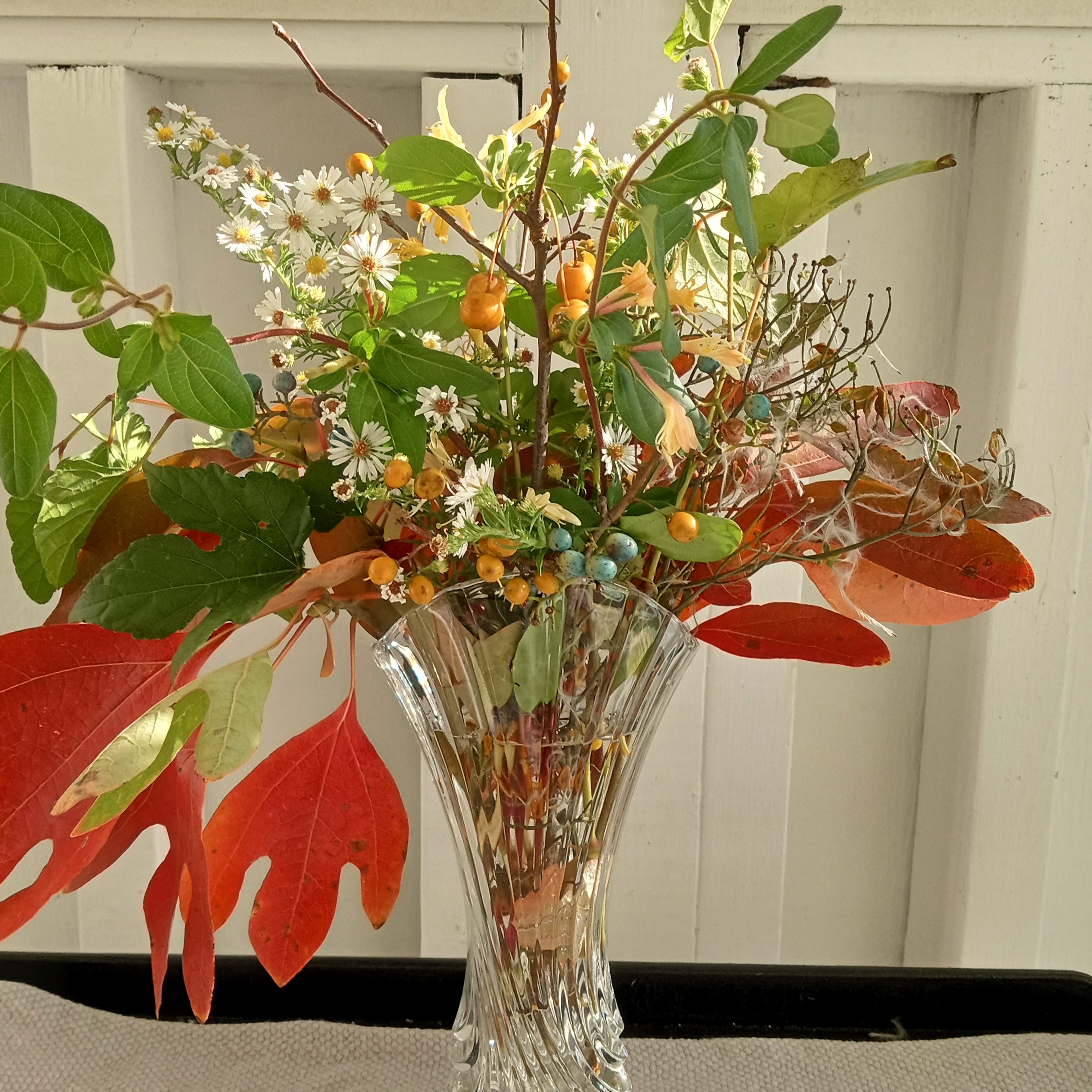
The plants used in today’s IAVOM are: honeysuckle, bittersweet berries, porcelain berries, crabapple, frost aster, autumn clematis seedpods and sassafras leaves. 

Plant – IAVOM – Postscript on Agastache Variety

I must amend my classification of the Agastache. I searched for it in my seed bin and realized I had sown the whole packet and not kept it for reference. I searched the two seed sources I use most, Botanical Interest and Baker Creek Heirloom Seeds. I found the variety at Baker Creek. I will have to amend the name to Fragrant Delight Mix Agastache. My success seemed to be limited to the apricot color. Other reviews and photos show a mix of colors. I am not unhappy about this…the apricot was beautiful. Here is a link to the variety and source. Agastache Seeds / Baker Creek.

Phloral Arrangement – IAVOM Last bouquets & FOTD

I still have a few plants blooming despite cooler temperatures. Gone is the cumbersome task of daily weeding, and left to me is a rebirth of the hardier blooms to cut and arrange. Here is a sampling of a few blossoms I thought were a good representation of Autumn colors. They are perfect for the In A Vase on Monday challenge.

My hyacinth bulb vase holds some coleus leaves, Knockout rosebuds in Coral, and sprigs of Agastache Poquito Orange. (After checking 2023 seed orders, I realized this plant is not Poquito Orange, but a apricot variety from the Fragrant Delight Mix of Agastache Seeds available from Baker Creek Heirloom Seeds.)

I love the Agastache I grew from seeds, sown indoors in late Winter. They are a beautiful shade; the blossoms are the size of a dime. Even the buds are attractive as they elongate and open. The flowers, growing in pots, never stopped their showy display from late Spring through Autumn. The photograph of my Agastache was taken yesterday. 

The plants thrived in medium-sized pots in combination with other hummingbird plants. There is evidence of a few small nibbles of insects, but the plant is basically ignored by most pests. Perhaps it is not any wisdom or luck on my part they are uninfested, but due to the fact that they are in potting soil instead of the garden beds. They are small, about 10 inches tops, and they have a graceful drape to their stems, making them perfect to place around the edges of planters and hanging baskets. Will I grow these again? Oh yes! 

I’m not ready to vegetate yet where the garden or Word Press challenges are concerned. I enjoyed including several challenges in today’s post. Thanks to all the hosts of these wonderful prompts to help me keep thinking and looking ahead. The Agastache flowers are part of Cee’s Flower of the Day and all my beautiful blooms are an entry in City Sonnet’s Colors and Letters Challenge – Letter F = Flowers.


Prayer – A Psalm of David

Rosemary for Remembrance

I am at a loss as to what to say in support of Israel. As I begin to write this they are beginning to report that rockets are targeting Jerusalem, God’s Holy City. Nothing I can say will change this tragedy, or prevent more attacks. In my life when things are so bad I find myself without words, I can only pray silently. To speak for me today, I will post a Psalm, a Prayer of David. God bless us all.

 Hear my voice, O God, in my complaint;
    preserve my life from dread of the enemy,
 hide me from the secret plots of the wicked,
    from the scheming of evildoers,
 who whet their tongues like swords,
    who aim bitter words like arrows,
 shooting from ambush at the blameless,
    shooting at him suddenly and without fear.
 They hold fast to their evil purpose;
    they talk of laying snares secretly,
thinking, “Who can see us?
     Who can search out our crimes?
We have thought out a cunningly conceived plot.”
    For the inward mind and heart of a man are deep!

 But God will shoot his arrow at them;
    they will be wounded suddenly.
 Because of their tongue he will bring them to ruin;
    all who see them will wag their heads.
 Then all men will fear;
    they will tell what God has wrought,
    and ponder what he has done.

 Let the righteous rejoice in the Lord,
    and take refuge in him!
Let all the upright in heart glory!

PSALM 64 – A PSALM OF DAVID – PRAYER FOR PROTECTION FROM ENEMIES -Revised Standard Edition

People & Quote – John Henry Newman

John Henry Newman – (1801 – 1890) “John Henry Newman was a Roman Catholic priest and cardinal who converted to Roman Catholicism from Anglicanism in October 1845.” ~ Christian Quotes.

I took this quote to heart. It is a failing of so many of us that we don’t continue to pursue our dreams because someone, or even ourselves, has found fault with what we do. I needed this today since I am working on a project I had set aside for years. It is a bit draining, but it has also made me laugh, and even enjoy, the words I had put to paper. It helped me realize I had created something not bound to the time I’m living in now. 

What is meaningful to me is the background of this quote. It is a macro photograph of a piece of watercolor I was not happy with and tore up. I have a whole basket of these scraps, collected for over twenty years. I tweaked the photo a bit in LunaPic and was pleased with the Autumnal appearance of the result. 

Don’t be absent from the classroom of your dreams, learn their lessons, take charge and make them count! Do everything feasible to succeed.

Place & People – Habitat/Pollinator Garden

Autumn is here, and winter approaches; I find this time of year ideal for planning out the next growing season’s projects. Here is a good one to consider, perfect for individuals or clubs, a good service task for those in 4H, the Boy/Girl Scouts, and various Youth Groups.

Our pet service provider is a person who, besides giving excellent care to our cat, does good for our community too. The Tall Pines State Preserve Pollinator Habitat, planted by Barbara and other volunteers, does what the sign says: provides food, water, cover, and places to raise young. The place is a perfect environment for birds, butterflies, animals and insects.

At one time this land was sunburnt grass and weeds. Now you will find hundreds of flowering plants in the area. Many desolate pieces of ground have the capacity to be turned into a pollinator paradise. This is another way to help nature along in this age of urban sprawl and the diminishing habitats of so many of God’s creatures.

Tall Pines State Preserve

Phascination & Place – Rocky Surprise & Block Island, RI

Cee’s Midweek Madness Challenge this week is the letter Q.  I thought at first, I can’t think of anything I have of interest that starts with Q. Then, as I often do, I reread Cee’s post. One of her photos was a beautiful turquoise bag. The Q only needed to be part of the word. (I am hearing my first grade teacher, in my head, at this point saying, ‘You did not follow the directions.’) Yes, I have always had a hard time not getting excited and running ahead with things before I heed the directions.

My quartz is a piece of a larger rock. When I researched it to find the proper identification, I promptly went out and retrieved a second chunk of it out of the border of one of my flower beds. It should be displayed in the house. The large piece has been used as a doorstop on my patio for a couple of years. I think I’m going to clean both pieces up and bring them indoors. 

I brought a few pebbles home from the beach in Block Island. We visited a week or two ago for the first time in ten years. The town hadn’t changed much, except for the loss of the Harborside Inn due to a fire this summer. We only stayed the day, so we didn’t have time to explore the outer edges of the whole island.

I never liked walking in the town too much, preferring instead the lesser-known beaches and land. I still felt the same a decade later. The town has busy streets and narrow sidewalks. It becomes disconcerting to feel you are holding back the pace of those walking behind who are always in a hurry.

I hope to get back again one day, but I’m not sure about that drive up 95. We were in an hour long traffic back-up between Bridgeport and Norwalk, Connecticut. We both said, never again are we driving that way, perhaps if we find a better route we will visit again one summer in the future. 

Planting – A Natural Support

The tip might be a little late for this year’s gardens, but keep it in mind for Spring planting. The red zinnia below is my photo for Cee’s Flower of the Day.

It’s always fun to traipse around the garden beds eye-level to the zinnias. Their height presents a problem though; how to support them? If you’ve ever grown these beauties, the taller varieties, you most likely know a heavy rainstorm will drive them to the ground if they are not staked. This year, quite by accident, I grew a natural staking plant nearby.

In the patio garden I planted zinnias, the State Fair variety that grows near four feet tall for me. Beside it I planted blue salvia since both flowers are hummingbird favorites. As the zinnias grew tall, and the salvia spread out in width, the zinnia grew up between the branches of the salvia and rested upon the natural support. No staking required. The plants look lovely growing together. Their roots have plenty of room. I can’t extol this combination enough; the hummingbirds are happy and so am I.

The growing season is almost over. We have had heavy rain along the Atlantic coast for days. The zinnias are now as tall as I am, and still, despite the downpours they are held aloft by the salvia plants. What a beautiful combination.

Pages & People – The Warner Sisters

Left to Right: Susan B. Warner, Anna B. Warner, William B. Bradbury – Photos courtesy of Wikipedia Commons.


After reading Book One of Then Sings My Soul, I was happy to see there were two more volumes. Written by Robert J Morgan, a pastor who loves hymns, the books brings to life the history of each song. In Book One and Two, on the left side of the page is the hymn, the facing page is the history of author and sometimes the composer. Book Three goes into more depth on author and hymn. The story of the Warner sisters is in Book Three.

Have you ever wondered about the author/composer of ‘Jesus Loves Me?’

The author of the words is Anna Bartlett Warner. (1827-1915) Her poem was composed for a novel called Say and Seal, written by her sister Susan B. Warner. (1819 – 1885) The sisters lived in a house on Constitution Island, near West Point. I learned their history in the third volume of Then Sings My Soul. I have all three volumes of these wonderful books. They are filled with hymns and history. The stories are inspiring; I read them in the morning as part of my devotions. I have finished the last volume of the series and would definitely purchase a number four if it is ever written.

The composer of the music, and the well-known chorus is William B. Bradbury. William Bradbury wrote the music for many hymns, a few you might be familiar with are: Just As I Am, Sweet Hour of Prayer, and My Hope is Built on Nothing Less.

Jesus loves me! This I know,
For the Bible tells me so;
Little ones to Him belong;
They are weak, but He is strong.

Refrain:
Yes, Jesus loves me!
The Bible tells me so.

Jesus loves me! This I know,
As He loved so long ago,
Taking children on His knee,
Saying, “Let them come to Me.”

Jesus loves me still today,
Walking with me on my way,
Wanting as a friend to give
Light and love to all who live.

Jesus loves me! He who died
Heaven’s gate to open wide;
He will wash away my sin,
Let His little child come in.

Jesus loves me! He will stay
Close beside me all the way;
Thou hast bled and died for me,
I will henceforth live for Thee.

Plants – Tulsi/Holy Basil – A Post Script

The cutting of Tulsi, dipped in honey and placed in half perlite, half potting soil, has quickly rooted. I removed it from the plastic bag when I noticed roots emerging from the drainage holes. When I gently coaxed the root ball out of the pot I was pleased with the exuberant evidence of roots. I will leave the plant out of the bag, and in the same pot, for another week or two. Then I will plant it in organic soil amended with some natural fertilizer. Once again, I must rave about this basil. It is wonderful!

Plants – Tulsi/Holy Basil

I am going to do a bit of raving in this post. I have a new favorite herb, probably in my top ten for all time. It is Tulsi, also known as Holy Basil. I grew my plants from seed. It has been a fabulous addition to my potted herb garden. It is growing even now, ten inches tall, after another mid-summer sowing. The heat never bothered it, if anything, it grew even faster than the plants I sowed in Spring. 


I am including the back of the Botanical Interest Seed Packet. I love the thorough information this company gives you on the packet.

Design-wise, there is none better. Botanical Interest seeds can be ordered online. They are available in some garden centers too; I sometimes drive 45 minutes to visit a nursery in our area that has an extensive display of Botanical Interest seeds each year. 


Back to the Tulsi, this herb, combined with Lemon Balm and Spearmint, has become a favorite to brew as mid-afternoon tea. It has alleviated a nagging, if small, physical problem I was fighting. It also elevates my mood when I drink it, and even when I rub the leaves to release the scent, I feel an almost instant uplift. They definitely recharge me a bit. Best of all they are a plant that loves to grow. The only drawback is they form flowers and seeds quickly too, but this can be postponed by constant pinching of the top leaves. (And you can use those pinchings in tea. )

I sowed another batch two days ago. If you look closely you can see they are ready to break free from the seeds and show green against the seed starter. 

Cuttings readily rooted in a perlite and soil mix. One cutting began to grow so fast I had to open the plastic bag and pinch it already. 

A sprig also rooted very well in a vase of water. Oh my, what a plant. I hope this amazing herb has been included in global seed vaults. There is nothing flimsy about this plant, it is a bushy, blue-green beauty. I really recommend growing Tulsi. You will be love it in so many ways.

Holy Basil dried fairly well for me, although it lost a portion of its amazing scent.

Photo Challenge – One to Three Photo

XingfuMama offers a Photo Challenge for September: “The challenge is simple: take one photo and get creative with it by processing it three different ways.”

I am using Lunapic.com. This is one of my favorite photo editing sites. When you want to save your photo after tweaking/filtering in LunaPic, go to file, click and a save box will drop down. Choose the format you want to save your photo in. The photograph is automatically saved in your download file. The file ending up in the download file tripped me up for awhile, but I finally figured it all out. It is so much fun to tweak your photos in LunaPic. You can also add text. You can save file, then you can go on tweaking without uploading the original again if that is how you are inclined to work. Have fun. Thanks to XingfuMama for the challenge.


The first filter I used was the ‘Homer’ Art Filter – One of the Famous Artists Filters.

The second filter I used was in the filter column and was called Thermal Iridescence. It is rather bright, but I love the way the filter accentuates the negative space in the photo, especially in the foliage of the tree. This is a good filter to use to help compose a painting or other artwork using the lighthouse photo as a reference.

The third filter is the Warhol Effect. I think all three tweaks of the photograph turned out well. Give Lunapic a try when you have some time to play around with photo editing.

The beautiful skies depicted in these photographs are part of Skywatch.

Plants – Top Performers

I have a few top performers in the vegetable garden this year. At the top of my list are two tomatoes.

Rosella is a salad tomato, small and compact, this delightful plant has produced dozens of tomatoes within the confines of a five-gallon cloth growing pot. I am hoping for many more harvests through the beginning of Autumn.

Spoon tomatoes have been a surprise. Grown in a five-gallon container, the plants have produced dozens upon dozens of tomatoes.

The fruit is super small, about the size of blueberries. A bit addictive, it’s easy to eat them by the handful. Best of all, the seeds were free, as a thank you for my purchase from Baker Creek Seeds.

Mini Bell Mix Peppers have been exactly what the name implies–miniature. They develop beautiful color while small in size. Delicious, and perfect to cut into pasta and garden salad, these have been productive growing in a regular sized bucket as a pot.

As you will notice from the seed packet photographs, these varieties are all from Baker Creek Heirloom Seeds. A great company, and the plus is they provide fast service and mailing. Any order over $10.00, at least this year, receives a free packet of seeds. One of the free packets was the Spoon Tomatoes.

Phlutters – Problem Solving in Raising Butterflies

Cannibalism fix – When I found two newly hatched caterpillars on the same leaf, I knew I could not let the pair continue sharing the space. The dilemma: how to move one to another leaf without causing injury by touching it? I prepared another leaf by making two small cuts in the flesh. I then cut away one of the caterpillars with the leaf intact and inserted the ends of this piece into the cuts on the other. I’m sure my explanation sounds a bit convoluted, so I’m glad to have a photograph too. Success! You can see the caterpillar adjusted and moved on to the surface of the new leaf.

Another problem is how to clean the butterfly house. The bottom becomes discolored due to water spills and caterpillar frass (waste). I purchased another house to have a switch-out option. After all the caterpillars/butterflies completed their cycles, I washed the dirty house with a heavy stream of water from the hose and then hung it on the clothesline to be sanitized by bright sunshine. I didn’t use any type of soap or cleaner, only fresh water; butterfly feet are ultra-sensitive and chemicals of any kind can be detrimental to their thriving.

At some point milkweed leaves will begin to dry up when separated from the main plant. When this begins to happen I place a fresh leaf beside the one beginning to dry and the caterpillars move to the fresher food source.

To thwart the flies that prey on caterpillars I concocted these fly traps. Many recipes can be found on the Internet. I used water, with a bit of vinegar, sugar and soap. My solution did work. Unfortunately, foliage beneath it died when it overturned. I have some bare spots on my grass where I set the traps. I think an animal knocked them over. Parasitic wasps prey on caterpillars too, but since I bring them in before they are big enough to be of interest to the wasps, so far at least, I haven’t had a caterpillar in the butterfly house afflicted by wasp eggs.

Quote – Time/Blaise Pascal

Blaise Pascal (1623-1662) French mathematician, physicist, inventor, philosopher, and Catholic writer. ~Wikipedia

Phlutters – The Magnificent Seven

The ‘phlutters’ on my porch have been magnificent. While I write this post, I am thinking of eleven empty and transparent chrysalides. Each is the evidence left behind of a successful eclose of the Monarch butterfly that developed inside. The brief sojourn of the caterpillar becoming a butterfly is complete. Below is a description with photos of how the day of “The Magnificent Seven” evolved.

Raindrops started falling early but then tapered off; the weather became a concern since seven chrysalides turned black and were ready to emerge over the span of twenty -four hours. Morning light revealed the markings of each butterfly through the walls of its chrysalis. After a few hours of daylight, they began to eclose.

First to break free was the only Monarch who formed its chrysalis on a milkweed stem.

The remaining chrysalides clustered along the top edges and corners of the butterfly house. Throughout late morning/early afternoon all seven eclosed at varying times. All emerged perfect, no malformation or problems breaking free from the chrysalis. 

Two to four hours after eclose the butterflies began to flutter within the confines of the butterfly house, I gently coaxed them onto my fingers and carried them to the open door. Several took to the air and flew out of sight over the rooftops, others seemed tentative, and these I rested upon a hanging basket. Later in the day, when I returned, they too had taken wing. 

A sense of elation filled me when I realized a lucky seven eclosed in one day. This brings the successful ecloses to a total of eleven. 

Today, as I post this, six newly hatched, ultra-small Monarch caterpillars are starting the cycle all over again. Will I ever grow weary of this miracle? Never.

This post is part of Skywatch Friday.

Phlutters – The Monarch Caterpillars


After spotting the vermilion orange flash of a Monarch butterfly laying eggs on my milkweed, I kept watch by tying a string on each leaf that had an egg on it. I was surprised, monarch eggs hatch quicker than the black swallowtails. Within a few days I spotted a small hole on one of the leaves. Sure enough, underneath I found an almost microscopic monarch butterfly caterpillar. 

Because I’ve experienced the dilemma of monarch caterpilla cannibalism, I needed to find a better way to raise them this year. I brought one of the monarch caterpillars in on its leaf and using an old water bottle, garden cloth, and a rubber band I created a standalone leaf holder for the small caterpillar. Besides working at keeping the caterpillar separated, the bottle added a benefit; the leaves have stayed pliable and fresh for days.

To create more stem for the leaf to absorb water, I cut up along the edge of the stem, always careful to be aware of where the caterpillar is on the underside, next remove a v-shape portion by cutting away the leaf to form a stabilizing appendage to grip the garden cloth. I could go on with an explanation, but I think the photos tell the story better. 

The caterpillars are thriving. They are now big enough for me to be able to see their spiky anthers.

In the course of adding water to the bottles, one caterpillar fell off on the rug, which is the same color as the caterpillar and even the same texture. I couldn’t find the small cat anywhere. I felt terrible. There was no sense in looking for the fallen caterpillar because I might squash it with my knee or foot while I searched. Instead, I laid a few leaves in the area where I thought it fell. The strategy worked, and today I found the wayward caterpillar on the leaf I laid on the floor. It is safely back on the rearing bottle now.

You can tell, by the holes in the leaves, and the freshness they’ve retained, that the single bottles work much better than leaving all the caterpillars in the bottom of the butterfly cage. Unfortunately, last year that is what I did, and I had seven caterpillars at one time on the bottom of the enclosure, eating the leaves. Overnight, my number was down to one. Yes, caterpillars of the monarch butterflies, although they are beautiful and delicate, are voracious cannibals of each other.

I might run into some trouble when they are big enough to loop themselves from one leaf to another. Maybe the problem will never present itself, but at least I am on the lookout for it. 

I am grateful that I have a whole garden bed filled with milkweed. I checked some of the wild areas and the milkweed is in horrible condition. I found no caterpillars, only aphids spiders, ants and other bugs that prey on the monarch caterpillars. The leaves were leathery and dry from all the hot weather in our area. I have the advantage with my garden bed since I keep it well watered and stay on pest alert at all times.

This has been longer than my normal posts, but I wanted to share how to keep the leaves fresh, and the caterpillars away from each other. One note, they do like to be shaded. I keep them shielded from the Sun with dish towels over the sides. So far none have attempted to reach the other leaves. They are thriving and growing. I’m looking forward to watching the process over the next few weeks.