
Quote – Thursday Thoughts/Time
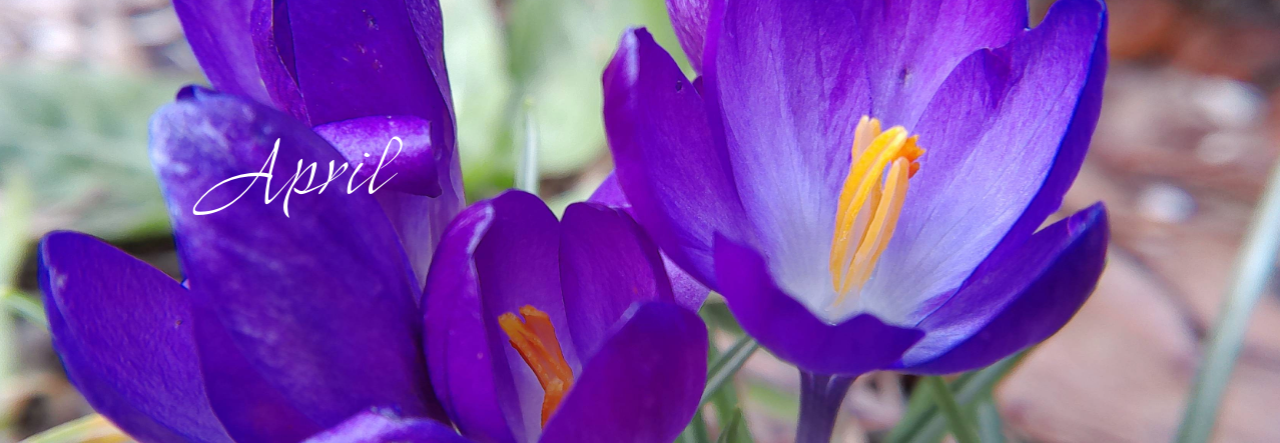

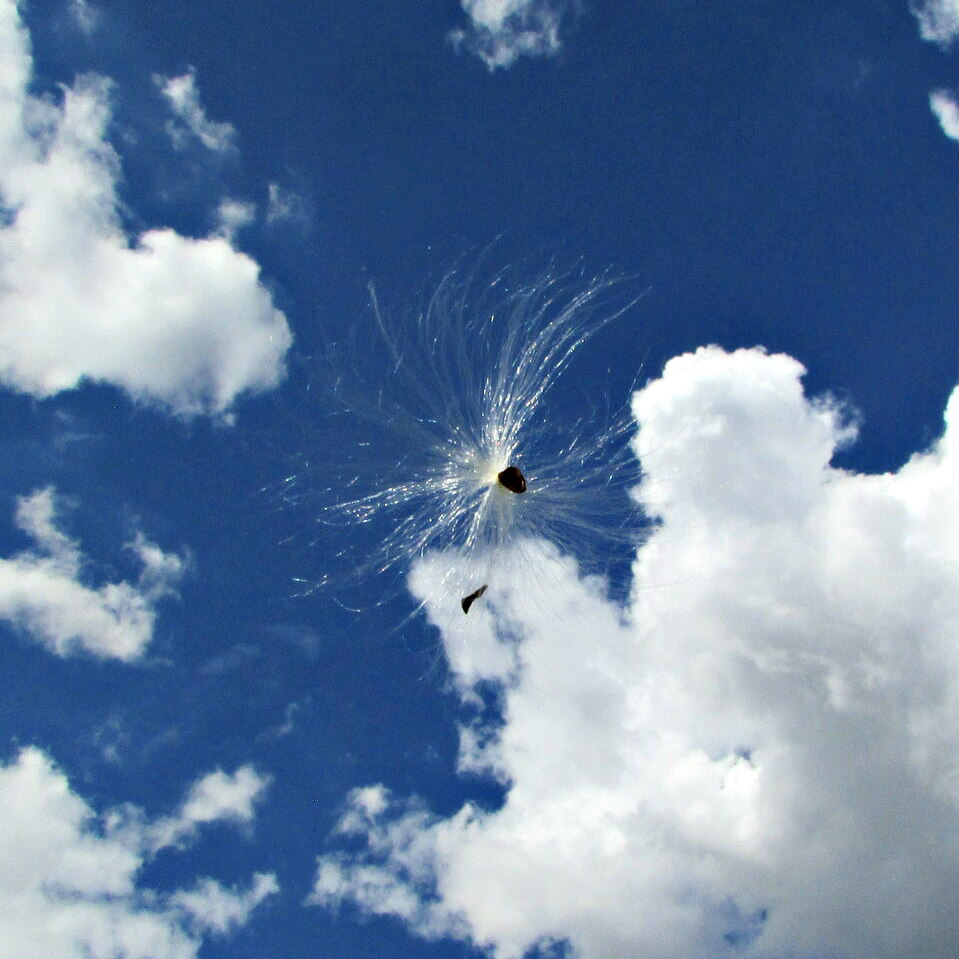
Are these fairy wishes as much a part of your childhood remembrances as mine? Some of my earliest memories of being outdoors involved chasing after these wishes.

I captured only a portion of this wish as it floated against the blue sky, but I am entranced by the way the feathery tendrils become a prism and reflect a bit of rainbow color.
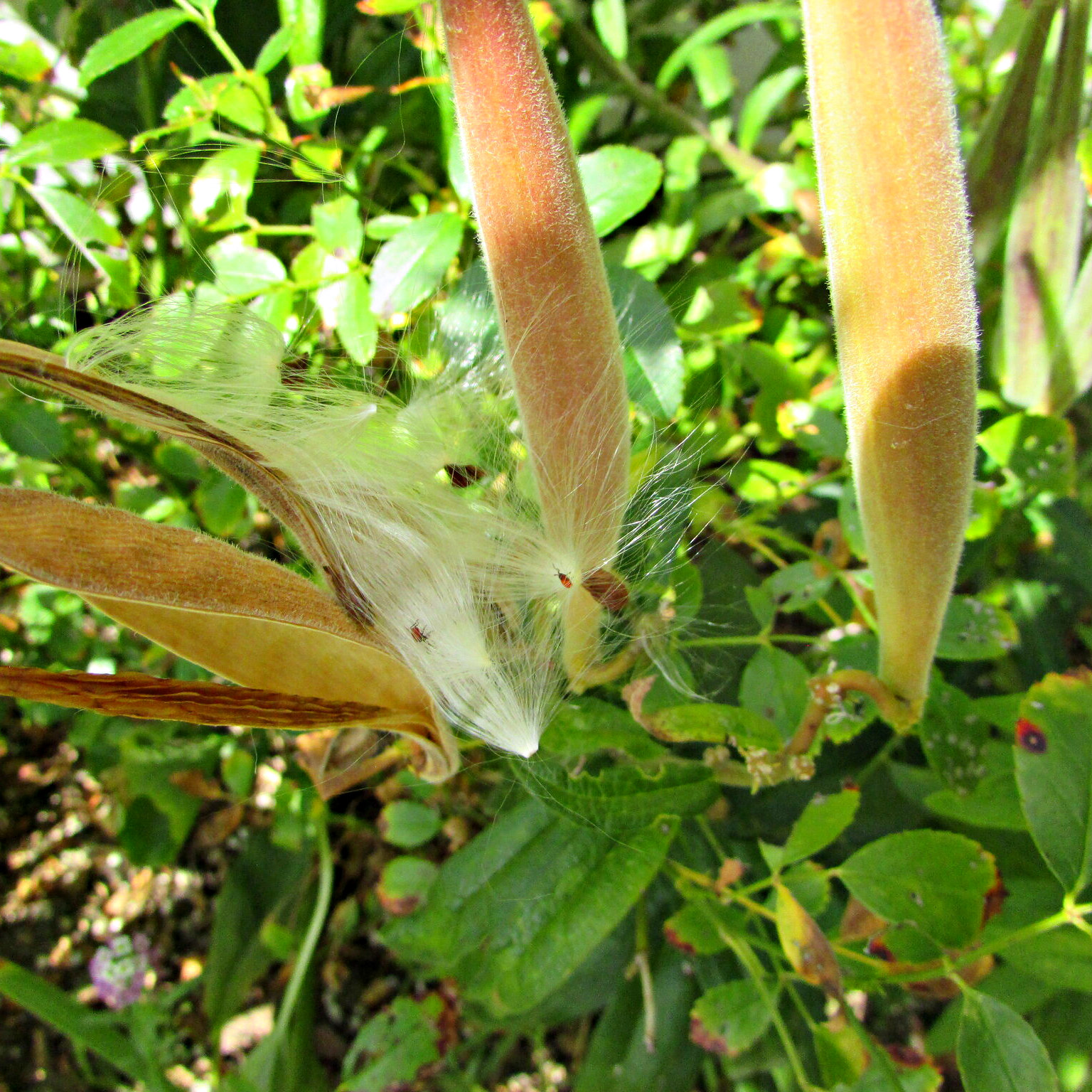
Many of the wishes floating in my yard are now emerging from these Butterfly Weed (Asclepias tuberosa) pods, a type of milkweed. I also have common milkweed pods opening and letting their seeds fly free on an aerial bit of fluff.

Pollinators love Butterfly Weed.

Butterflies, such as this Black Swallowtail, also sip the nectar from the blossoms.

I couldn’t resist cropping out a close-up of this beautiful butterfly face.
This post is part of Friday Skywatch. Thank you to the Host of this challenge.


Today, I had strange companions along for the ride as I drove to Red Bank Battlefield. Ten caterpillars, mid-sized in their cycle, rode along to become residents of the Butterfly House. The fennel plants collapsed a bit in the heat, but the caterpillars did well.

The house has many butterflies, chrysalis, and caterpillars. The interior is filled with dozens of nectar and host plants.

The volunteers (Butterfly Whisperers) were pleased to welcome and make room for the new residents. The jar holding the fennel sprigs they were feasting on was placed beside a beautiful fennel plant growing in the house.

It gives me great joy to think of all the visitors receiving a bit of pleasure as they watch the butterflies throughout their life cycle.

The Revolutionary War Battlefield, now a historic park, is located on the banks of the Delaware River. Philadelphia’s skyline is in view to the right of the park.


Yes, you are correct if you think this blog becomes inundated with butterflies at this time of year.

Today’s photographs are part of the Cosmic Photo Challenge, Contrast. The markings on the butterfly are an excellent example of contrasting colors. The butterfly contrasts nicely with the garden plants he rests upon as he finishes drying off his wings.

Another good contrast is the natural support of the butterfly chrysalis on the left compared to the one on the right. I save so many caterpillars; they sometimes bump finished chrysalises right off their mooring of spun web. I found the chrysalis in the papoose-like sling of string lying on the floor of the butterfly house. I am hoping it will develop properly and emerge perfectly.


The first Black Swallowtail butterfly was ‘born’ today. The high heat, present even in the morning, sped up the drying process, and the butterfly was ready to fly within two and a half hours. I took the butterfly enclosure outside, and the new butterfly easily flew into the world and quickly disappeared. Success!
I like the way the photo shows the web they spin to anchor themselves in place. Due to the number of caterpillars I was able to save, I’ve had a few mishaps. I’ll post some of the solutions later in the week.


I had a rude awakening to one of the perils butterflies and caterpillars face. In mid-spring, expecting the butterfly chrysalis to hatch at some point, I brought the butterfly houses out to the porch and hung them from the ceiling. One day, checking them, I saw a delicate wasp of some sort had gotten inside the house and was trapped. Being a bit of a bleeding heart, I shooed the wasp out and felt I had done my good deed for the day. Wrong.

Two more wasps, surprisingly to me, also found a way into the house. I let these out also. Afterwards, I looked at the seven chrysalis on the sides. What! There was some type of hole in the sides of a few. I knew some parasite had attacked them.

When another wasp suddenly appeared in the house, I knew that it would not appeal to my softheartedness; I squashed it.
Trogus Pennator Wasps eat the swallowtail caterpillars from the inside out and emerge from the chrysalis. I can attest to the truth of this remark. Three overwintered chrysalis have opened in the past week or two, and beautiful Black Swallowtails have taken wing after the long wait. I have seen them fluttering over the fennel plants, and sure enough, I found several of the tiny eggs on inspection.
This weekend, small caterpillars appeared. I have twelve safely in one of two, new butterfly houses. I have also kept the older one from last year. Now that I have seen one of the parasitical threats they face firsthand, I will redouble my efforts and save as many as I can manage.
I will be keeping a 2024 Butterfly Diary. The link is here: Butterfly Diary 2024. It can also be found at the top of the blog page in the bar beneath the title. I will try to create a sidebar link too. Thanks so much for following the butterflies with me.


We had a hard freeze last night. The white frosting was still visible on the zinnias after the sun came up. It’s time to put the garden to bed.

The hardiest butterflies were cabbage whites and the skippers, but even those are gone now. Hopefully, the offspring they left behind are in their chrysalises over-wintering in sheltered spots.

Ten Black Swallowtail caterpillars, within the butterfly house, formed their chrysalis in late summer. We had a couple cold nights in August and this set off diapause, a state of hibernation, in the butterflies. Three of the caterpillars formed their chrysalis on objects within the butterfly house. Seven of them formed on the screening. Those who chose the screens were easy. I checked on them, tied a string to the top, and hung them from the garage ceiling, quite an exclusive high-rise to rest in for the winter. They are far enough up that they would be hard to find by a wandering rodent. When it rains I will climb a ladder and spray a little bit of misty water into the house to mimic what’s going on outdoors.

Three of the caterpillars formed their chrysalis on other items. Two of them on a piece of landscaping stone I had at the bottom of the house to keep it secure when storms struck.

The other formed on a stem. These also need to be in the garage but must have some kind of protective covering. Recently, in the grocery store, I picked up several mesh bags sold for fruit; the perfect solution. I placed them around the objects holding the chrysalis and put them on a garage shelf for the winter.

The raising of butterflies has never become commonplace to me. I enjoy seeing the butterfly house hanging in the garage. It reminds me Spring will come again and hopefully a bevy of butterflies will emerge.
“Butterflies that go through diapause enter into a hibernation-like state, where physiological processes are suspended. After adverse weather conditions clear, they will come out of this state of suspended animation and return to normal functioning.”
Bugs Under Glass

After spotting the vermilion orange flash of a Monarch butterfly laying eggs on my milkweed, I kept watch by tying a string on each leaf that had an egg on it. I was surprised, monarch eggs hatch quicker than the black swallowtails. Within a few days I spotted a small hole on one of the leaves. Sure enough, underneath I found an almost microscopic monarch butterfly caterpillar.
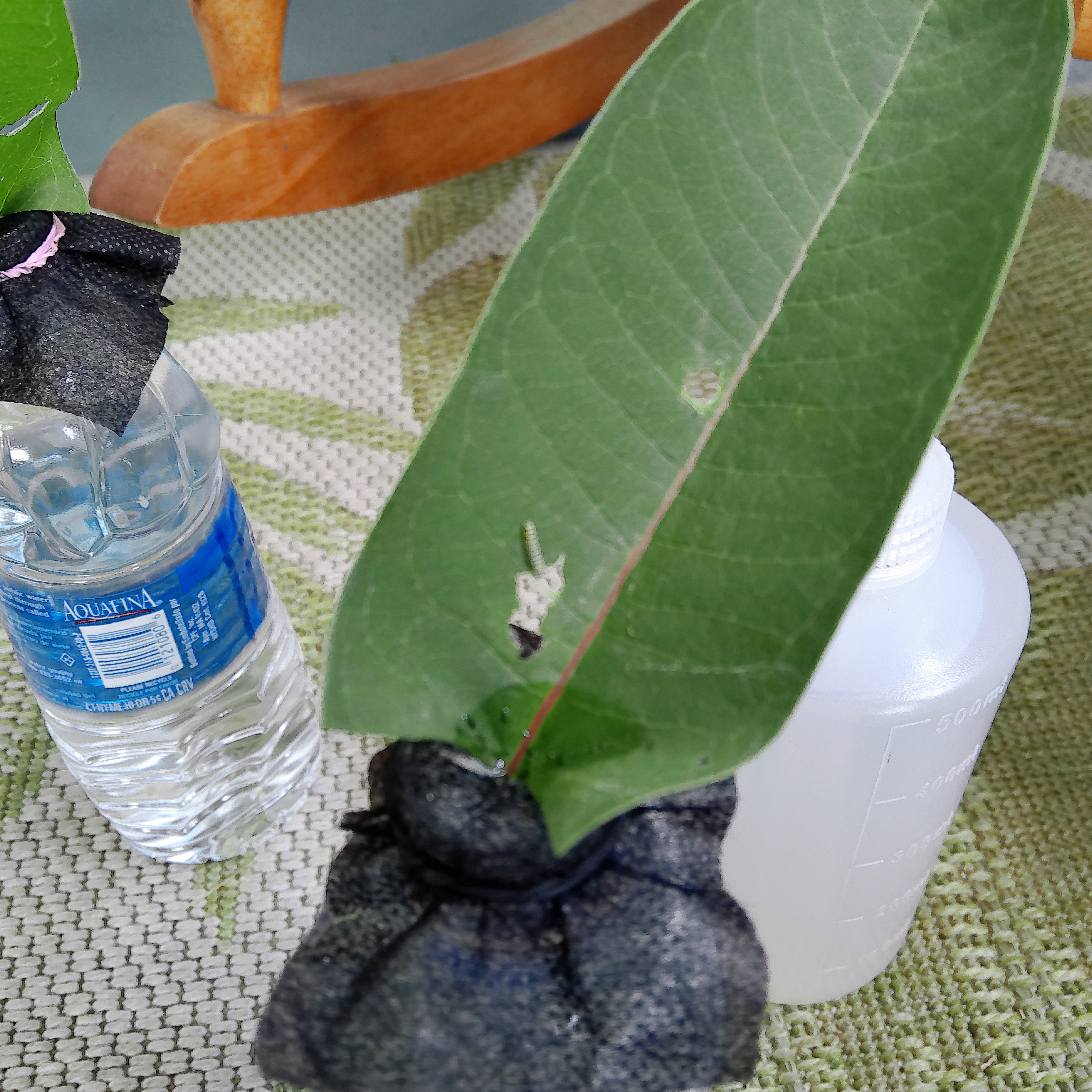
Because I’ve experienced the dilemma of monarch caterpilla cannibalism, I needed to find a better way to raise them this year. I brought one of the monarch caterpillars in on its leaf and using an old water bottle, garden cloth, and a rubber band I created a standalone leaf holder for the small caterpillar. Besides working at keeping the caterpillar separated, the bottle added a benefit; the leaves have stayed pliable and fresh for days.

To create more stem for the leaf to absorb water, I cut up along the edge of the stem, always careful to be aware of where the caterpillar is on the underside, next remove a v-shape portion by cutting away the leaf to form a stabilizing appendage to grip the garden cloth. I could go on with an explanation, but I think the photos tell the story better.

The caterpillars are thriving. They are now big enough for me to be able to see their spiky anthers.

In the course of adding water to the bottles, one caterpillar fell off on the rug, which is the same color as the caterpillar and even the same texture. I couldn’t find the small cat anywhere. I felt terrible. There was no sense in looking for the fallen caterpillar because I might squash it with my knee or foot while I searched. Instead, I laid a few leaves in the area where I thought it fell. The strategy worked, and today I found the wayward caterpillar on the leaf I laid on the floor. It is safely back on the rearing bottle now.
You can tell, by the holes in the leaves, and the freshness they’ve retained, that the single bottles work much better than leaving all the caterpillars in the bottom of the butterfly cage. Unfortunately, last year that is what I did, and I had seven caterpillars at one time on the bottom of the enclosure, eating the leaves. Overnight, my number was down to one. Yes, caterpillars of the monarch butterflies, although they are beautiful and delicate, are voracious cannibals of each other.
I might run into some trouble when they are big enough to loop themselves from one leaf to another. Maybe the problem will never present itself, but at least I am on the lookout for it.
I am grateful that I have a whole garden bed filled with milkweed. I checked some of the wild areas and the milkweed is in horrible condition. I found no caterpillars, only aphids spiders, ants and other bugs that prey on the monarch caterpillars. The leaves were leathery and dry from all the hot weather in our area. I have the advantage with my garden bed since I keep it well watered and stay on pest alert at all times.
This has been longer than my normal posts, but I wanted to share how to keep the leaves fresh, and the caterpillars away from each other. One note, they do like to be shaded. I keep them shielded from the Sun with dish towels over the sides. So far none have attempted to reach the other leaves. They are thriving and growing. I’m looking forward to watching the process over the next few weeks.


I found a packet of Butterfly friendly Spring bulbs this year. Since I am all about attracting butterflies to my gardens, I couldn’t resist. Of course, just one wasn’t enough, and I bought two. I had an instant dilemma when I opened the packages, the bulbs were all mixed up. I had no idea what was which, or which was what, and there were dozens of them. I gave up trying to identify variety and sorted them by sizes. Larger bulbs in the back of my pot, smaller sizes up front, and a row of a tulip I like in the middle.

They are planted way too close, but since they are a one season planting in garden pots, I will decide after they bloom if I am going to save and replant another year. The biggest problem I must solve is keeping the critters that munch on bulbs out of the pots. In soft dirt they will be easy pickings for rodents that dig.
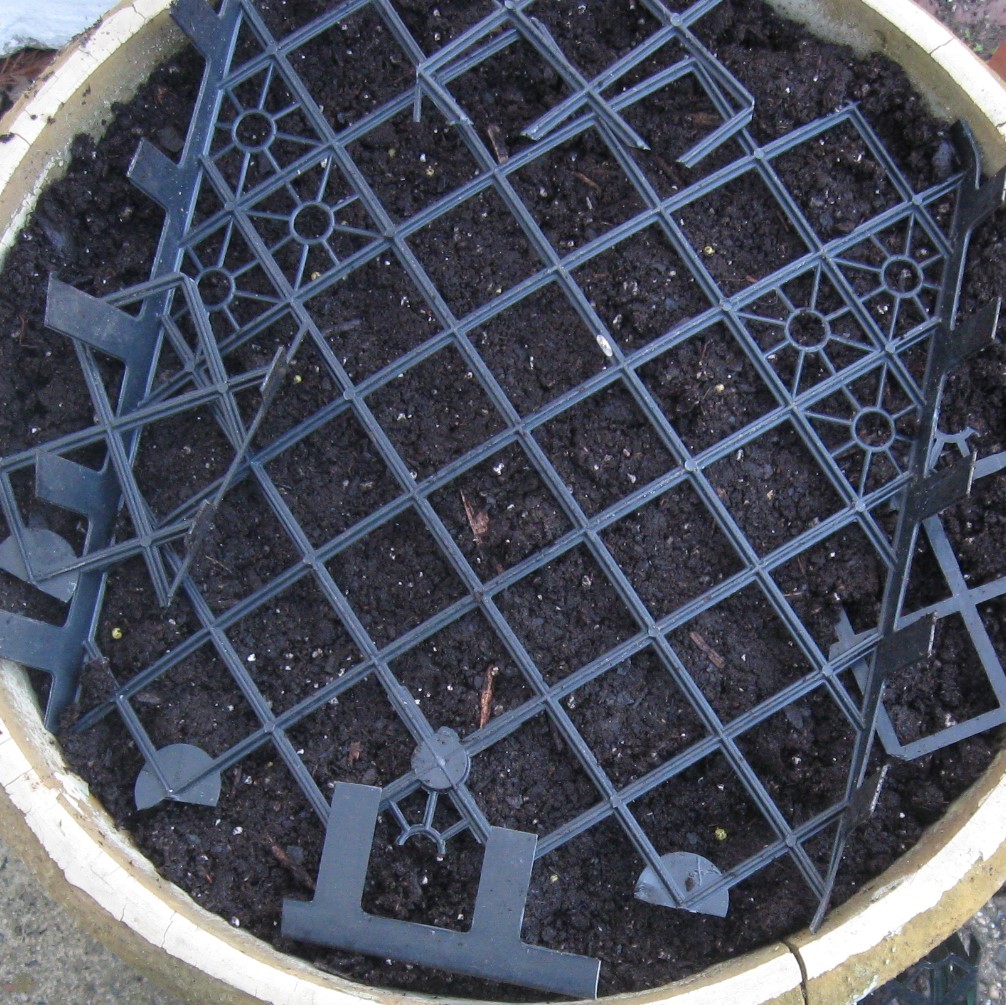
I came up with a solution I hope will work for me. I used this tactic in my spring garden buckets and will try it with the bulb plantings. I cut the grates out of flat trays and secure them with large six inch anchor pins. When the bulbs begin to sprout I will remove the plastic grids and drape some netting over them. It gives me joy to think ahead to Springtime and butterflies.


My husband and I spent the good part of an hour this past winter in search of a praying mantis pod. Praying Mantis are a terrific predatory bug for keeping garden pests in check. Unfortunately, they cannot discriminate between a bad bug/good bug, and will eat caterpillars, butterflies and ladybugs too. There have even been instances, captured on video, of praying mantis devouring toads, frogs, small snakes, juvenile rodents and other small creatures.
We never found a pod this year, and I thought…’Well, maybe it is meant to be…the butterflies will be safer this year.’ Imagine my surprise to find a pod, as in the past, quite close, hidden in my holly bush.

I have mixed feelings about the praying mantis. I want a mantis in my vegetable garden to keep cabbage moths and other destructive bugs at bay, but I don’t want to lose any beneficial or beautiful creatures to their powerful forelegs and mandibles. Praying mantis in the garden are definitely a mixed blessing.

This month’s Floral Plant Parade Challenge at WetCanvas is a combination work of art with the subject matter of any flower with a butterfly included. Plant Parade Challenge – May 2015
Welcome to the Plant Parade for May, 2015, or a ‘Symphony of Colors’!!
With Spring showing off the different flowers, a remarkable sight begins grabbing our attention!! We notice that the flowers are not the only attraction, but small insects that have brilliant and colorful wings start ‘strutting’ their stuff!! They put on a grand show of flitting and swirling around the flowers and amaze us with their beauty!! How can there be so many unique shapes of the Butterflies? But, watch, when they land on a flower, we have stereo colors. . .both are competing for our attention! But, wait, competing or becoming one? A flower alone is sometimes breathtaking, but with a Butterfly so brilliant with its own remarkable markings, wow, what a kaleidoscope of colors!!
This month we are going to paint brilliant flowers with equally brilliant Butterflies attached to them. We will call it a “Symphony of Colors”!!

Floral Plant Parade reference photograph courtesy of WetCanvas Library and DominicM

“Away with the colors of Hanukkah, Christmas, and Kwanzaa. Show us what “Yellow ” means to you.” Photo Challenge at WordPress – December 19th

My first thought for this challenge was to choose a photograph of yellow flowers. I have dozens, hundreds, maybe thousands of flowers on disc. Many of the photos have been taken in my own gardens, others at local public gardens in the area I live.
I decided instead to combine a favorite flower, zinnias, with a yellow swallowtail butterfly. Perfect. I love swallowtails. Lately, the weather and environmental issues have diminished their ranks, but hopefully their numbers will rebound in our area soon.
I love zinnias, and especially am entranced by the yellow ring of flowers surrounding their center. I always give this ring of small flowers, technically called “disc flowers” my own whimsical name of fairy ring flowers. This is where the butterflies find the nectar that they drink.
Zinnias have “Heads composed of both disc and ray flowers, with disc flowers tightly packed together in the head’s “eye,” while enlarged ray flowers function as petals radiating outward from the eye.” Composite Flowers – Backyard Nature
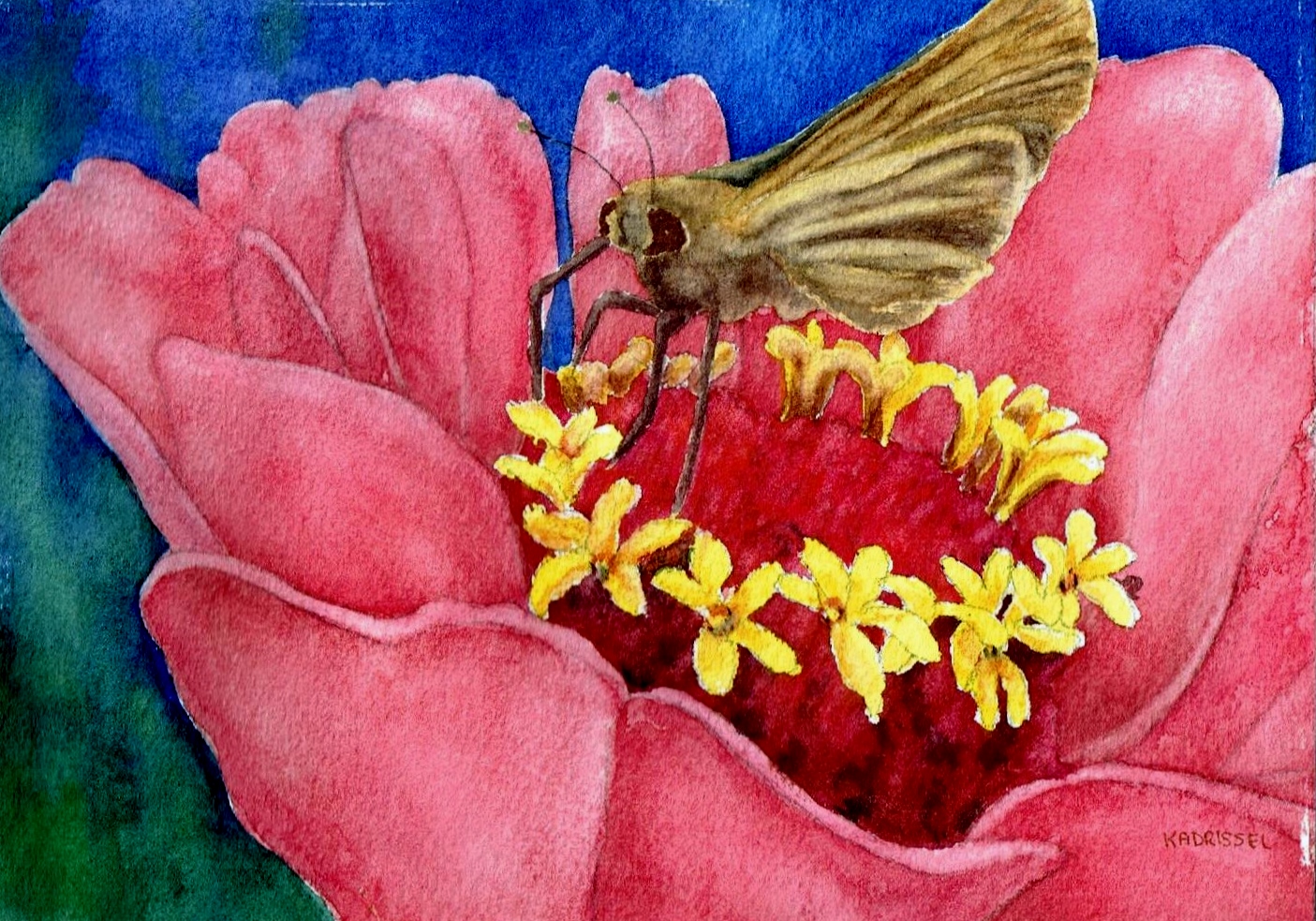
Here’s a closer look at the yellow “fairy ring” of zinnia disc flowers, this time hosting a Skipper butterfly.

I loved this photograph so much I used it as a reference for a 5 x 7 watercolor, and posted the finished results on this blog: Skipper on a Zinnia

Another visitor to the zinnias is a bumblebee in a fuzzy yellow jacket. Gorgeous insects all!
This post is definitely a tad out of season, but perhaps you are like me, and at the threshold of winter enjoy being reminded that Spring is only three months away.

We live within the shadow of the Almighty, sheltered by the God who is above all gods.” Psalms 91:1

Recharging…Resting…Rejuvenating… In the meantime, I’m re-blogging some of my best garden posts. Happy Spring!
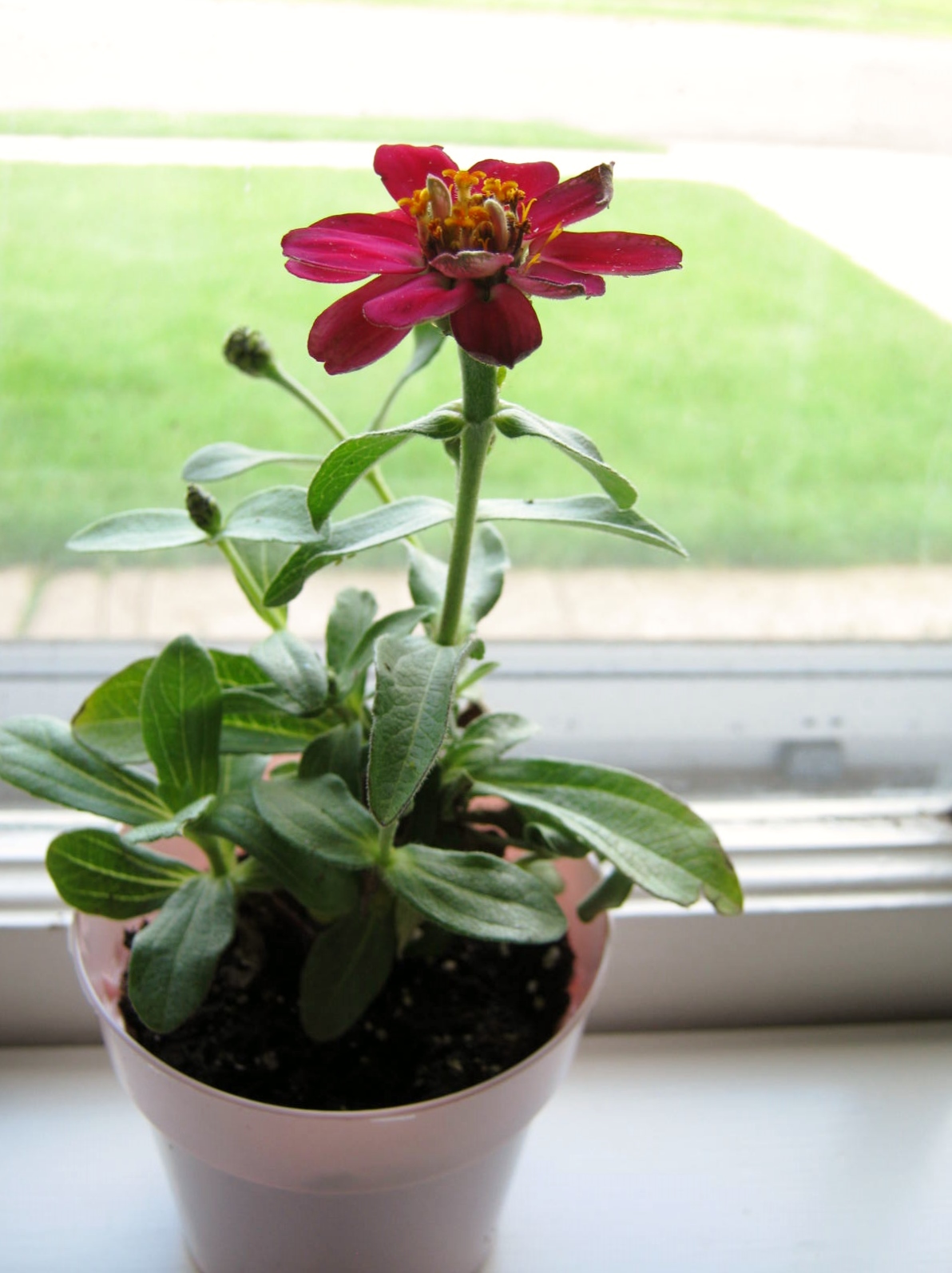
Last Saturday night my husband went to the races. In honor of Mother’s Day the racetrack, and a local garden center, provided a zinnia plant for the mothers present at the race, and for those who stayed home. I was delighted when I found this extra small flower pot on my kitchen table.
I adore zinnias. I think it is genetic. My maternal great-grandmother grew a large bed of zinnias in the summertime. I am named for her, so perhaps, a little extra of who she was lives on in me.
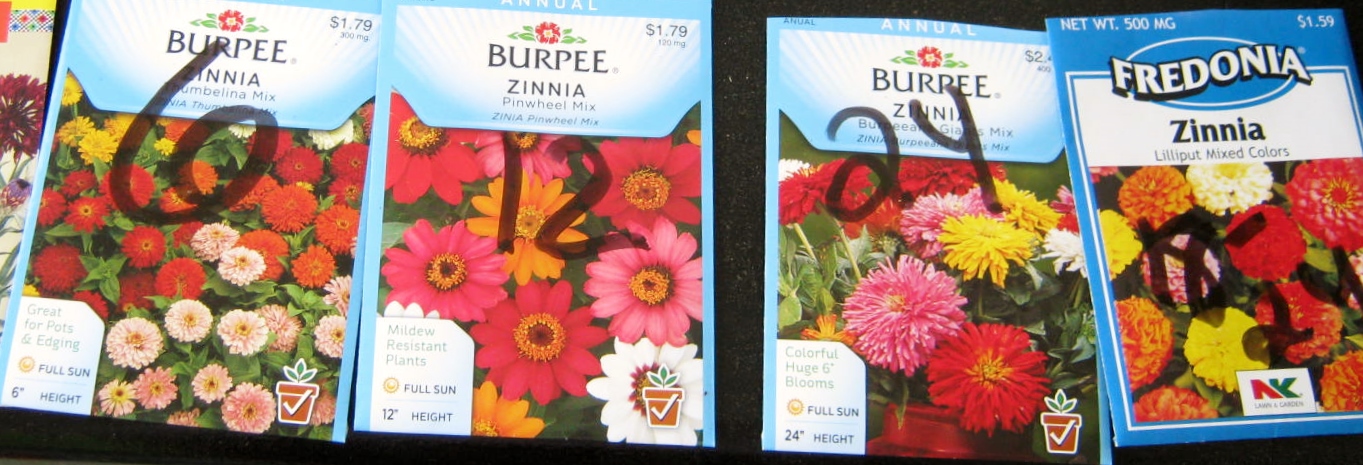
I recently found quite a few zinnia seed packets on sale. I had already planted the larger varieties, 36 inches and taller, throughout my garden. Still, I could not resist the smaller sizes. I bought four packets, and I am full of purpose to place a few in every bare spot I might find in my garden. I am also planning on growing a dozen or so in pots so that when I have the invariable bedding plant catastrophe, I will have a few replacement plants on hand.
Zinnias are a favorite of mine to watercolor.
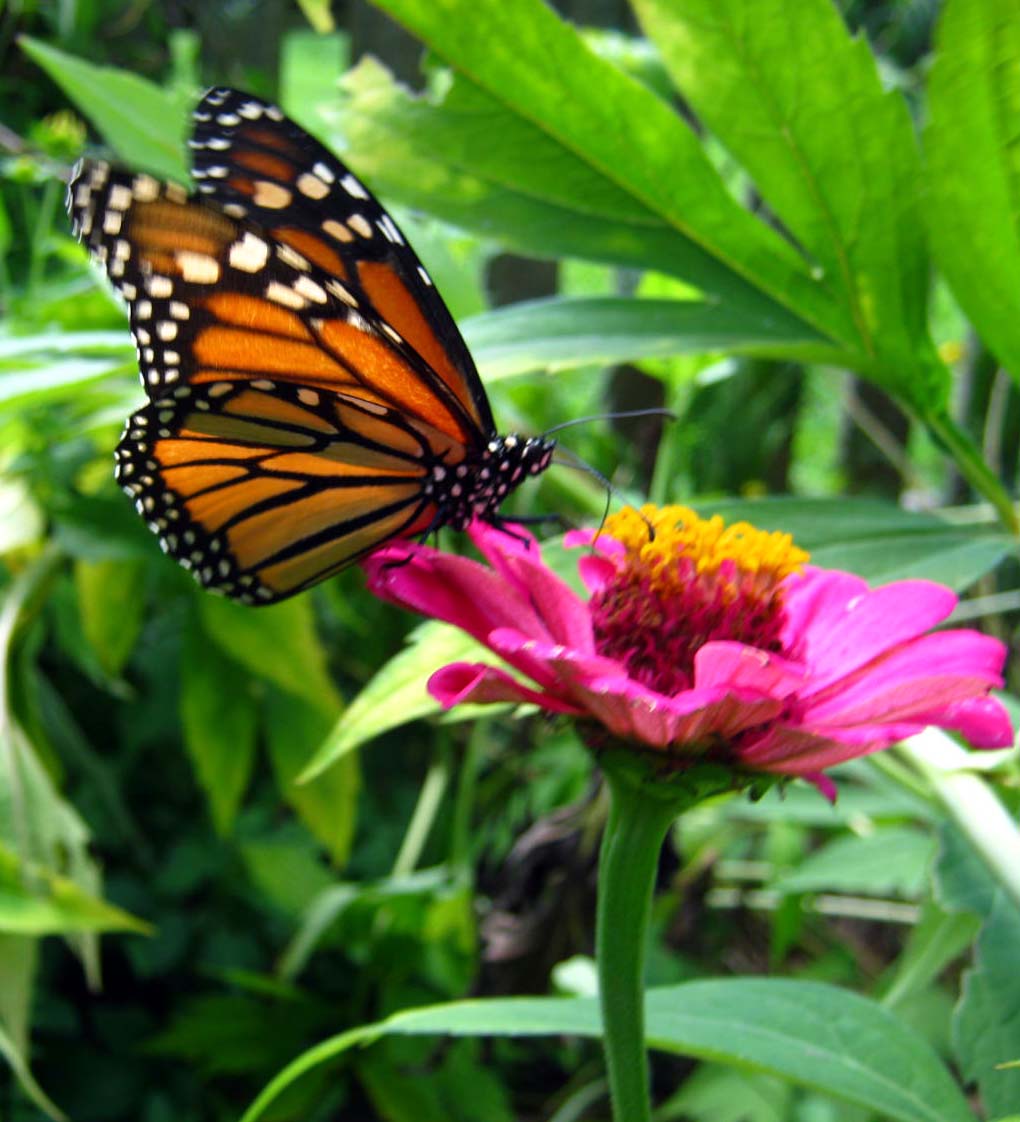
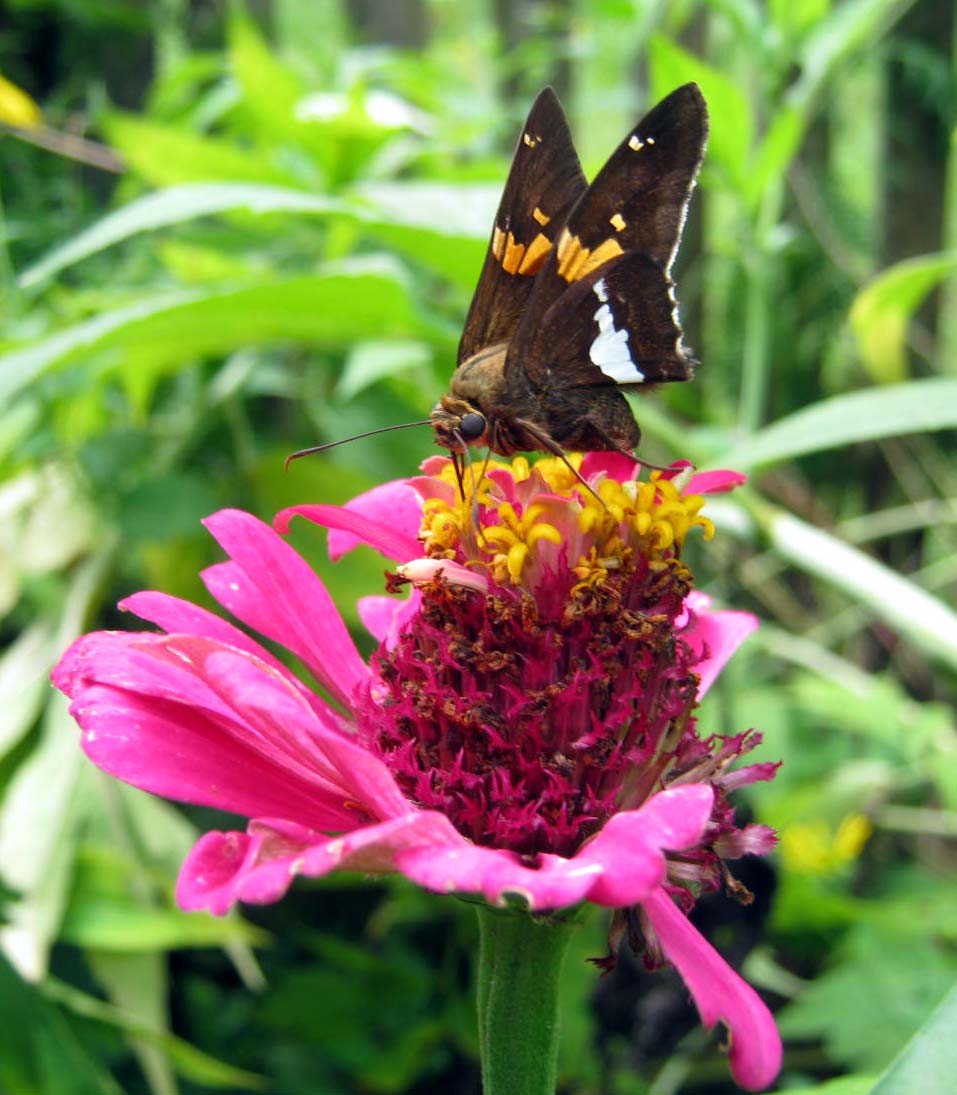
I love the second ring of yellow flowers lying deep within the larger petals. These small yellow flowers are where the nectar hides. Hummingbirds and butterflies will visit your yard daily, more than once, to sup on this treat. Here are a few of my zinnia reference photographs with some of their visitors. All artists and crafters are welcome to use any of my reference photographs for inspiration. Happy Painting!


“…May all who search for you
be filled with joy and gladness in you.
May those who love your salvation
repeatedly shout, “God is great!”
Psalm 70:4


 Last year I wrote about a plant I loved by the name of Verbena bonariensis. Well, this year I love the plant and its flowers even more! The plant self-seeded and now I have dozens of this tall and beautiful perennial adorning my mid-summer garden. The flowers draw honeybees, bumblebees and butterflies.

I get a lift each time I walk by and see the blossoms swaying in the breeze or playing host to a hungry bee or butterfly.

 Some great information about verbena bonariensis can be found here: Verbena bonariensis


My husband and I have just returned from our yearly vacation to Block Island. Block Island is a gorgeous island off the coast of Rhode Island. This beautiful butterfly was photographed outside of the cottage we rented on the island. You can find more information on “The Cottage” and “The Upstairs,” at this link: The Upstairs at Block Island. We love this spot on the island, secluded, yet the center of town is only an easy walk or bike ride away.

This butterfly bush on the property kept me fascinated. Each time I passed by I found a beautiful winged creature to admire and photograph.

This gorgeous hummingbird moth visited the butterfly bush every day. What an amazing sight, imagine my delight when I spied two of these beauties on the same bush. Here’s a bit of information about Hummingbird Moths: Hummingbird Moths

Sweet little skipper butterflies also stopped by the bush.

Although their season is almost over, the wild roses are still putting on quite a show. This one was photographed beside “The Cottage” where we stayed the week.


The Academy of Natural Sciences in Philadelphia is a nice outing for all ages. My favorite exhibit is the Butterfly Room. You can find more information here: Butterfly Room at Academy of Natural Sciences
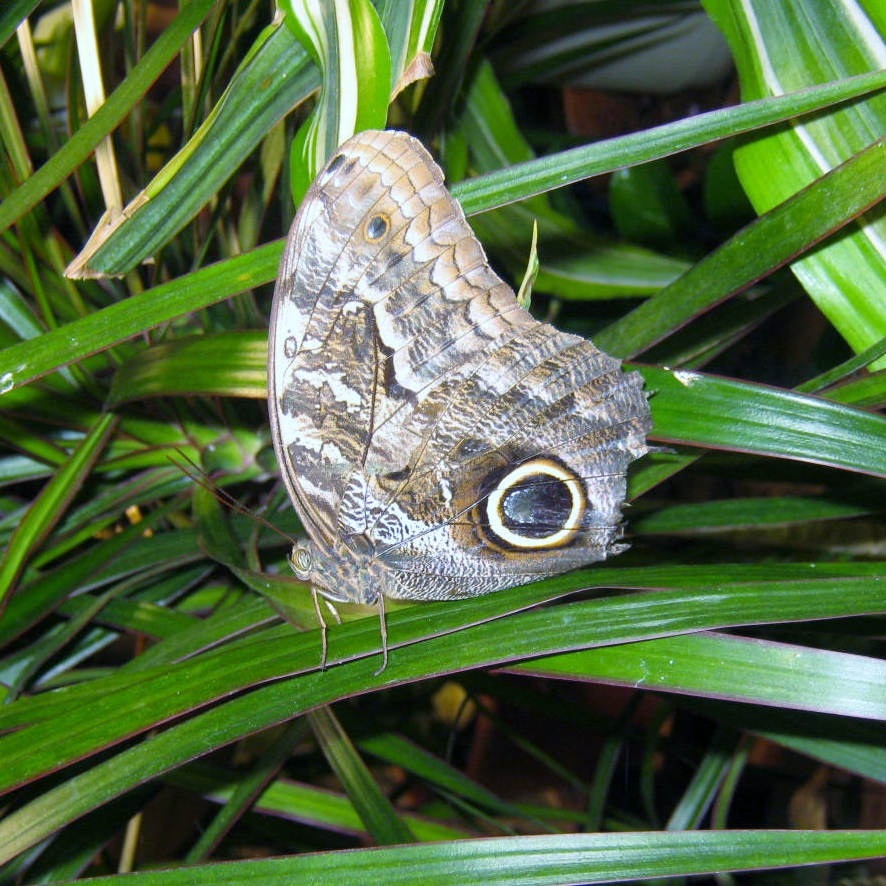
I was fascinated by the cocoon hatching area.

The butterflies are attracted to the yellow walls of the room.

Maybe the butterfly in me is why I am attracted to yellow walls. SMILE!

I’m not sure I can sufficiently explain the idea behind this haunting video, but it seems appropriate to post it now with what is going on in the Middle East. Children are still dying. Wars are still being fought with possible horrific consequences for us all? Does anyone know the answer? Although this video and the butterflies were made in 2010, the purpose behind the project will never end. We should never forget what happened in the Holocaust, we should guard against it happening again.
Here is the link to the author of this video’s blog post: The Butterfly Mandate


