In spring, my garden is a blank slate as the daffodils push above the soil’s surface, where they have slept away in the summer, winter, and autumn. It’s never unexpected, but always still amazing when August displays a thick jungle of flowers in the place where blooming began sparsely in March.
I haven’t taken part in the Lens-Artist Challenge for quite a while. I was drawn in by the title of the challenge. I am a bit late, but still happy to take part in Challenge #311.
Today as I was photographing the flowers I was surrounded by Black Swallowtails sipping from the Butterfly Bush and other flowers in the yard. I decided, since they use my fennel as host plants, and I help them out by raising them in butterfly houses on the porch, they too are growing in my garden.
The antidote to the windy weather of yesterday was to take a morning walk around the yard and gather Spring flowers for IAVOM.
I have placed a few of the flowers blooming in my garden inside the vase. The inner petals of the tulip are gorgeous. What a sanctuary for a bee! If I were small and had wings, I would dive in after the pollen and buzz in delight. There is nothing ho-hum about these beautiful colors and forms.
Other flowers in the vase are Iris, Bleeding Heart, and Vinca.
I keep hearing the children’s chorus, This Little Light of Mine, as I gaze at the bright area around the tulip’s stigma and anthers.
Yesterday, I was able to text my son a photo of this beautiful puff of salmon. I told him it was a cutting grown from a Geranium he gave me on Mother’s Day two years ago. Plants given as gifts are especially dear to me.
Before frost arrived last year, I dipped a cutting of the geranium in honey and placed it in loose soil with a Ziplock bag over the plant to keep it humid. Not every cutting works, so I usually grow three for every plant I want to save.
I also tried bagging/boxing up a few bare-root geraniums, and the photo shows what I found just an hour ago when I opened the bag. I will continue to grow cuttings and, in the future, leave bare root storage to the experts.
I have some lavender plants on a windowsill near my desk. I love to stop what I am doing and brush them with my hands. The lovely, fresh scent of lavender fills the air and gives me a boost of energy amid mid-winter doldrums.
You can imagine my outcry when, out of the corner of my eye, I spotted movement on my lavender—spider mites. The tiny pests were fearless and having a marvelous time, creating webbing, feasting on the juices, and multiplying by the minute.
Running the plant under a heavy stream of water is always my first course of action. The spider mites are small and are quickly swept away by the deluge. So far, my initial treatment is working, and I’ve only seen one or two stray mites.
One of the problems with diagnosing spider mites on a houseplant is their size. The webbing and drying leaves are a clue to an infestation. Sometimes, as in my case, you can see them moving along their webs. To be sure I was aware of all the infested spots, I sprayed the lavender with water before washing the mites away. The side-by-side photo shows how much easier it is to see an infestation after spraying.
Unfortunately, I must be realistic; removing every spider mite from the lavender will most likely take several sessions under the faucet. This pest spreads quickly in the dry air of a heated house. I will check all my houseplants for infestation with water sprays throughout the week.
The beautiful moss spores are my choice for The Cosmic Photo Challenge/What’s Flowering Where You Are? Before the recent snowstorm, I grabbed my camera and took a woodland walk. I was amazed at the vivid green of the mosses and lichens. In places where the sun shone through the branches, I noticed some of the mosses had already sent up spore capsules. I’m going to stretch and say these are a type of bloom.
If I had to rate these moss spores for beauty between 1-10, they would receive a 10+ from me.
Skunk cabbage has also emerged in the dead of winter. Here are some of the ‘knobs’ before the snow covered them. I read an amazing fact on the PFEIFFER NATURE CENTER site: some skunk cabbage plants can be over 100 years old. Wow, I will feel a bit more awe over them when I take my next woods walk.
Next time when I become a bit winter-worn and weary over the cold weather, I’ll remind myself of those skunk cabbages never giving up.
As always, lichen on fallen branches are a welcome touch of green.
Whatsoever is Lovely? Definitely the small and delicate bits of green I found in the woods. I wish I could have a large garden plot filled with mosses and lichens in the winter.
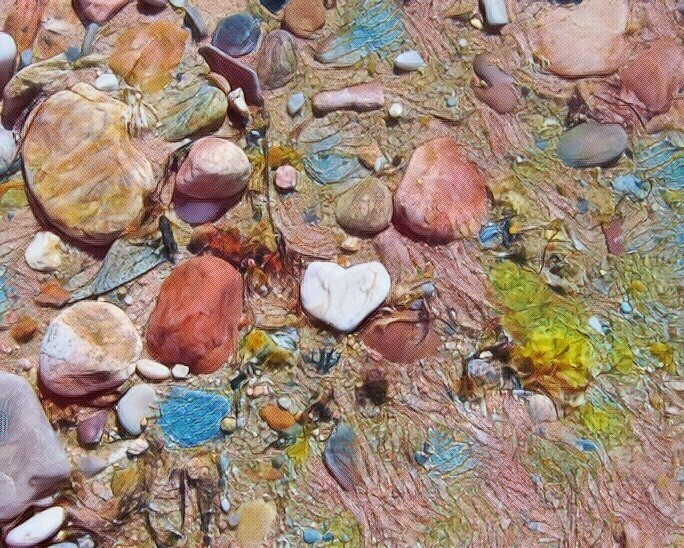
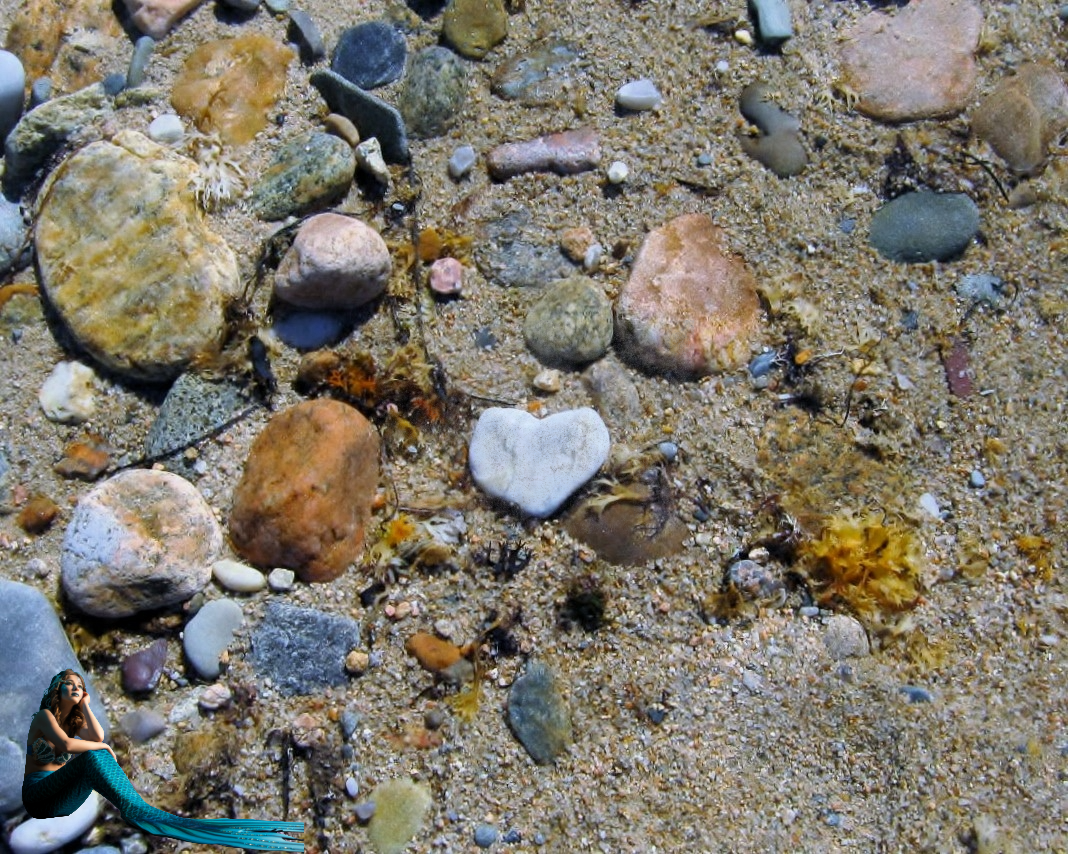
Judy Dykstra Brown’s Blog offers a unique new challenge. The basis of the challenge is to search your photos with a number and create a blog post with them. This week the number is 126. Post a selection of photos on your blog and link back to her blog. Fun! I thought I would have more, but these are the three photos that had 126/26.
This is my first time taking part in this challenge. I will definitely try again. Why not take part too? What a good moment it was when a photo of my grandparents showed up in my search.
The two beachy scenes are Block Island, Rhode Island. I love the way visitors and islanders alike build rock cairns on the slopes and sand.
I was surprised I didn’t have more photos in the search, but then again, sometimes I relabel the numbers. If you do this also, Judy Dykstra Brown has a way for you to take part, choose a word instead.
Like the Steinbeck quote below, my photos seem to multiply while I sleep. Most of mine are on CD discs for storage.
Ideas are like rabbits. You get a couple and learn to handle them, and pretty soon you have a dozen.
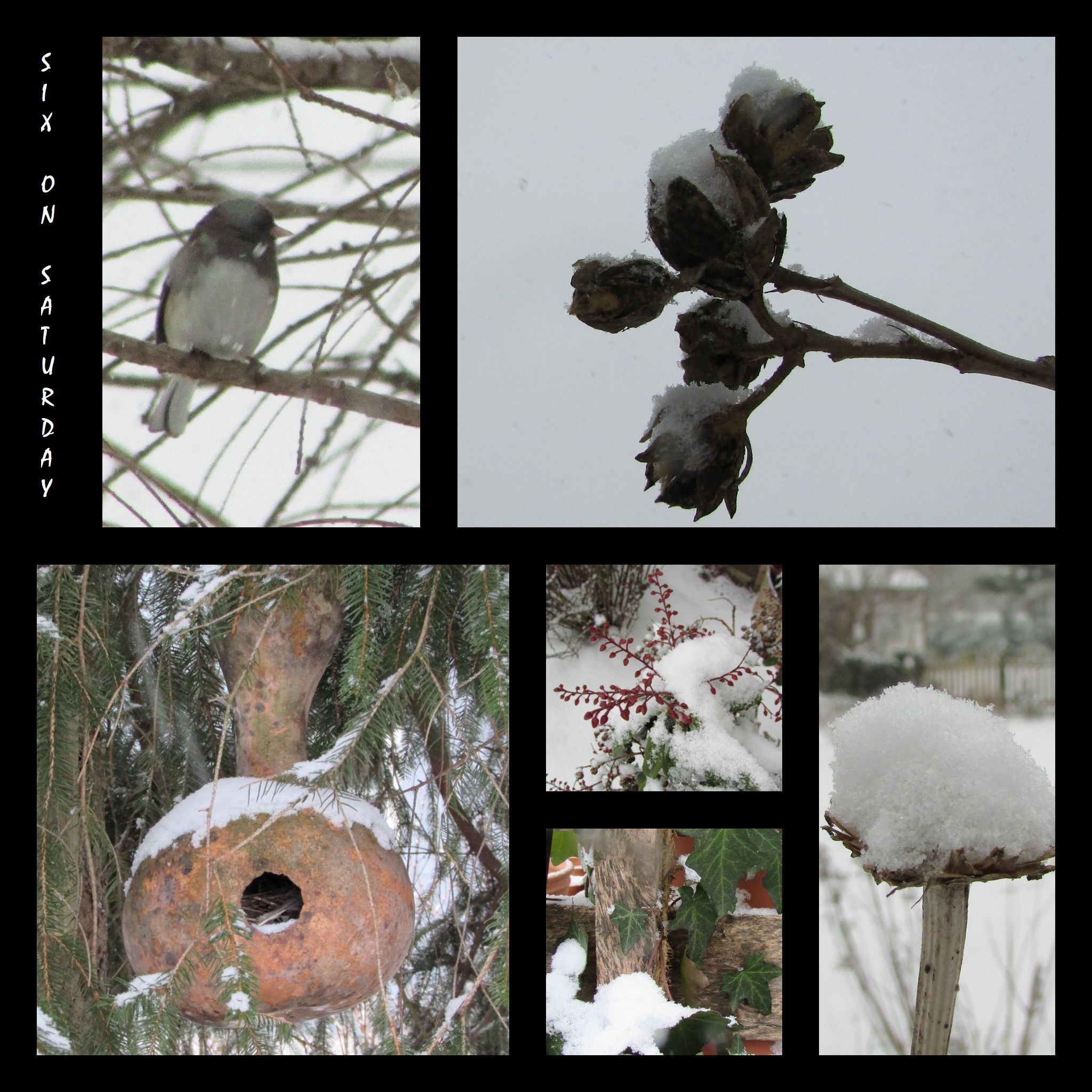
My area of Southern New Jersey went over 700 days without accumulating snowfall. Yesterday, we had a beautiful snowstorm throughout the day. What a lovely sense of peace the quiet flakes instill into the atmosphere. Early in the morning, I couldn’t resist grabbing my camera and taking photos as I fed the birds.
A Junco, one of a large flock that visits my yard, seemed to wait patiently for me to scatter birdseed.
The Rose of Sharon pods were the perfect resting place for snowflakes. Looking closely, you can see a few of the sharp points of individual flakes.
The gourd birdhouse, crafted several years ago, looked lovely with a coating of snow.
The Japonica, colorful with new growth, wore a blanket of snowflakes.
English Ivy, indestructible, seemed impervious to the cold.
A stem of a zinnia, left in place as cover for birds, held a mound of crystal snowflakes…beautiful.
The flying pig who holds court over the sideyard couldn’t escape the snowfall. A natural monochromatic setting with the grey sky behind him and the bird bath pedestal beneath him seems a good choice for Skywatch Friday.
I love this quote from my Farmer’s Almanac Daily Calendar:
When oak trees bend with snow in January, good crops may be expected.
Gathering in the green is one way to crawl out of the brain sludge of dreary winter weather. By green, I mean plants, green dreams of gardens to come, and green thoughts of using what is usually thrown away.
Quite a few pieces of ginger you buy in the supermarket are sprayed with a sprouting inhibitor. I recently found, in Produce Junction, a large ginger rhizome with swollen joints. They looked like they wanted to grow. Of course, to me, the sight of that ginger was irresistible. I let it lay undisturbed in my basement, and the swelling grew larger.
Yesterday, I planted it in a large 10″ pot. I hope to see sprouting above the soil’s surface in just a few weeks. I will update on the progress.
Planting indoors in such a large pot might have created havoc with dirt and debris everywhere, but I recently read an excellent tip in Martha Stewart’s Very Good Things: use an under-the-bed storage bin for planting indoors. This tip worked great for me. So much easier to close the lid when I was through and roll it under my plant table until needed again.
The online Farmer’s Almanac has an in-depth article on growing ginger from supermarket rhizomes.
I don’t have much growing in the garden, but my IAVOM arrangement for the first day of 2024 contains the few flowers and pieces of foliage still blooming.
Contained in the vase is a Bidens blossom. This tiny flower is about the size of a quarter. It is inconspicuous in the garden border during the summer, overtaken by plants that grow exuberantly. After these plants die back in the cold temperatures, the Bidens thrive for several months. The Spruce has a great article on how to grow Bidens perennials in the garden.
One pansy was blooming brilliantly in a terracotta pot in the backyard. Hurrah! It is bedraggled in a few places, but on the whole, it is still lovely and perfect for Cee’s Flower of the Day.
Dandelions are within the vase but opened after I took the photograph. There will be more to come on dandelions tomorrow. I love the spent seedhead. It’s done its job, and the umbrella-like pappus dispersed all the seeds into the air.
Fennel is still filling the garden beds in various heights and sizes. When I picked a few sprigs for the vase I momentarily smelled that distinctive licorice fragrance the foliage puts out. This wonderful herb is one of my major host plants for butterflies. I imagine many Black Swallowtail caterpillars on the fennel come to Spring when I daydream about my 2024 gardens.
Lastly, I picked a few pieces of Butterfly Bush foliage, still glowing blue-green in the grip of winter weather, and used those leaves as a base for the flowers.
Here is a timely ‘playback’ post from 2016. If your Christmas timetable is beginning to crash, and you would like to create a personalized gift quickly, here is an easy way to transfer lettering of all sizes.
Creating this simple ‘PEACE ON EARTH’ plaque was easy and inexpensive. A scrap piece of wood would work just as well as a purchased plaque. I used FolkArt artist pigments for the best possible coverage. Because I wanted the wood to look rustic I only gave it one coat of Napthol Crimson.
The Napthol Crimson alone was a little brighter than I expected; I used Liquitex Transparent Burnt Umber Ink to antique the plaque. It worked perfectly. Quick Tip: Utilize a disposable brush to apply the ink, wipe off quickly to remove the majority of the color.
I chose a font and printed out letters in the size I desired for the plaque. I was lucky; you can see I almost ran out of ink. To transfer these letters to the plaque, I colored a piece of children’s sidewalk chalk over the back of the printed sheet.
Taped onto the front of the plaque with painter’s tape, I could trace around the edges of these letters with a ballpoint pen and transfer the chalk to the plaque. The outline is easy to see, yet any residue left behind after painting can wiped away when the paint is dry.
I used gold acrylic paint to fill in the letters. A swipe of black paint along the right sides gave the letters a shadowy dimension.
PEACE ON EARTH TO ALL MY BLOGGING FRIENDS! A BLESSED DECEMBER TO YOU.
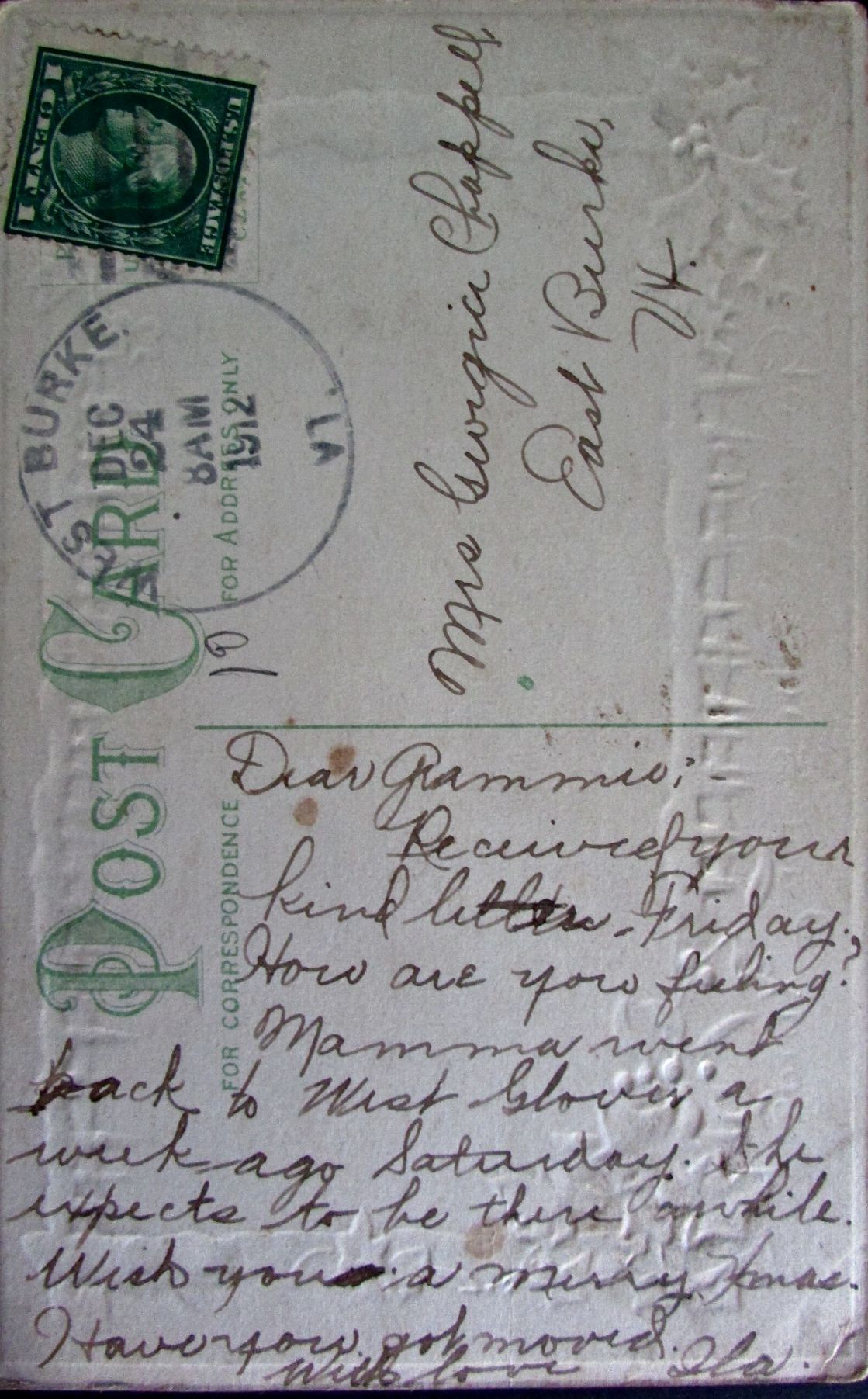
I enjoy finding ways to display my vintage postcards. I searched my file box and found over a dozen Christmas or New Year’s themes. The artwork on the postcards is often exceptional. However, they range in age from 100 – 120 years old and must be protected from too much exposure to light.
I used some cardstock I had on hand and cut it to 4.5 x 6.5 inches, giving me a half-inch border around each postcard. Glue and tape are definitely banned from attaching the postcards to a display. Instead, I used a paper trimmer and made small slits near the corners. I then gently inserted each postcard in two of the slits, creating a double-sided display for two postcards on one piece of cardstock.
A piece of twine attached through small holes is enough to keep such a featherlight piece of vintage art in place.
I’ll leave the display out for about two weeks, then place them in their file and back in the dark closet. It’s fun to take them out now and then read the old-fashioned, cramped messages. I enjoy daydreaming about the people who wrote them and imagine what course their lives might have taken.
Sometimes, much like today, I need to focus momentarily on something simple and beautiful, and set aside every nuance that might darken my day. Ralph Waldo Emerson’s quote, this flower, both do me good during a day of running around, cleaning, and cooking. God bless you all on Thanksgiving Eve.
The roses are a mirage of my memory now. Photographed a few years ago in the Longwood Conservatory, the rose hall has been torn down and is being replaced by a new, more modern structure. I will miss walking alongside the beautiful bushes, and hope rebuilding will not be a protracted project.
I still have a few plants blooming despite cooler temperatures. Gone is the cumbersome task of daily weeding, and left to me is a rebirth of the hardier blooms to cut and arrange. Here is a sampling of a few blossoms I thought were a good representation of Autumn colors. They are perfect for the In A Vase on Monday challenge.
My hyacinth bulb vase holds some coleus leaves, Knockout rosebuds in Coral, and sprigs of Agastache Poquito Orange. (After checking 2023 seed orders, I realized this plant is not Poquito Orange, but a apricot variety from the Fragrant Delight Mix of Agastache Seeds available from Baker Creek Heirloom Seeds.)
I love the Agastache I grew from seeds, sown indoors in late Winter. They are a beautiful shade; the blossoms are the size of a dime. Even the buds are attractive as they elongate and open. The flowers, growing in pots, never stopped their showy display from late Spring through Autumn. The photograph of my Agastache was taken yesterday.
The plants thrived in medium-sized pots in combination with other hummingbird plants. There is evidence of a few small nibbles of insects, but the plant is basically ignored by most pests. Perhaps it is not any wisdom or luck on my part they are uninfested, but due to the fact that they are in potting soil instead of the garden beds. They are small, about 10 inches tops, and they have a graceful drape to their stems, making them perfect to place around the edges of planters and hanging baskets. Will I grow these again? Oh yes!
I’m not ready to vegetate yet where the garden or Word Press challenges are concerned. I enjoyed including several challenges in today’s post. Thanks to all the hosts of these wonderful prompts to help me keep thinking and looking ahead. The Agastache flowers are part of Cee’s Flower of the Day and all my beautiful blooms are an entry in City Sonnet’s Colors and Letters Challenge – Letter F = Flowers.
There are loves throughout my life that have been questionable: people, habits, places, some friends. But my love of nature and the pollen-gathering creatures God has made is not a choice I feel will diminish or ever be deemed debatable. I don’t remember the exact moment in time I took this photo, but when I came across it today, it immediately brought back the spring/summer rush I feel when I grab my camera and run straight for the garden bed and insects gathered there.
The hum of bees is the voice of the garden. Elizabeth Lawrence
There is nothing motley about the pollen sprinkled across the bumblebees, in fact it seems ethereal, dusting the bumblebee’s fur/pile with magic.
Bumblebees have round bodies covered in soft hair called ‘pile’, making them appear and feel fuzzy.
Nature – Check out this article for amazing facts about bumblebees!
The sweet bumbler hangs on and collects pollen from lavender bee balm (Monarda fistulosa), a dependable perennial in my summer garden. Bee Balm blossoms are my Flower of the Day.
At least 65 years plus in age, my birdbath still holds water for my backyard birds. It mimics the full moon that has been gracing February’s cold night skies. It first belonged to my maternal grandmother. I remember being nose-high to its edge, peering over the rim at the silvery reflections. It resembles a crystal ball. Strange, I am considered a reasonable person, but I have no desire to know the future, near or far. I gaze into it to remember the joys of the past.
There is nothing fancy about the Sea Grape. I love the plant/bush because it reminds me of the first time I vacationed in Jamaica. We traveled there with my son and daughter-in-law, her parents and sister, and it was there we first heard the news that a new grandchild was on the way. Sea Grapes bordered the walkways of the Runaway Bay Club Caribbean. They grow wild all over the island nation. I fell in love with them at first sight. Thick leaves, with red veins intersecting the two halves; I began to dream of how to grow one at home. Unfortunately, transporting seeds/plants from one country to another is prohibited. I was out of luck. Eventually, I did order some seeds online from Florida, but they never sprouted.
Flash forward to Sanibel Island, Autumn 2021. I once again found several sea beans on the beach. I soaked them, planted several, and a few grew for me. Oh, Happy Day, it turned out one of those sprouts was a Sea Grape.
Sea Bean – Drift seed, a seed of any of a number of tropical plants growing in coastal areas, the seeds of which are found floating upon ocean currents, by means of which the seeds are dispersed.
The Sea Grape has thrived, although it grows slowly. The newest leaf it developed is the largest so far. Sitting beside the plant is a teacup of shells also found on the Sanibel Island beaches. We were horrified by the hurricane that slammed into this area in October 2022. We keep track of the progress being made in rebuilding, and we will certainly visit again and support the community as soon as possible.
I subscribe to this wonderful shell seekers YouTube channel. This video shows both South West Florida beachcombing, and some of the devastation on Fort Myers Beach. If you miss summertime, and are in a state of winter-induced torpor, this video is a good way to dream of warmer days.
The woods that border my neighborhood is a cherished retreat for me in all seasons. Of course, today’s first frosting of snowfall prompted me to grab my camera and head outdoors. I managed to zoom in and get a close-up for Cee’s Midweek Madness Challenge.
On the path before me a robin rustled among the leaves for insects. As I captured his image, I realized the woods was alive with a large flock of robins.
The robins are drawn to our woods by the native holly trees growing tall beneath the canopy of larger oaks, tulip trees, and sweetgums. I stood for quite a while, taking photos, an easier task than usual as there were dozens of birds all around. I stayed in one spot, and they soon perceived I was no threat. One few so close overhead, I was sure his wing must have grazed me as he swooped by.
It was a curious morning; the wintry frosting of snow belied the springtime sparkle of the sun. Half of the surrounding view shouted, ‘Spring,’ but the cold air and flurries adorning the foliage sagely disagreed and whispered, ‘Winter.” I felt myself in a natural sanctuary, blessed by the song of the birds, the brilliance of the sun. The atmosphere around me was aglow with one of my favorite colors, a light-infused ethereal green. I added my voice to the praise and thanksgiving, “Thank you Lord, this is one of my best days.”
A few of the friendly flock of robins. Amazing to see so many on the first day of February, 2023.
Though my orientation hadn’t changed, my feet exactly on the same stretch of ground from where I photographed the robins, I somehow captured the image of a new bird with my lens. This photo is part of Skywatch.
The Longwood Gardens Conservatory boasts a gorgeous display of orchids. Not only can you view hundreds of varieties, you can also gaze out upon the ongoing construction of Longwood Reimagined in the Orchid room. There are many signs on the grounds, and articles available on the web, that apprise visitors of the future gardens and buildings. It’s quite exciting to imagine myself walking in these structures in the future.
While the sun glare, magnified through the window, can make it difficult to take a larger photo, a close-up of these beautiful blooms in the orchid room is enhanced by the back-lighting.
There is no one dominant species of orchid in the display, but I am always drawn to the faces of the Paphiopedilums. Just like pansy blossoms, they seem to have a perky personality.
This lovely orchid almost seems artificial. The inner recesses of the labellum are sunrose yellow, the January 30th color for City Sonnet’s January Colors and Letters.
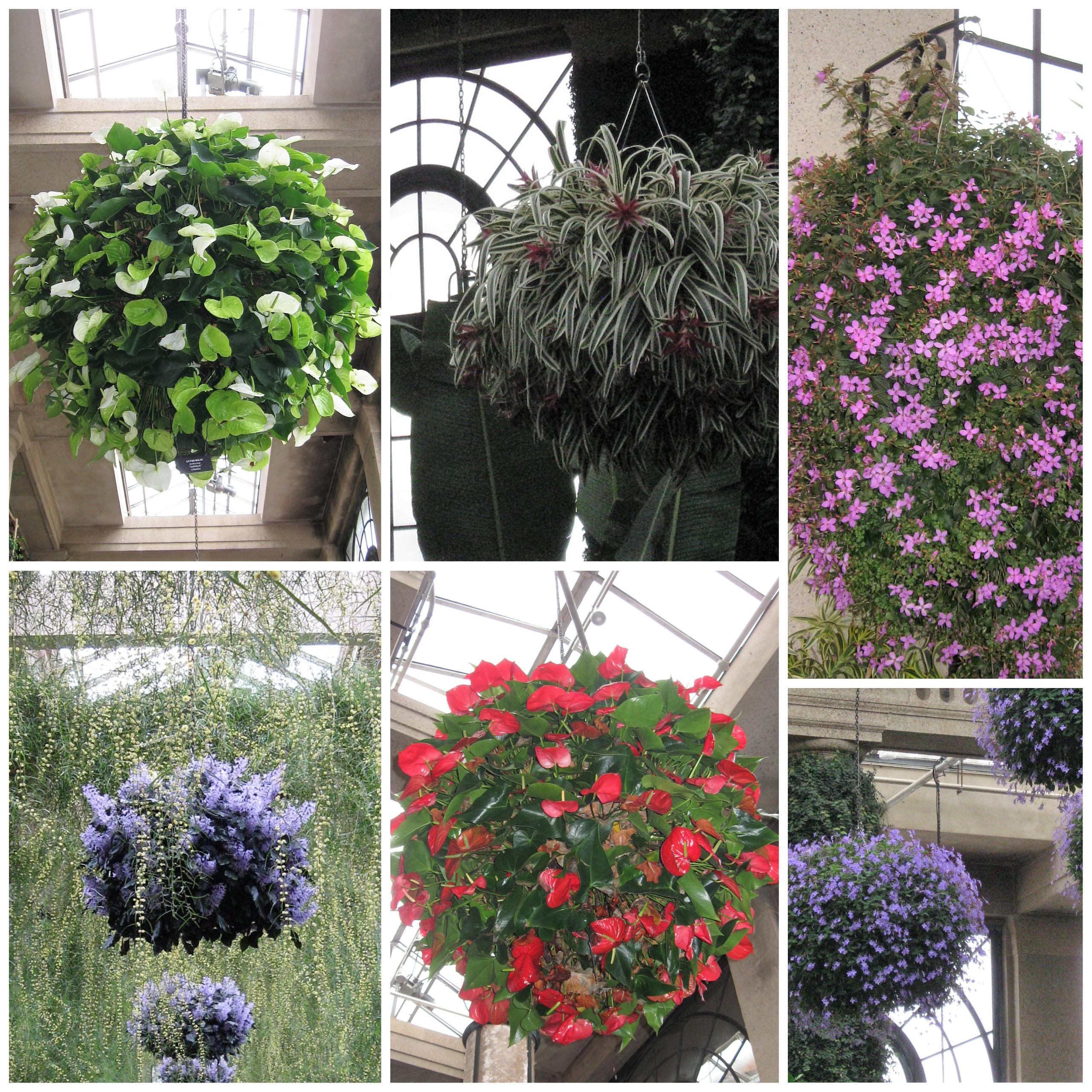
Here’s a sampling of the hanging baskets in the Longwood Gardens Conservatory yesterday. It’s hard to capture the size/scale of the flower baskets. To say they are large is an understatement.
Some of the plants are: Cape-primrose (Streptocarpus), Anthuriums, Cinnamon-Wattle Acacia, Bromeliads.
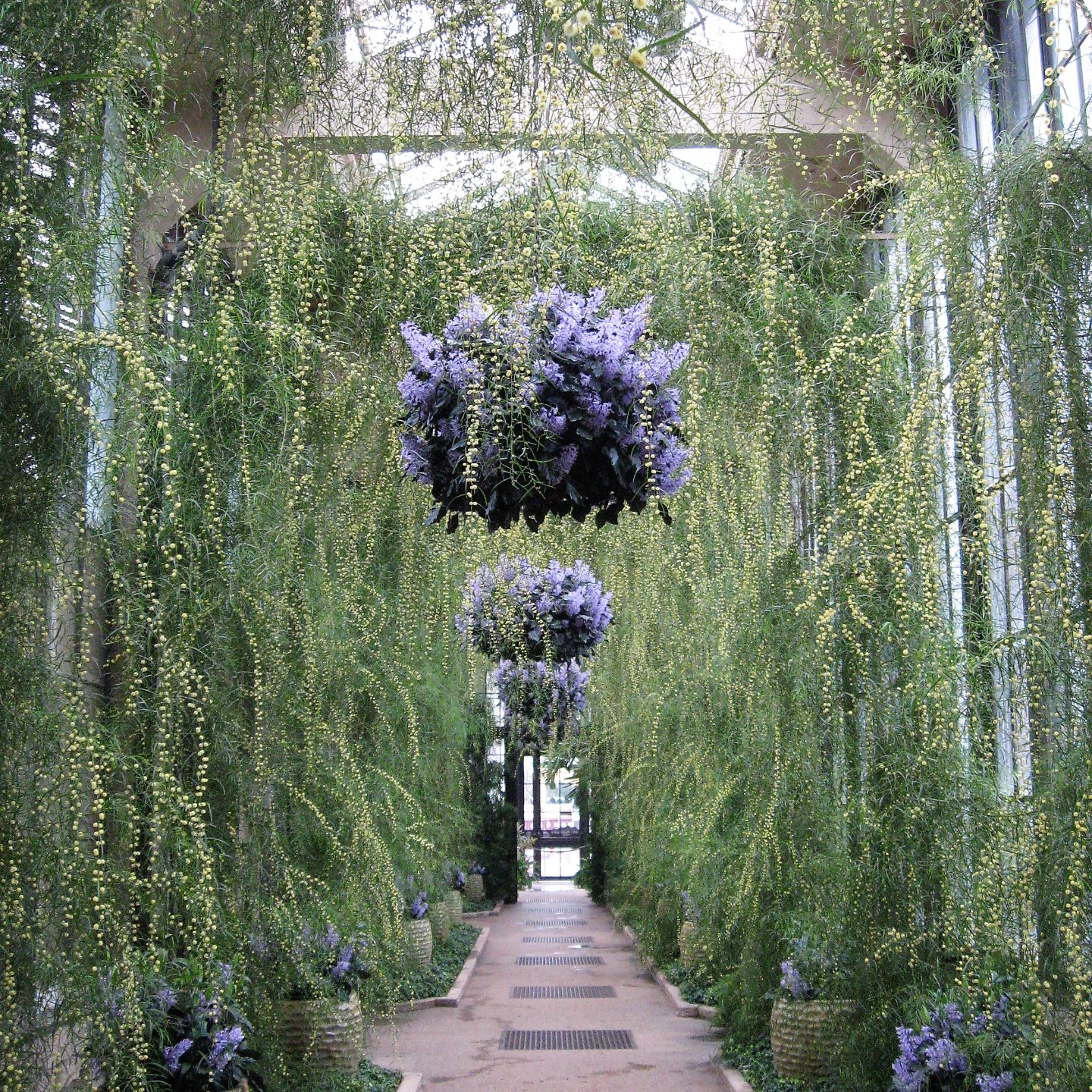
My favorite walk was along the acacia passage. The Cinnamon-Wattle acacias were in bloom. The fragrance was incredible. There was definitely a feeling of enchantment present as we gazed down the corridor. Periwinkle is one of my favorite colors, and the combination of the streptocarpus with the soft yellow of the acacia was stunning. The streptocarpus are part of Cee’s Flower of the Day.
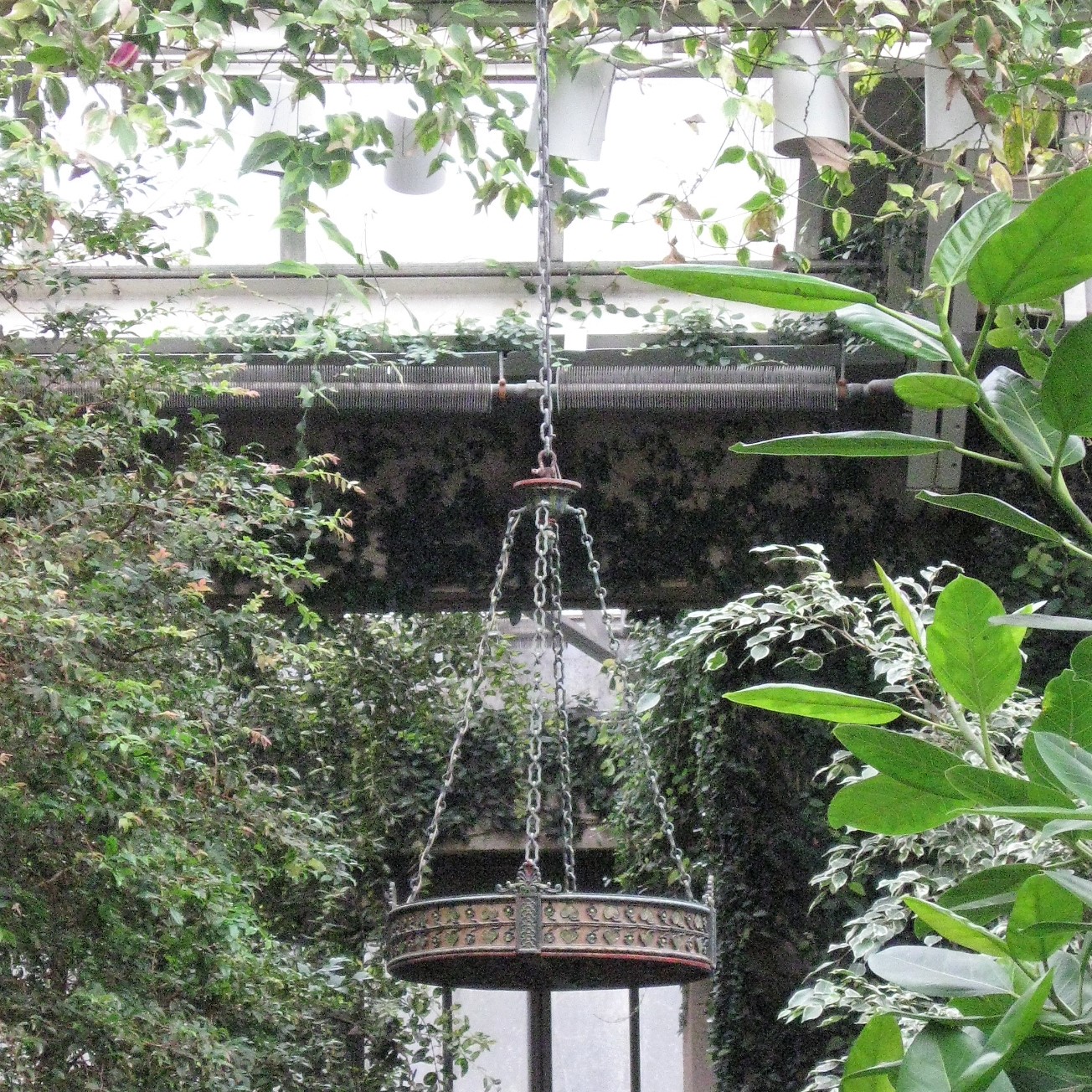
I also had some moments of inspiration. I don’t know if this is a hanging basket of some type for displaying flowers, a light fixture, or something totally unique to my imagination. I am determined to create better hanging basket arrangements this year for the porch and outdoors and this will be my artistic muse for the project.
As we walked within the walls the soft winter sun outdoors illuminated everything inside with a glow of Royal Silver. I wish I could somehow capture and copy the indescribable atmosphere in a watercolor painting.
Here’s a silly self-portrait of us in the conservatory; a visual description of our joy. It’s a little distorted, the mirror had a funhouse quality, but it still captured our happiness in being in a place filled with flowers and fragrance.
I love the soft pink of these dime-sized blooms on my Crown of Thorns, the color almost a copy of cotton candy. The plant lives outdoors on the screened-in porch for five months of the year. Through the Autumn and Winter it delights me with flowers when everything outdoors is dormant. No coddling needed, the plant is easy to grow and maintain. This beautiful flower is part of Cee’s Flower of the Day.