Gathering in the green is one way to crawl out of the brain sludge of dreary winter weather. By green, I mean plants, green dreams of gardens to come, and green thoughts of using what is usually thrown away.
Quite a few pieces of ginger you buy in the supermarket are sprayed with a sprouting inhibitor. I recently found, in Produce Junction, a large ginger rhizome with swollen joints. They looked like they wanted to grow. Of course, to me, the sight of that ginger was irresistible. I let it lay undisturbed in my basement, and the swelling grew larger.
Yesterday, I planted it in a large 10″ pot. I hope to see sprouting above the soil’s surface in just a few weeks. I will update on the progress.
Planting indoors in such a large pot might have created havoc with dirt and debris everywhere, but I recently read an excellent tip in Martha Stewart’s Very Good Things: use an under-the-bed storage bin for planting indoors. This tip worked great for me. So much easier to close the lid when I was through and roll it under my plant table until needed again.
The online Farmer’s Almanac has an in-depth article on growing ginger from supermarket rhizomes.
A few of the many shades of blue pansies and violas I have grown in my gardens over the years.
Pansy and Johnny-Jump-Up are a variety of seeds I will be sowing this week. It seems early, but I should have sown them four weeks sooner. I don’t follow the recommended dates on the back of the packets. Earlier is always better if I want to have larger-sized plants for the Spring Garden. If my seedlings are pitifully small, I fall victim to the lure of lusher-appearing plants in the local nurseries.
I purchased several interesting varieties from Baker Creek Heirloom Seeds at the end of Autumn, and I can’t wait to see if they are as lovely as the photograph on the package. (Dilemma: I don’t remember the ‘safe’ spot I stored them in.)
The seeds of Pansy and Johnny-Jump-Ups sprout with some bottom warmth and humidity but also have one crucial requirement: they must have total darkness. I will put a plastic tray over the top of my flat and also cover that with a dark, wet washcloth. This will seal out any light rays that might interfere with sprouting.
Organic seed starter and sterile organic potting soil are what I use to start my seeds. The plants develop robustly if I fill the bottom 3/4 of the flats or pots with soil and the top quarter with seed starter. The foliage sits against the quick-draining starter, and the roots reach down into the richer soil. Two types of grow-lights work well for me: overhead and adjustable surround wands. A sunny window provides natural light and is also a good choice.
One variety I loved, purchased from Baker Creek last year, was Laeta Fire, a viola with dime-sized blooms perfect for flower pressing. I have a few seeds left in the packet and will grow them again. You can see how small this flower is in comparison to the normal-sized geranium leaf alongside it. When I persevere in my gardening throughout the winter, the process brings me a sense of peace and renewal.
I enjoyed a quick walk on this second morning in January. The air, crisp with cold, was stimulating, waking me up and opening my eyes to the beauty in the winter landscape. The limbs and twigs of the trees against the chilly sky are God’s sculptures raising their arms toward the heavens. I could almost imagine them beginning to sing.
I searched for dandelion cones with fluff emerging from their tips. I am partial to dandelions; in fact, I have named 2024 my year of the dandelion. I want to be as productive and as resilient as this beautiful plant.
What do I love about dandelions? Perhaps it’s the color and shape. The flower reflects the Sun. I admire the resilience of dandelions. They will bloom wherever they can and grow lushly, even within the cracks of the street and sidewalks. Just today, I photographed this determined plant thriving in the smallest of spaces between the curb and the blacktop. I have read recently that one dandelion plant can produce up to 2,000 seeds. I hope to be as productive as the dandelion and spread as much GOOD NEWS as possible.
Here’s a fun project to do with children. You can string the unopened pods of dandelion seeds onto a piece of thread, and within 24 hours, they change and open up into perfect spheres. It’s so easy, and if you choose the right place, they will reflect the sunshine and glow and bring a touch of magic into the room. The photos below show the process. So much fun!
The candy is light enough not to break the string but heavy enough to give it a bit of weight. I love bringing a touch of whimsy to winter days.
I don’t have much growing in the garden, but my IAVOM arrangement for the first day of 2024 contains the few flowers and pieces of foliage still blooming.
Contained in the vase is a Bidens blossom. This tiny flower is about the size of a quarter. It is inconspicuous in the garden border during the summer, overtaken by plants that grow exuberantly. After these plants die back in the cold temperatures, the Bidens thrive for several months. The Spruce has a great article on how to grow Bidens perennials in the garden.
One pansy was blooming brilliantly in a terracotta pot in the backyard. Hurrah! It is bedraggled in a few places, but on the whole, it is still lovely and perfect for Cee’s Flower of the Day.
Dandelions are within the vase but opened after I took the photograph. There will be more to come on dandelions tomorrow. I love the spent seedhead. It’s done its job, and the umbrella-like pappus dispersed all the seeds into the air.
Fennel is still filling the garden beds in various heights and sizes. When I picked a few sprigs for the vase I momentarily smelled that distinctive licorice fragrance the foliage puts out. This wonderful herb is one of my major host plants for butterflies. I imagine many Black Swallowtail caterpillars on the fennel come to Spring when I daydream about my 2024 gardens.
Lastly, I picked a few pieces of Butterfly Bush foliage, still glowing blue-green in the grip of winter weather, and used those leaves as a base for the flowers.
Did you know that the next full moon happens on January 25th, and it is called The Wolf Moon? As I write this, the current moon phase is a Waning Gibbous, and the moon is 88% full. I learned these things by visiting the Farmer’s Almanac Web Page.
What do you know about pom-poms? Well, a Farmer’s Almanac webpage is devoted to precisely that: information about pom-poms. Wow! I was going to post about the Almanac magazine and calendar I purchased for myself, and now, as a bonus, I have found this amazing webpage; a freebie to throw into the mix, offering you three good ways to keep up with the moon, the weather, and with all kinds of interesting facts.
I will glom onto each calendar page and visit the website every day. Another newbie today is the word glom, courtesy of One Daily Word Prompts challenge word. I didn’t know that to glom is a term from the Scot’s dialect, glaum, which means to grab onto.
Everything Must Belong Somewhere, the Ragtag prompt for today, perfectly describes how my daily calendar will sit by my computer, prompting me to tear off a page daily. Reading this calendar will enlarge (FOWC challenge) my gardening ability and give me a few conversation starters when visiting my friends.
A Postscript: Try a few of the one-word challenges this coming year. They are fun and get your brain cranking.
My IAVOM (In A Vase on Monday) floral arrangement has a definite Christmas theme. Although no flowers are left blooming in my backyard, I have many evergreen trees and bushes to use in vases. The vase in this arrangement is a heavy-bottomed crystal bowl. The weight helps keep the long piece of floral foam/oasis steady. I used an entire piece for this project and trimmed the top corners. to a Christmas tree shape.
The bottom layers are inserted into the oasis with a downward curve, the following few middle layers are inserted straight out, and the top layers of greens are inserted pointed upwards. I added a few purchased roses and some baby’s breath. A friend created the tree with me, and it’s interesting how different our trees were when finished.
One caution if you create a similar tree, place the container in the sink for a few hours. Gravity caused the water in the oasis to drain downward. The result was overflow. I also put a plate under the arrangement; a bowl would have worked too.
Here is the same arrangement in color. Both of my sons wore the shoes around the bottom. The little pink slippers were mine as a baby. They look sweet around the Christmas tree; having them out allows me to cherish the memories again.
The baby shoe display is part of Xingfu Mama’s ‘Whatsoever is Lovely’ challenge. I applaud all who take the time to offer challenges for WordPress bloggers, and a big end-of-the-year thank you to the readers who leave such gracious feedback in my comment section. It is appreciated.
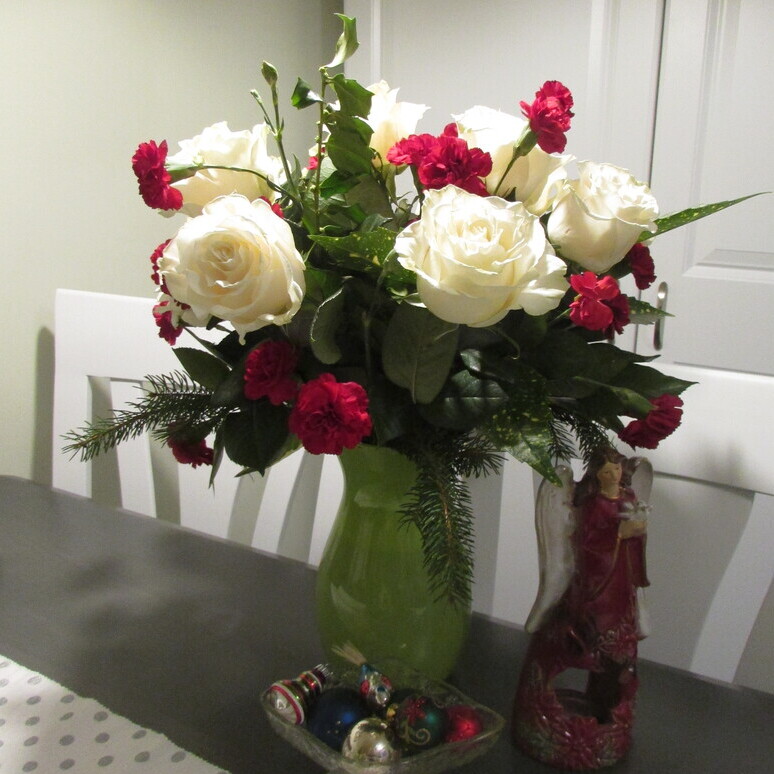
My IAVOM (In A Vase on Monday) this week contains half garden/half purchased flowers. The foliage from my garden is Pine, Holly, and Aucuba leaves. The arrangement is my revolving Christmas table decoration. As the flowers fade, I remove them and add new stems.
The greenery will last for the entire month and even longer if I keep it. The Aucuba stem has rooted for me in the past, but the bush takes years to become full size, and it is easier to purchase a nursery plant if you want to include it in your garden beds. I love Aucuba greens. They are lovely for arranging flowers. The sturdy, long stems are like a grid inside the vase and will help separate your flowers and hold them steady.
A Christmas Angel and an old antique crystal dish holding extra ornaments are alongside the vase. I have many empty vases and bowls filled with baubles in dark areas around the house. They speckle the dark corners in the house with Christmas cheer.
The red mini-carnations are over a week old and still blooming nicely. They have a mild cinnamon fragrance. The white roses were a lucky find, purchased in the supermarket; it is rare to find roses with such a high petal count and without browning for under $10.00.
Flower Arranging Tip: To choose a bunch of roses that will last, gently squeeze the base of the rose where it joins the stem. If it is squishy, it won’t last. If the feel is firm, the roses are fresh. Slightly open Roses will continue to bloom. Flowers that end in a sharp point are unlikely to unfurl. Cut the stems underwater at a diagonal to make roses last even longer in an arrangement. This technique keeps the stem from forming an air bubble and allows the water to flow into the entire stem.
Are you like me? Sometimes, I gift myself with computer programs that enable me to blog more easily, write with better grammar, and listen to my words read back to me. I thought it would be a good idea to share throughout this week, along with some other reposts, the computer apps I use that make life easier and help me move toward completing goals.
Today’s app is Ribbet.com. The program helps me create beautiful photos with some tweaking for fun. I feel like a child again when I decorate my favorite garden photos with this app. The photo above is tweaked with Ribbet.
Here is my original photograph, a summer capture of Verbena blossoms. It’s very pretty on its own, but I love to play around with overlays to take images from normal to showy.
I uploaded the Verbena photograph to Ribbet.com. Square photos work best on my blogs, so I cropped the image first and Auto-fixed the colors. My computer shows content on the left side and a work area on the right.
To read the symbols on the toolbar, hover over them, and you will see the name appear. I used Effects to add a matte border to my photograph. You can strengthen the matte effect by sliding the strength bar to the right. You can use the same effect twice on the photo to create a strong image. There is also a Text symbol that enables me to add words.
I added some Bokeh lights using the Overlay filter. I did the opposite with the lights and diminished their effect so that they would only lightly highlight the photo. At this point, I was satisfied with the image and saved it to my computer.
Sometimes, much like today, I need to focus momentarily on something simple and beautiful, and set aside every nuance that might darken my day. Ralph Waldo Emerson’s quote, this flower, both do me good during a day of running around, cleaning, and cooking. God bless you all on Thanksgiving Eve.
The roses are a mirage of my memory now. Photographed a few years ago in the Longwood Conservatory, the rose hall has been torn down and is being replaced by a new, more modern structure. I will miss walking alongside the beautiful bushes, and hope rebuilding will not be a protracted project.
We’ve had a hard frost and there’s not much left alive in the garden. Happily for me, there are still several roses blooming. They are rewarding me now after a summer slump. It’s easy to decide on what to use when your choices are limited.
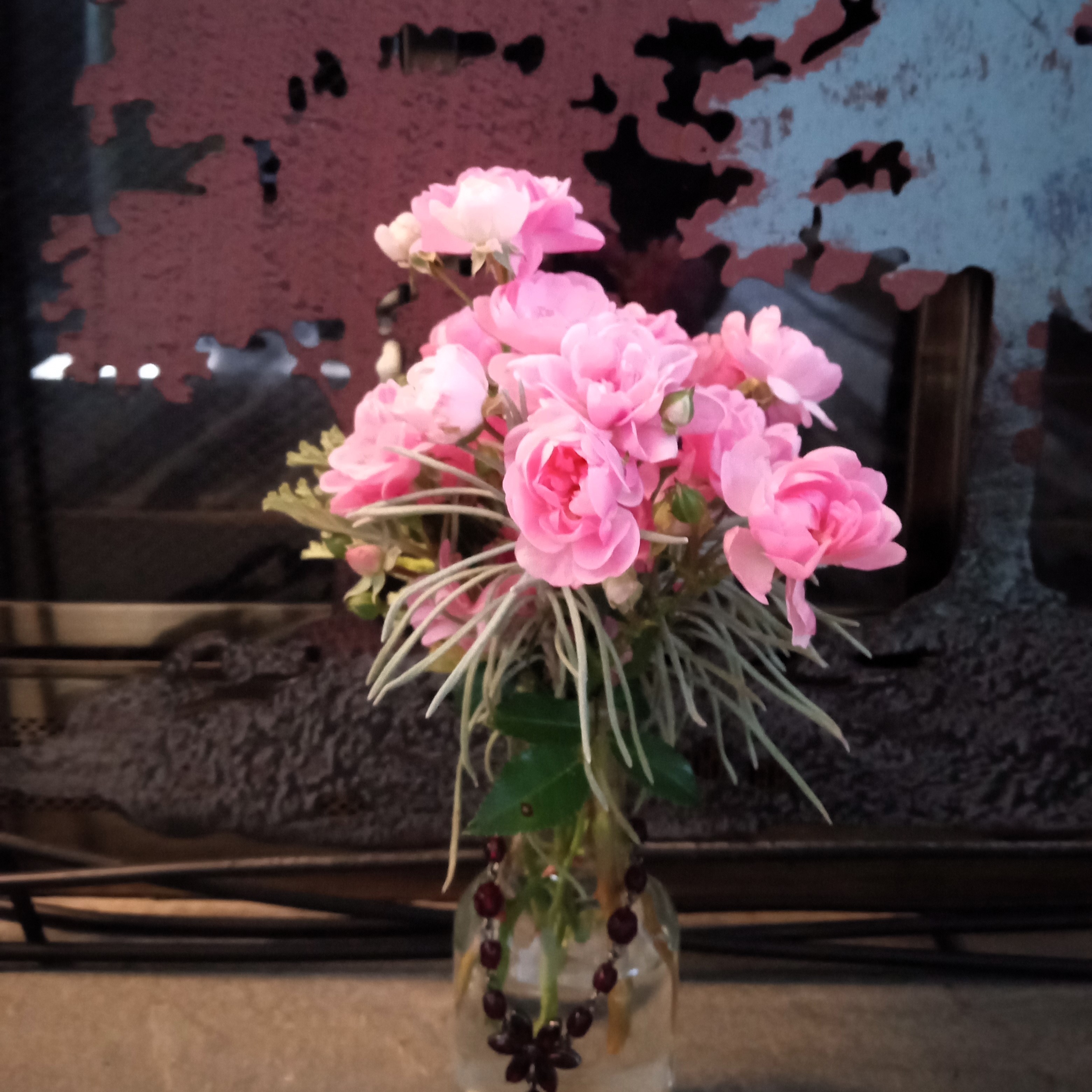
Roses are some of the first bright blooms of spring after the pansies, daffodils and tulips. One of my best varieties is a brilliant pink miniature rose called Fairy. In the beginning days of November, it is loaded with pink blossoms. I almost hate to cut them, but since I don’t go out as frequently now that the weather has turned chilly, bringing flowers in will give me more time to enjoy them.
They are my IAVOM selection, and also a part of Cee’s FOTD. Included in the vase, a bottle I use for rooting cuttings, are pieces of foliage that are still surviving: Helichrysum Icicles and scented geranium sprigs. The vase itself looked a little plain so I dressed it up a bit with one of my necklaces.
We had a hard freeze last night. The white frosting was still visible on the zinnias after the sun came up. It’s time to put the garden to bed.
The hardiest butterflies were cabbage whites and the skippers, but even those are gone now. Hopefully, the offspring they left behind are in their chrysalises over-wintering in sheltered spots.
Ten Black Swallowtail caterpillars, within the butterfly house, formed their chrysalis in late summer. We had a couple cold nights in August and this set off diapause, a state of hibernation, in the butterflies. Three of the caterpillars formed their chrysalis on objects within the butterfly house. Seven of them formed on the screening. Those who chose the screens were easy. I checked on them, tied a string to the top, and hung them from the garage ceiling, quite an exclusive high-rise to rest in for the winter. They are far enough up that they would be hard to find by a wandering rodent. When it rains I will climb a ladder and spray a little bit of misty water into the house to mimic what’s going on outdoors.
Three of the caterpillars formed their chrysalis on other items. Two of them on a piece of landscaping stone I had at the bottom of the house to keep it secure when storms struck.
The other formed on a stem. These also need to be in the garage but must have some kind of protective covering. Recently, in the grocery store, I picked up several mesh bags sold for fruit; the perfect solution. I placed them around the objects holding the chrysalis and put them on a garage shelf for the winter.
The raising of butterflies has never become commonplace to me. I enjoy seeing the butterfly house hanging in the garage. It reminds me Spring will come again and hopefully a bevy of butterflies will emerge.
“Butterflies that go through diapause enter into a hibernation-like state, where physiological processes are suspended. After adverse weather conditions clear, they will come out of this state of suspended animation and return to normal functioning.”
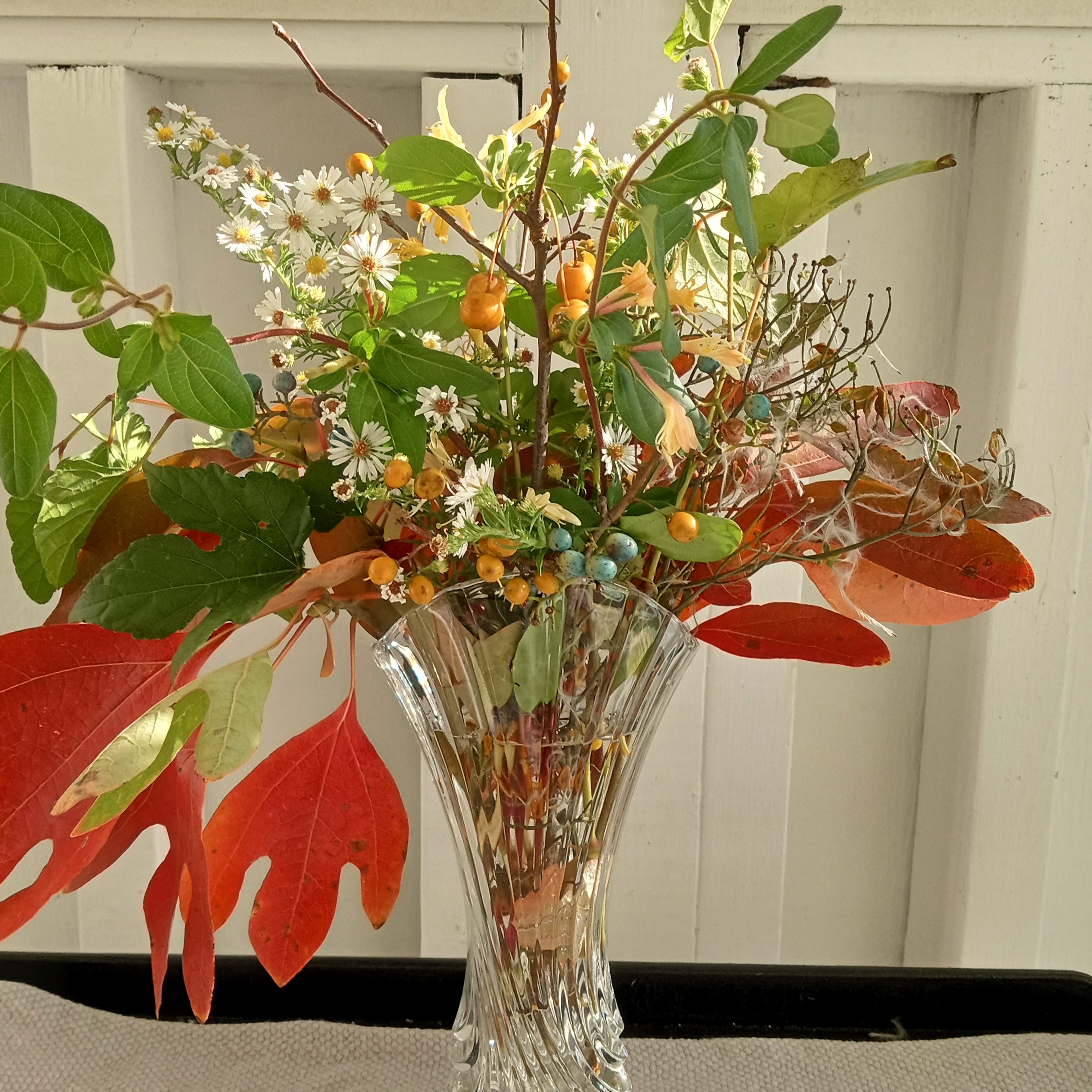
In my gardens everything is beginning to dry out and brown. The annuals have had their summer fling, and the perennials are beginning to nod off too, ready to be put to bed for the winter months. I thought instead of picking flowers from my gardens for this week’s In a Vase on Monday, I would take a bike ride and see if there were any wildflowers to be found.
I was surprised to find a few sprigs of honeysuckle having a bit of a renaissance, blooming, and still spreading a bit of fragrance. Since it was in a spot no one would see, I didn’t feel badly picking it for a bouquet. I kept riding, picking berries, and Autumn leaves, surprised to find the goldenrod was over, I had been sure it would still be available.
A neighbor saw me peddling up the street, took note of the sprigs I held in my hand, and asked if I was giving my flowers a ride. I answered yes, and that they were free flowers.
One wild stem I found was Porcelain Berry, something new to me, and a little dangerous in appearance. If a berry ever looked poisonous to me, this one surely did. I had a plastic bag in my pocket and I wrapped it around the stem after I picked it in case the sap was deadly.
For a bit of clarity, and peace of mind, before I handled it further, I used my photo search app. Ampelopsis glandulosa is its classification. It isn’t poisonous at all, and has some health benefits. These are the culinary uses I found when I researched the plant: Leaves and buds can be consumed after being cooked, the fruit (berries) can be consumed raw or cooked.
I find the porcelain berries beautiful, however, they are very invasive and can kill native plants. Birds eat the plump berries and the seeds are spread in this way.
Health benefits of Ampelopsis glandulosa: Some health benefits are treating boils, abscesses and ulcers, bruising. They are anti-inflammatory, diuretic, has been used to treat breast cancer.
The plants used in today’s IAVOM are: honeysuckle, bittersweet berries, porcelain berries, crabapple, frost aster, autumn clematis seedpods and sassafras leaves.
I still have a few plants blooming despite cooler temperatures. Gone is the cumbersome task of daily weeding, and left to me is a rebirth of the hardier blooms to cut and arrange. Here is a sampling of a few blossoms I thought were a good representation of Autumn colors. They are perfect for the In A Vase on Monday challenge.
My hyacinth bulb vase holds some coleus leaves, Knockout rosebuds in Coral, and sprigs of Agastache Poquito Orange. (After checking 2023 seed orders, I realized this plant is not Poquito Orange, but a apricot variety from the Fragrant Delight Mix of Agastache Seeds available from Baker Creek Heirloom Seeds.)
I love the Agastache I grew from seeds, sown indoors in late Winter. They are a beautiful shade; the blossoms are the size of a dime. Even the buds are attractive as they elongate and open. The flowers, growing in pots, never stopped their showy display from late Spring through Autumn. The photograph of my Agastache was taken yesterday.
The plants thrived in medium-sized pots in combination with other hummingbird plants. There is evidence of a few small nibbles of insects, but the plant is basically ignored by most pests. Perhaps it is not any wisdom or luck on my part they are uninfested, but due to the fact that they are in potting soil instead of the garden beds. They are small, about 10 inches tops, and they have a graceful drape to their stems, making them perfect to place around the edges of planters and hanging baskets. Will I grow these again? Oh yes!
I’m not ready to vegetate yet where the garden or Word Press challenges are concerned. I enjoyed including several challenges in today’s post. Thanks to all the hosts of these wonderful prompts to help me keep thinking and looking ahead. The Agastache flowers are part of Cee’s Flower of the Day and all my beautiful blooms are an entry in City Sonnet’s Colors and Letters Challenge – Letter F = Flowers.
John Henry Newman – (1801 – 1890) “John Henry Newman was a Roman Catholic priest and cardinal who converted to Roman Catholicism from Anglicanism in October 1845.” ~ Christian Quotes.
I took this quote to heart. It is a failing of so many of us that we don’t continue to pursue our dreams because someone, or even ourselves, has found fault with what we do. I needed this today since I am working on a project I had set aside for years. It is a bit draining, but it has also made me laugh, and even enjoy, the words I had put to paper. It helped me realize I had created something not bound to the time I’m living in now.
What is meaningful to me is the background of this quote. It is a macro photograph of a piece of watercolor I was not happy with and tore up. I have a whole basket of these scraps, collected for over twenty years. I tweaked the photo a bit in LunaPic and was pleased with the Autumnal appearance of the result.
Don’t be absent from the classroom of your dreams, learn their lessons, take charge and make them count! Do everything feasible to succeed.
Cee’s Midweek Madness Challenge this week is the letter Q. I thought at first, I can’t think of anything I have of interest that starts with Q. Then, as I often do, I reread Cee’s post. One of her photos was a beautiful turquoise bag. The Q only needed to be part of the word. (I am hearing my first grade teacher, in my head, at this point saying, ‘You did not follow the directions.’) Yes, I have always had a hard time not getting excited and running ahead with things before I heed the directions.
My quartz is a piece of a larger rock. When I researched it to find the proper identification, I promptly went out and retrieved a second chunk of it out of the border of one of my flower beds. It should be displayed in the house. The large piece has been used as a doorstop on my patio for a couple of years. I think I’m going to clean both pieces up and bring them indoors.
I brought a few pebbles home from the beach in Block Island. We visited a week or two ago for the first time in ten years. The town hadn’t changed much, except for the loss of the Harborside Inn due to a fire this summer. We only stayed the day, so we didn’t have time to explore the outer edges of the whole island.
I never liked walking in the town too much, preferring instead the lesser-known beaches and land. I still felt the same a decade later. The town has busy streets and narrow sidewalks. It becomes disconcerting to feel you are holding back the pace of those walking behind who are always in a hurry.
I hope to get back again one day, but I’m not sure about that drive up 95. We were in an hour long traffic back-up between Bridgeport and Norwalk, Connecticut. We both said, never again are we driving that way, perhaps if we find a better route we will visit again one summer in the future.
The tip might be a little late for this year’s gardens, but keep it in mind for Spring planting. The red zinnia below is my photo for Cee’s Flower of the Day.
It’s always fun to traipse around the garden beds eye-level to the zinnias. Their height presents a problem though; how to support them? If you’ve ever grown these beauties, the taller varieties, you most likely know a heavy rainstorm will drive them to the ground if they are not staked. This year, quite by accident, I grew a natural staking plant nearby.
In the patio garden I planted zinnias, the State Fair variety that grows near four feet tall for me. Beside it I planted blue salvia since both flowers are hummingbird favorites. As the zinnias grew tall, and the salvia spread out in width, the zinnia grew up between the branches of the salvia and rested upon the natural support. No staking required. The plants look lovely growing together. Their roots have plenty of room. I can’t extol this combination enough; the hummingbirds are happy and so am I.
The growing season is almost over. We have had heavy rain along the Atlantic coast for days. The zinnias are now as tall as I am, and still, despite the downpours they are held aloft by the salvia plants. What a beautiful combination.
I have a few top performers in the vegetable garden this year. At the top of my list are two tomatoes.
Rosella is a salad tomato, small and compact, this delightful plant has produced dozens of tomatoes within the confines of a five-gallon cloth growing pot. I am hoping for many more harvests through the beginning of Autumn.
Spoon tomatoes have been a surprise. Grown in a five-gallon container, the plants have produced dozens upon dozens of tomatoes.
The fruit is super small, about the size of blueberries. A bit addictive, it’s easy to eat them by the handful. Best of all, the seeds were free, as a thank you for my purchase from Baker Creek Seeds.
Mini Bell Mix Peppers have been exactly what the name implies–miniature. They develop beautiful color while small in size. Delicious, and perfect to cut into pasta and garden salad, these have been productive growing in a regular sized bucket as a pot.
As you will notice from the seed packet photographs, these varieties are all from Baker Creek Heirloom Seeds. A great company, and the plus is they provide fast service and mailing. Any order over $10.00, at least this year, receives a free packet of seeds. One of the free packets was the Spoon Tomatoes.
After spotting the vermilion orange flash of a Monarch butterfly laying eggs on my milkweed, I kept watch by tying a string on each leaf that had an egg on it. I was surprised, monarch eggs hatch quicker than the black swallowtails. Within a few days I spotted a small hole on one of the leaves. Sure enough, underneath I found an almost microscopic monarch butterfly caterpillar.
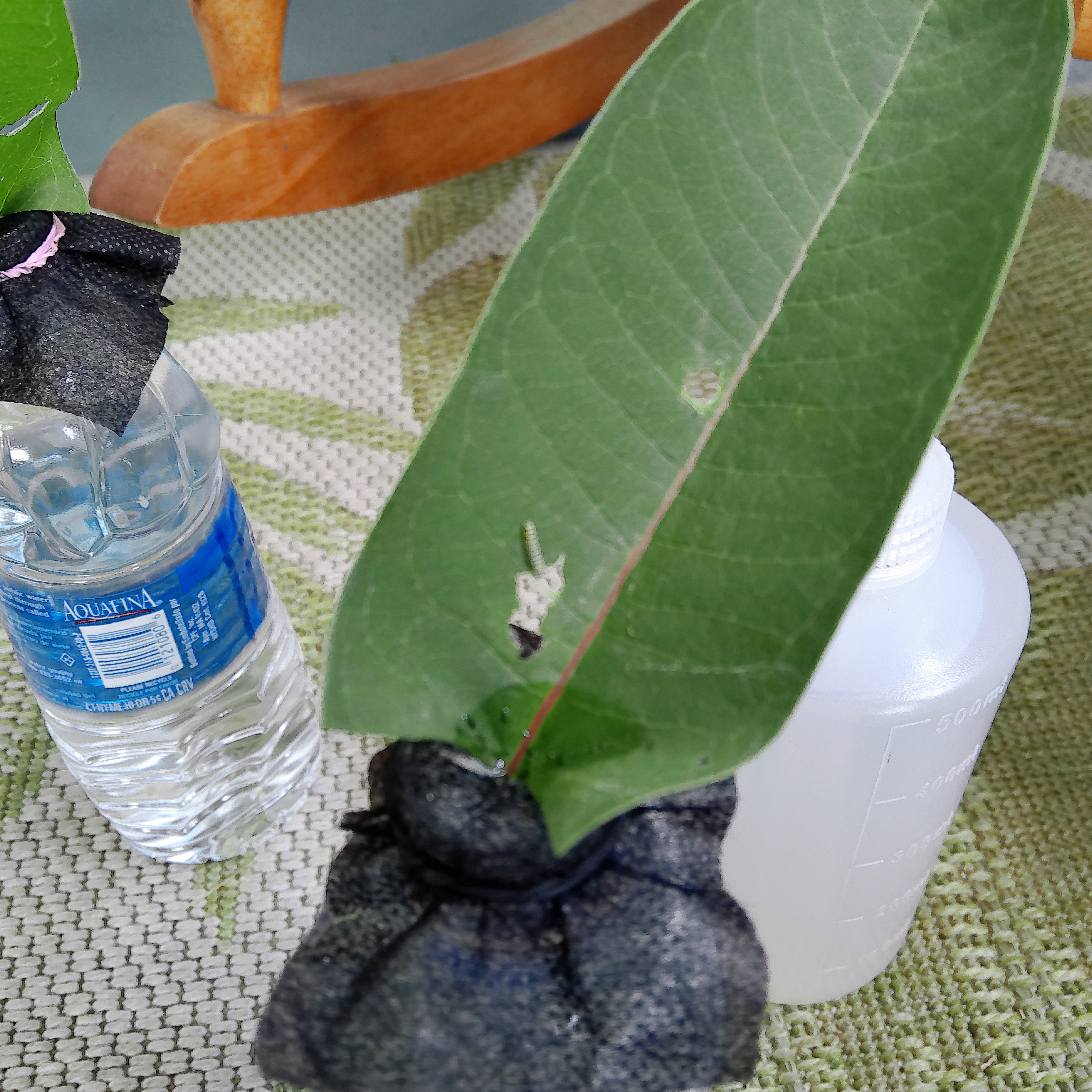
Because I’ve experienced the dilemma of monarch caterpilla cannibalism, I needed to find a better way to raise them this year. I brought one of the monarch caterpillars in on its leaf and using an old water bottle, garden cloth, and a rubber band I created a standalone leaf holder for the small caterpillar. Besides working at keeping the caterpillar separated, the bottle added a benefit; the leaves have stayed pliable and fresh for days.
To create more stem for the leaf to absorb water, I cut up along the edge of the stem, always careful to be aware of where the caterpillar is on the underside, next remove a v-shape portion by cutting away the leaf to form a stabilizing appendage to grip the garden cloth. I could go on with an explanation, but I think the photos tell the story better.
The caterpillars are thriving. They are now big enough for me to be able to see their spiky anthers.
In the course of adding water to the bottles, one caterpillar fell off on the rug, which is the same color as the caterpillar and even the same texture. I couldn’t find the small cat anywhere. I felt terrible. There was no sense in looking for the fallen caterpillar because I might squash it with my knee or foot while I searched. Instead, I laid a few leaves in the area where I thought it fell. The strategy worked, and today I found the wayward caterpillar on the leaf I laid on the floor. It is safely back on the rearing bottle now.
You can tell, by the holes in the leaves, and the freshness they’ve retained, that the single bottles work much better than leaving all the caterpillars in the bottom of the butterfly cage. Unfortunately, last year that is what I did, and I had seven caterpillars at one time on the bottom of the enclosure, eating the leaves. Overnight, my number was down to one. Yes, caterpillars of the monarch butterflies, although they are beautiful and delicate, are voracious cannibals of each other.
I might run into some trouble when they are big enough to loop themselves from one leaf to another. Maybe the problem will never present itself, but at least I am on the lookout for it.
I am grateful that I have a whole garden bed filled with milkweed. I checked some of the wild areas and the milkweed is in horrible condition. I found no caterpillars, only aphids spiders, ants and other bugs that prey on the monarch caterpillars. The leaves were leathery and dry from all the hot weather in our area. I have the advantage with my garden bed since I keep it well watered and stay on pest alert at all times.
This has been longer than my normal posts, but I wanted to share how to keep the leaves fresh, and the caterpillars away from each other. One note, they do like to be shaded. I keep them shielded from the Sun with dish towels over the sides. So far none have attempted to reach the other leaves. They are thriving and growing. I’m looking forward to watching the process over the next few weeks.
The large butterflies are finally showing up in my backyard. We’ve also seen many Yellow Swallowtails on daytrips as we drive toward the ocean shoreline. I am relieved. They are late, but they are here. Today I saw two Yellow Swallowtails, the largest butterfly in this area, on my butterfly bush at the same time.
Late last week, a bronze Monarch laid eggs on the underside of Milkweed leaves as I watched. Today, I went in search of the small dome-like eggs and marked each leaf with a string when I found one. I know the small caterpillars are poisonous, but that does not stop other insects from eating them. Ants, mantids, wasps, spiders are a few of the insects that will eat Monarch caterpillars. You can find solutions for combatting this problem on the Monarch Butterfly Garden site.
This caterpillar decided to form its chrysalis almost on top of another chrysalis. This is a view of the top corner of the smaller butterfly house.
I’m encouraged that the big butterflies are returning. I am peering out the windows constantly, camera ready, prepared to instantly run out in the yard to record their arrival and feeding.
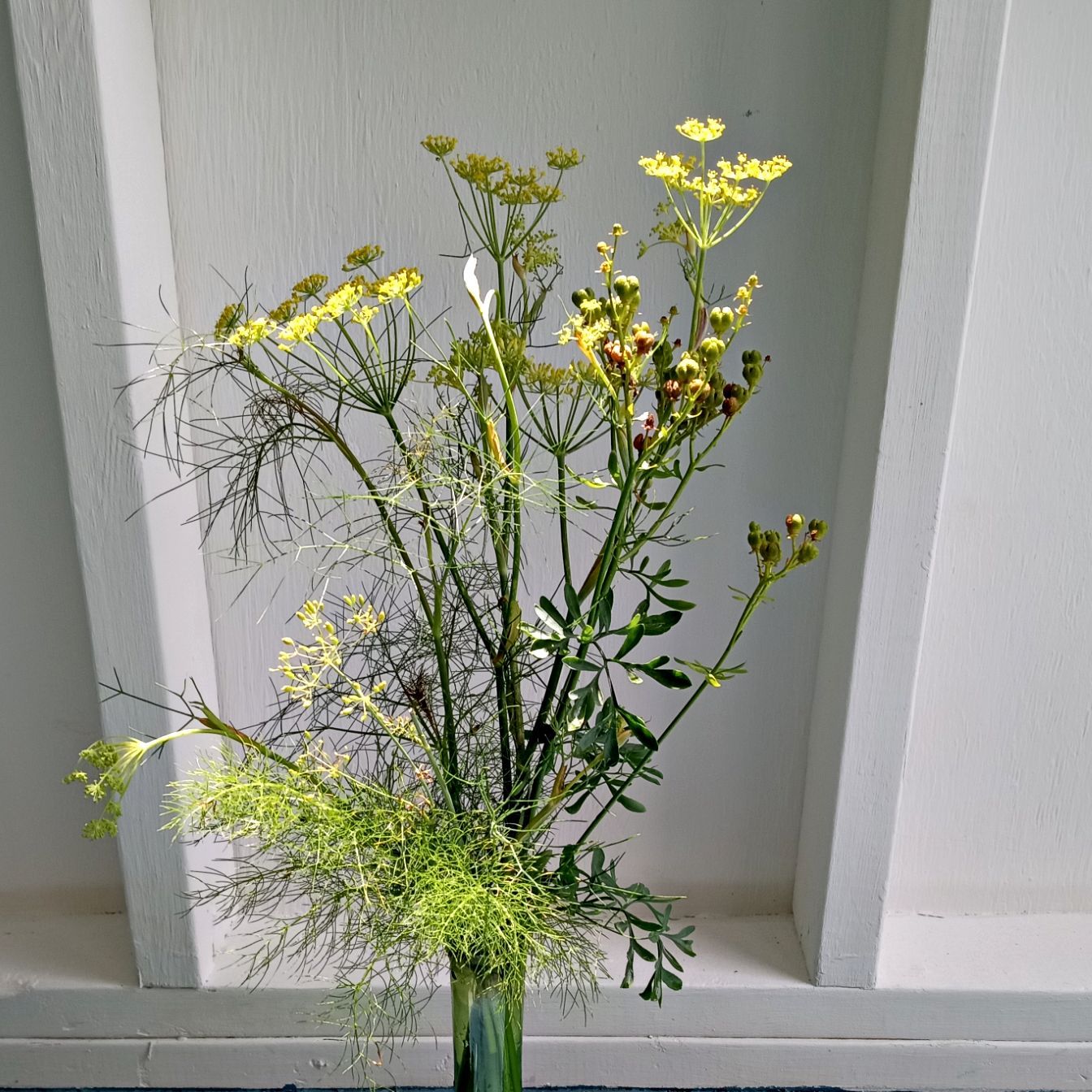
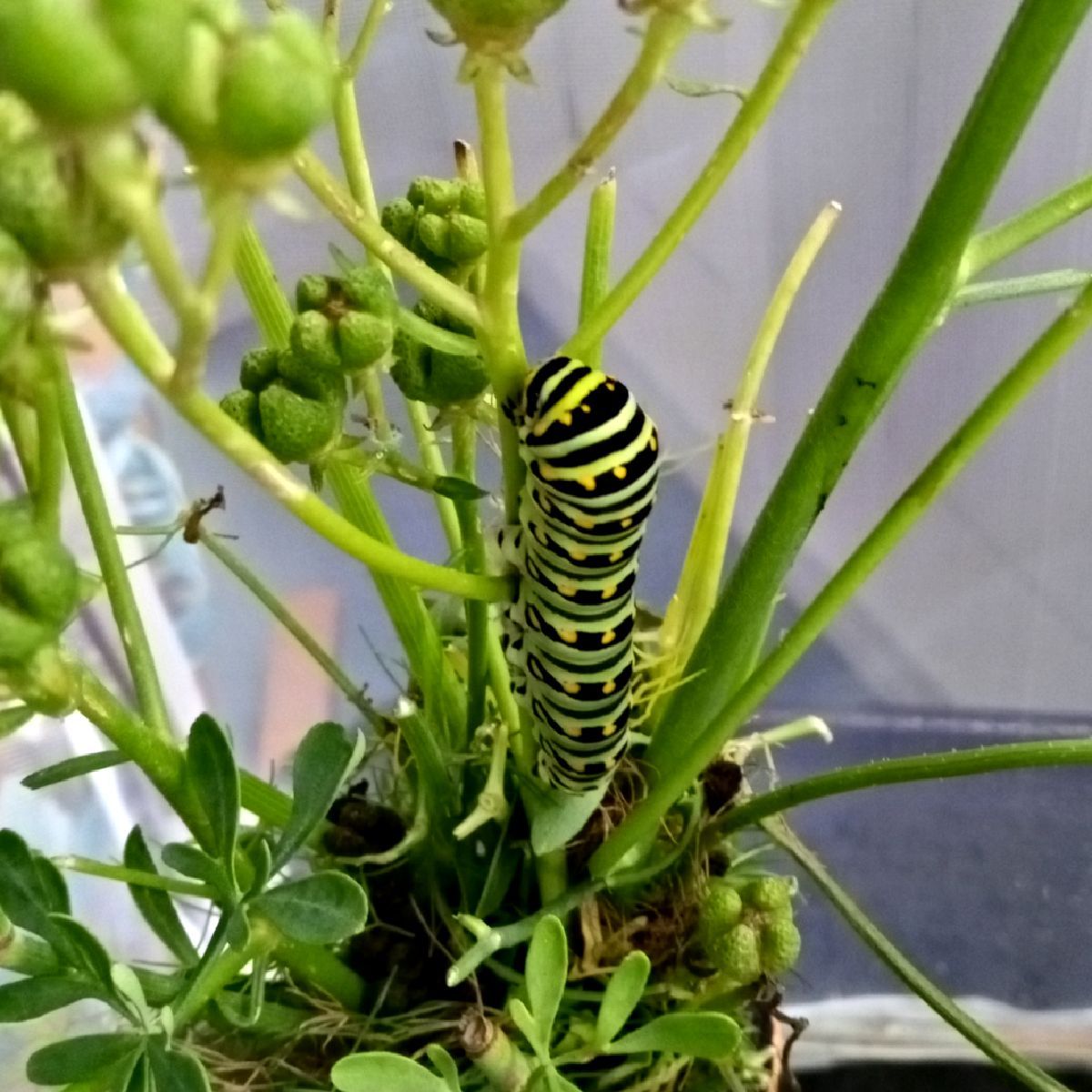
Fennel flowers, Rue seedpods, and some fennel fronds with a piece of dill added here and there, make up my rather strange vased bouquet for Ramblings in the Gardens challenge of In a Vase on Monday. The herbal bouquet has a job to do, provide food for the caterpillars feeding in the Butterfly House. They are still in the small to medium stage, the larger ones have formed chrysalis, save one, who is still deciding if the time is right to drop off the rue stem.
I have seven smaller caterpillars happily munching the new bouquet. The climate in this area has been perfect for the development of caterpillars now that the wildfire smoke is gone. This bouquet will soon be eaten down to mere nubs, not a long-lasting arrangement to be sure. All of these herbs, along with parsley and Queen Anne’s Lace are host plants for Black Swallowtail butterflies in my area.
Although they produce a lot of frass (insect waste), they don’t make any type of fracas, and are silent companions on the porch. An ongoing diary of the Butterfly rearing of 2023 can be found at the top of this page, or can be followed from this link: Butterfly Diary.