Promise – The Bride of Christ Jesus

“Let us rejoice and be glad and give him glory! For the wedding of the Lamb has come, and his bride has made herself ready.” Revelation 19:7

old bohemia church

Old Bohemia Church Warwick, Maryland

Christ Jesus might come today, he could come tomorrow…or it could be many, many years before He comes again. The Bible is clear that no one knows the timing but God the Father.

“But about that day or hour no one knows, not even the angels in heaven, nor the Son, but only the Father.” Matthew 24:36

Though no one knows the exact day or moment, so many signs of our time seem to be pointing to His arrival. Prophecies are being fulfilled on earth and in the heavens. Each day brings us closer to his coming. When he comes I will meet him in the air, rising from my place of rest if I have passed on, or taken suddenly from this earth in less time than it takes for an eye to twinkle.

“Listen, I tell you a mystery: We will not all sleep, but we will all be changed—  in a flash, in the twinkling of an eye, at the last trumpet. For the trumpet will sound, the dead will be raised imperishable, and we will be changed.”  I Corinthians 15:51-52

“For the Lord himself will come down from heaven, with a loud command, with the voice of the archangel and with the trumpet call of God, and the dead in Christ will rise first. After that, we who are still alive and are left will be caught up together with them in the clouds to meet the Lord in the air. And so we will be with the Lord forever.”
I Thessalonians 4:16-17

Are you ready for Christ’s coming? If not, will you ask Him to save you from your sins today? It is as simple as this…”Yes, Lord Jesus…come into my heart. I repent of my sins. I am yours, you are mine.” Believe in him and you will dwell with him for all eternity.

A few words from Charles Haddon Spurgeon on Christ’s relationship to his bride; we are that bride, we who have opened our hearts to Him are his church.

“Art thou, beloved one, with Christ Jesus? Does a vital union knit thee to Him?

… Come, my soul, if thou art indeed His own beloved, thou canst not be far from Him.

If His friends and His neighbours are called together to see His glory, what thinkest thou if thou art married to Him? Shalt thou be distant?

Though it be a day of judgment, yet thou canst not be far from that heart which, having admitted angels into intimacy, has admitted thee into union.

Has He not said to thee, O my soul, “I will betroth thee unto Me in righteousness, and in judgment, and in lovingkindness?”

Have not His own lips said it, “I am married unto thee, and My delight is in thee?” If the angels, who are but friends and neighbours, shall be with Him, it is abundantly certain that His own beloved Hephzibah, in whom is all His delight, shall be near to Him, and sit at His right hand.

Here is a morning star of hope for thee, of such exceeding brilliance, that it may well light up the darkest and most desolate experience.”


Phavorites – Deep in the Green by Anne Raver & Links I love

IMG_9870

If you are a dabbler in dirt, and a reader, as I am, you might have a surplus of garden books stacked around the walls of your home. I am lucky enough to have an extra room where I keep odds and ends of furniture and stack upon stack of books. My grandmother’s china cabinet resides in the room, filled with, you guessed it, books. She would not be unhappy about this use of her cabinet. When I walk through her home in my memory I see rooms filled with books in every possible space. I am so glad I take after her in this aspect of my life, books have always been one of my chief pleasures.

I am enjoying the timeless garden essays of Anne Raver, NY Times Gardening Columnist, in a book titled, “Deep in the Green.”  Each short essay touches the gardener’s heart within me. This is a perfect book to read to escape the final doldrums of a long winter. Even before I begin to read the chapters I am smiling, how can I not with titles like: “The Poop on Crickets,” “If Geese Could Drive,” and “My Invisible Garden.” The book is available on Amazon, hardcover or Kindle edition.
A sampling of Anne Raver’s NY Times Gardening Column can be found here:

Anne Raver/Gardening Topics/NY Times

Quick Tip – Freezing Broths and Buttermilk

IMG_9867

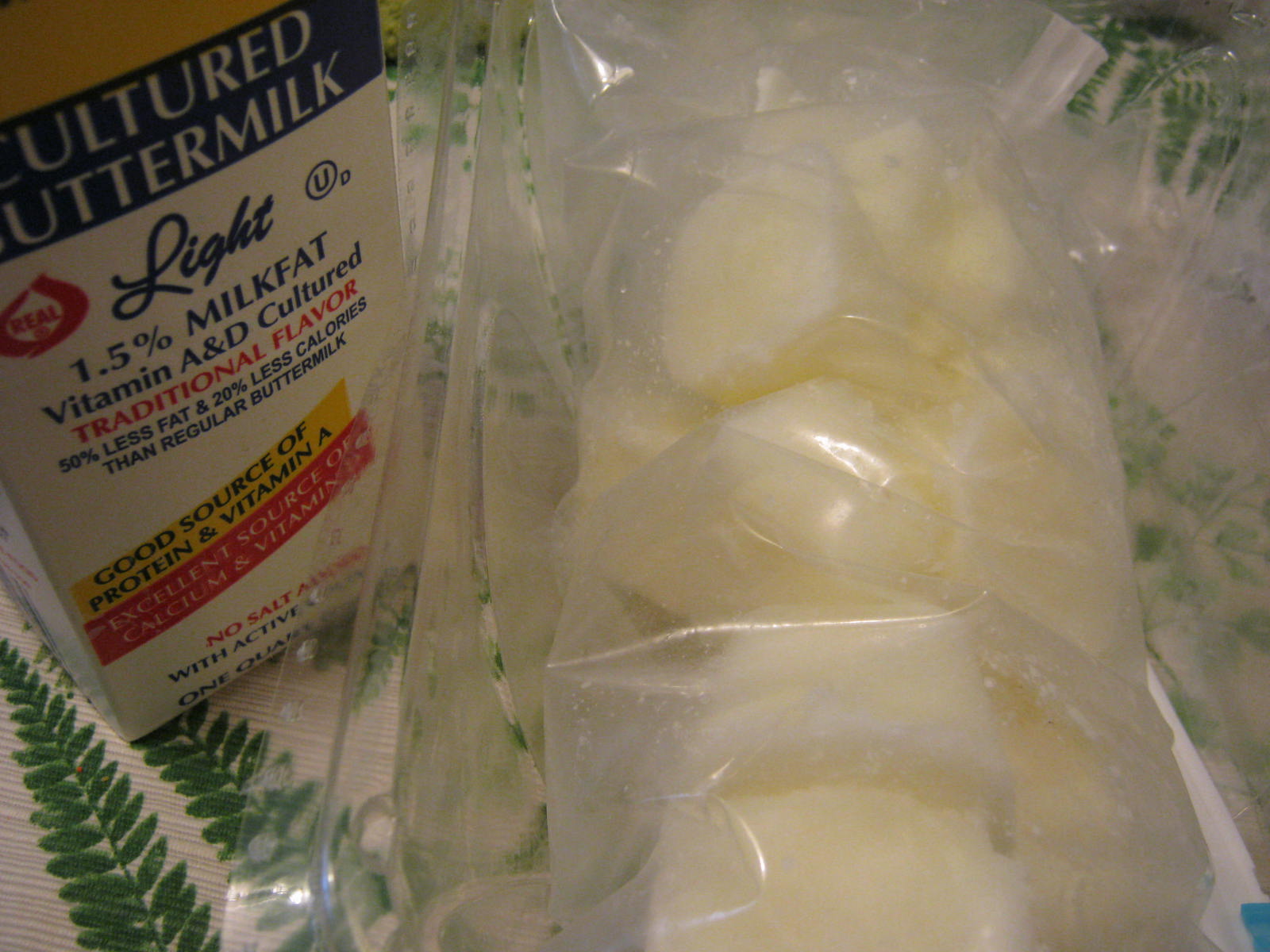
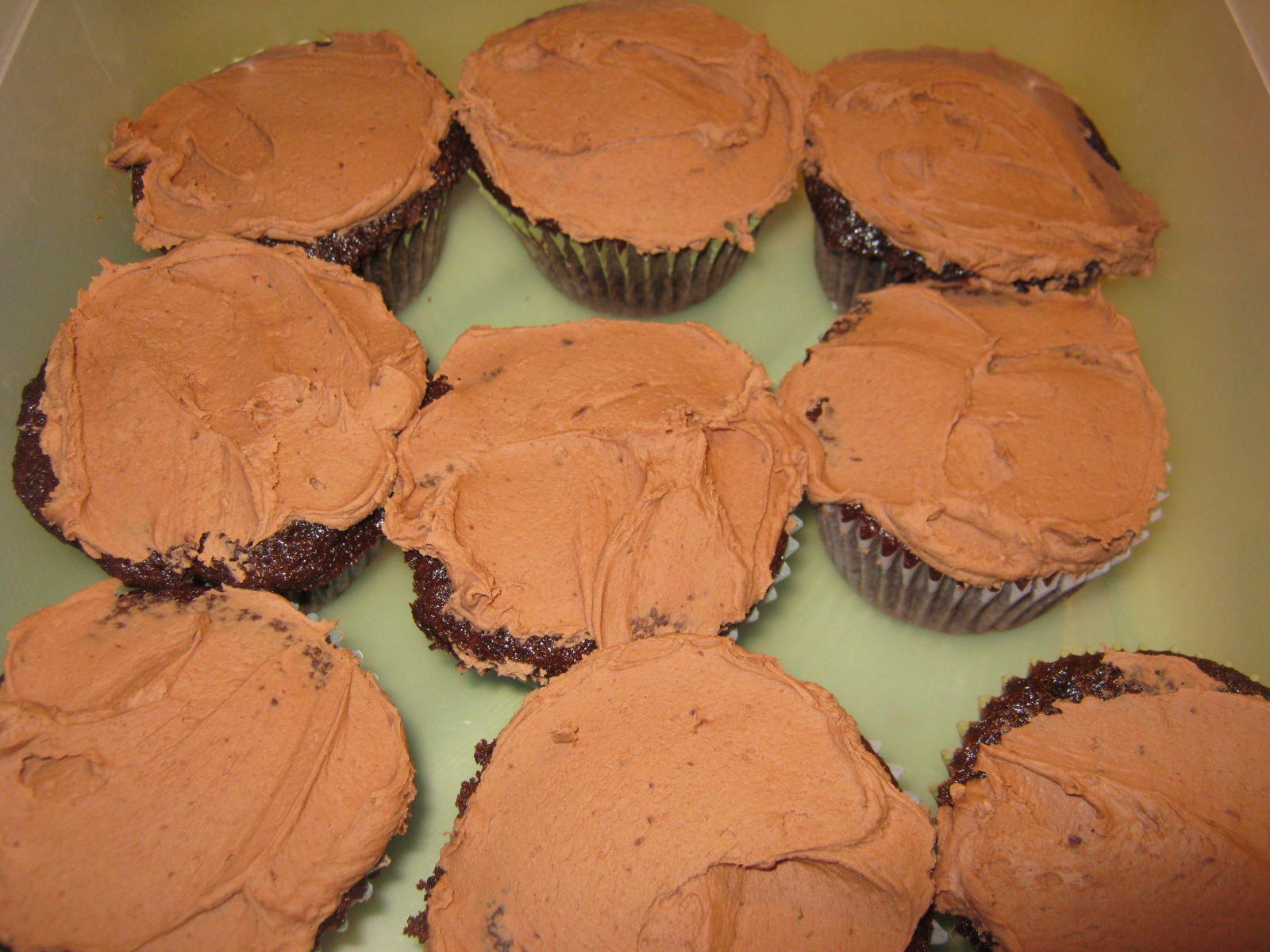
I enjoy cooking with buttermilk. It adds a little bit of “zing” and moistness to several of my recipes. I recently found a good recipe for Buttermilk Chocolate Cupcakes on Cooks.com. (See bottom of post for recipe links) The cupcakes turned out great, moist, and without an overload of sugar.

Buttermilk runs near $3.00 in my area. Because I only use it in a few recipes, often when the expiration date draws near I am left with half a carton or more to use. I have found buttermilk freezes surprisingly well. I pour it into ice cube trays, freeze, pop out the cubes and store in my freezer. When I thaw the cubes, the buttermilk separates a bit, but a quick whisk with a fork reincorporates the liquid.

A good rule for freezing liquid is to make sure the ice cube trays you are using are BPA free. A good article on toxin-free cooking and food storage can be found here: 12 Ways to Avoid Toxins in Kitchen

It’s a good idea to put as many of the “kitchen fixes” in practice as you can without becoming a complete nervous wreck over it. Sometimes, through the Internet and constant news programs, the problems we face in keeping out homes and bodies healthy can become overwhelming and a danger in itself to our stress levels and mental health.

A Thank you to Jane who added these additional ideas for freezing liquids in the comment section: “I think a lot of us have had that problem with leftover buttermilk. If you put them in ice trays, though, I would think that you would have to use them exclusively for this or other leftover liquids, etc, because they are plastic and tend to absorb the odor of whatever you would freeze in them. I’ve tried the dried buttermilk but it is expensive. I think you could also measure out 1/2 cups and put that in those snack-sized or sandwich ziplock bags. I freeze a lot of spaghetti sauce, soups, etc, in quart sized freezer bags because they are flat and don’t take up as much freezer space as a rubber maid container. Before I freeze food in the rubber maid containers, I press a layer of plastic wrap directly onto the food surface (tucking the excess into the container) to avoid ice crystals. Sorry for the long post.  I should add that when I put those ziplocks in the freezer (remove all air in the bag), I lay them on a flat surface  until hardened – easier to stack them afterwards.”

IMG_9869

Buttermilk Chocolate Cupcakes

Scoop the batter out with an ice cream dipper for uniform cupcakes.

IMG_9865

An alternative frosting can be found here: Chocolate Sour Cream Frosting

Chocolate flavor with a tang of sour cream is a novel choice for a cupcake topping. I do refrigerate these cupcakes to keep the sour cream fresh. The frosting has a fudgy consistency due to the melted chocolate. Milk chocolate or dark chocolate are both good choices. Happy Baking!

Follow Me on Pinterest

Quick Tip – Seed Sowing 101/Seed Packet Storage and Sowing Seeds

seed packet 1

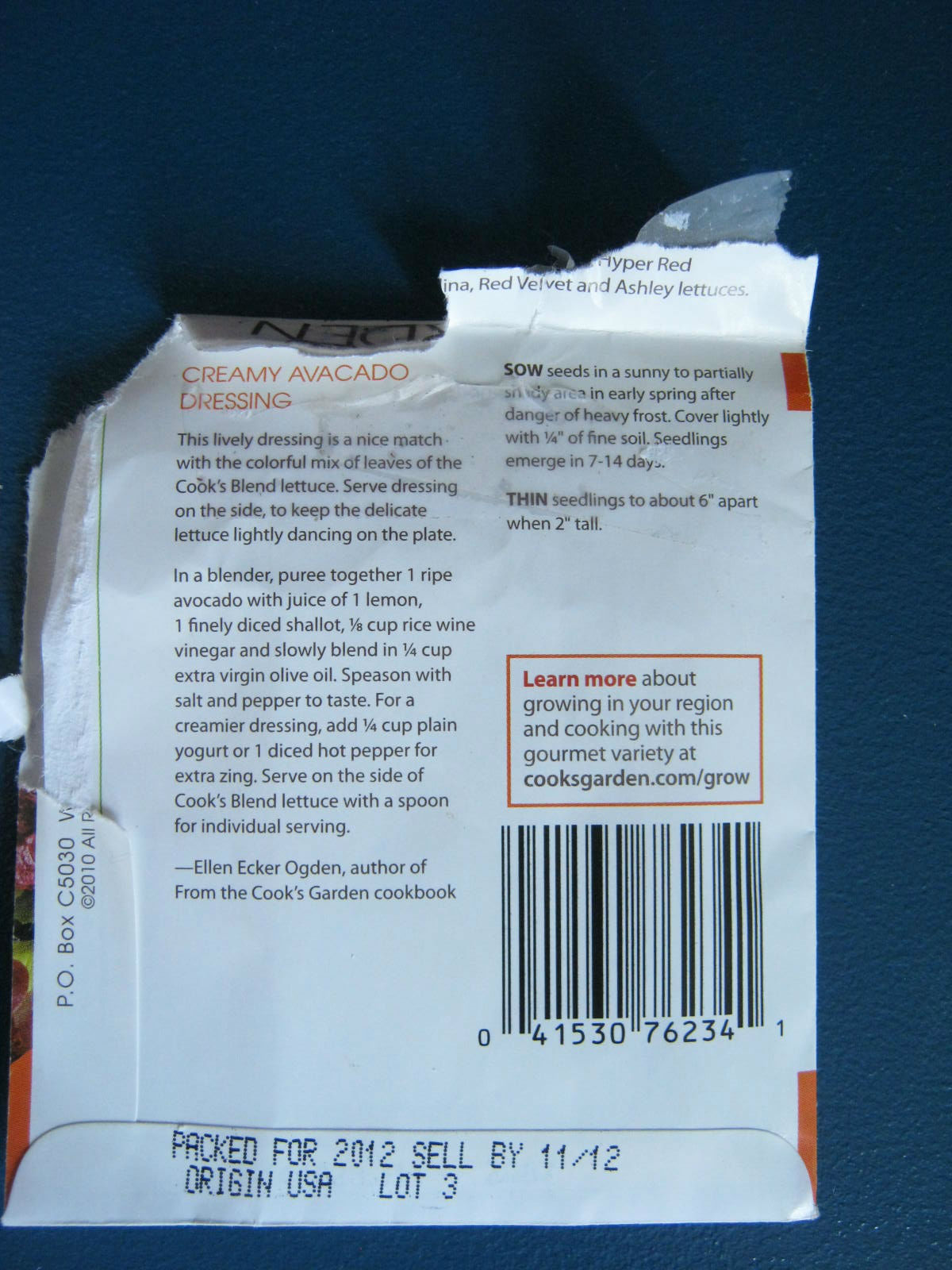
I’m afraid I must admit that many of my older seed packets look like the one pictured above. Tearing off the top, resealing with scotch tape, creates a ragged and ripped mess when I try to reopen. I know it sounds silly to even take time to give write a tip like this, but it is more a reminder, than it is a tip, on how much information is contained on the small space of the packet.

seed packet 2

For instance, if I tear away the top of the seed packet shown above I will never again be able to rely on the terrific and almost poetic description of the contents printed on the top of the flap.

“Crisp textured loose heads have broad frilled and crumpled leaves.”

There are also height, width, sunshine and water requirements printed on the packet. To save as much information as possible cut away with scissors the smallest fraction of the packet top when opening.

seed packet 3

In the past I have often taped the top of the my packets down when I am finished sowing the seeds they contain. If I don’t firmly close them in a way that will stay secure I will end up with hundred of seeds, completely unidentifiable, on the bottom of my seed box. A small, tight paperclip holds the twice-folded seed packet top closed without possibility of loosening.

seed packet 4

Another important tip is labeling the small white packet inside some varieties of seeds. Burpee packages its seeds with an inner foil pack. Take my word for it, all these look alike if you mix them up. Unless you are a real professional at identifying seeds, it will be plant and hope for the best if you mix up the inner packets. I’ve learned my lesson and I now label the inner packet with a permanent black felt-tip pen.

I know these tips might seem rather self-evident, but hey, it’s so easy to get excited about planting and lose track of what you are doing in the pursuit of the perfect garden. These are just a few of the simple ways I make the whole experience enjoyable and less frustrating at the time of planting and in the future.

I received a terrific idea through the comment section of this post. I thought it would be a good idea to edit the post and add the comment as another alternative for saving the information on the packets. Thanks so much Tulani!

Tulani comments, “Here’s an idea in dealing with the torn/frayed tops of the seed packets. If you have an all in one printer, make a copy of the seed packet BEFORE you open it…that way you have all that precious information intact & semi easy to read whenever you may need it. If you do not have an all in one printer, many of the local drug stores & other businesses have copy machines & charge $0.10 – $0.25 per copy.  Libraries are another place to go for copies too! When you have all these copies made, they can then be cut down so you only have the picture of that packet, & store them in a photo album. If there’s a problem with the plant, or the seeds, you’ll have all that info at your fingertips, & you will know whether or not to buy them seeds next year. It may not be foolproof, but it sure beats dealing with torn/frayed seed packets.”

seed packet 5

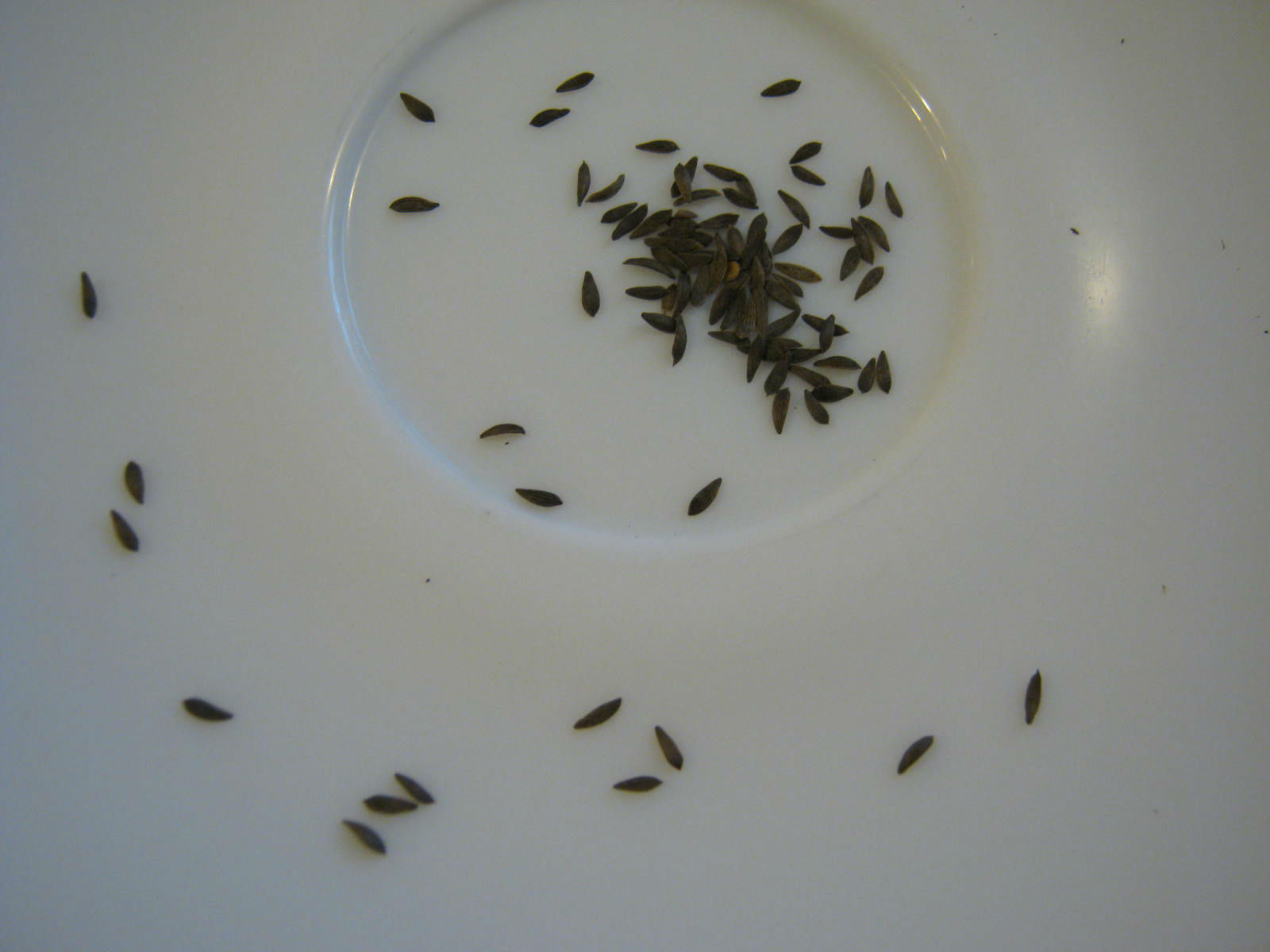
Another quick tip – For larger seeds I often dump out the contents of the packet onto teacup saucer. The little indentation in the center holds the bulk of the seed. I then pull a few seeds up onto the lip of the plate. Because the dish curves upward, it is easy to slide a few seeds to the edge of the plate with my forefinger and then grasp one or two between forefinger and thumb and place each where I want them on the soil. I know that many people “broadcast” the seeds across the top of the planting medium, but I have found over and over again that this method causes crowding and is the forerunner of damping-off disease. Happy Gardening!

Follow Me on Pinterest

Phlowers & Painting – Primrose Part II

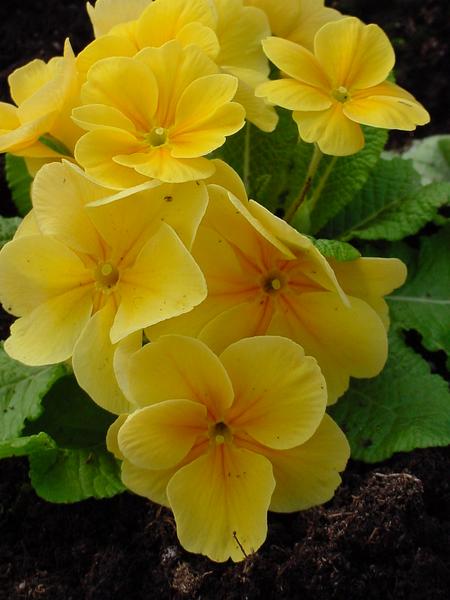
must create yellow primula

Yellow Primula by MustCreate

For those who like to paint/draw/craft all types of Flowerart, check out the WetCanvas March 2014 Plant Parade Challenge: March 2014 The Plant Parade – Primrose/Primula. The reference photograph for the beautiful primrose above, courtesy of the WetCanvas Reference Library and MustCreate, along with many others can be found on the WetCanvas site and used copyright-free for artwork. Happy creating!

Plant – Primrose Part I/Care and Sowing Seed

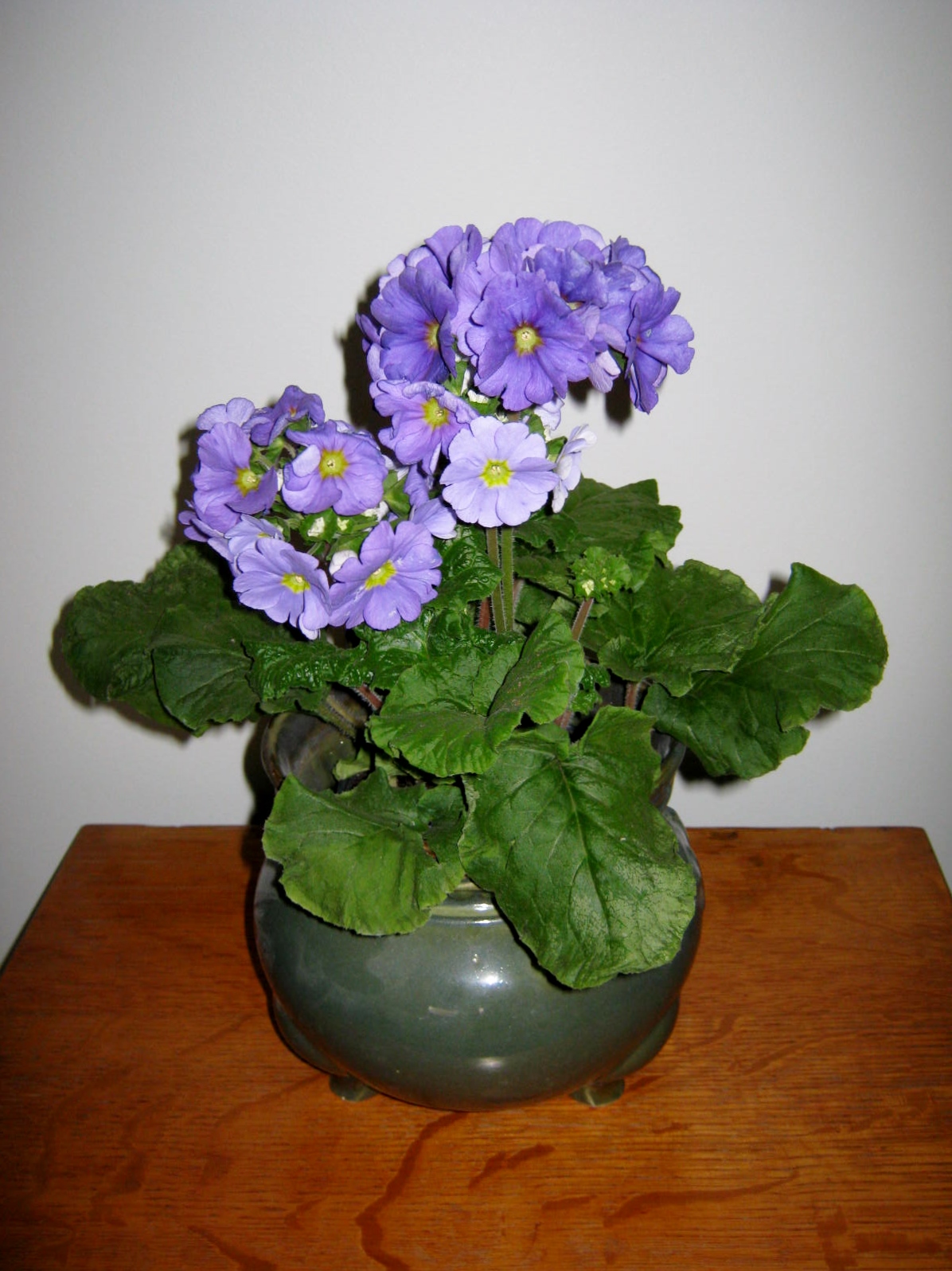
IMG_9830

Last week I was thrilled to find this gorgeous primrose on sale at my local supermarket. The beautiful flowers rival those I see planted in my favorite conservatory at Longwood Gardens. This is the season of primrose and other cold hardy seasonal plants.

You can find an informative article on how to grow primroses here: Dave’s Garden – Primroses

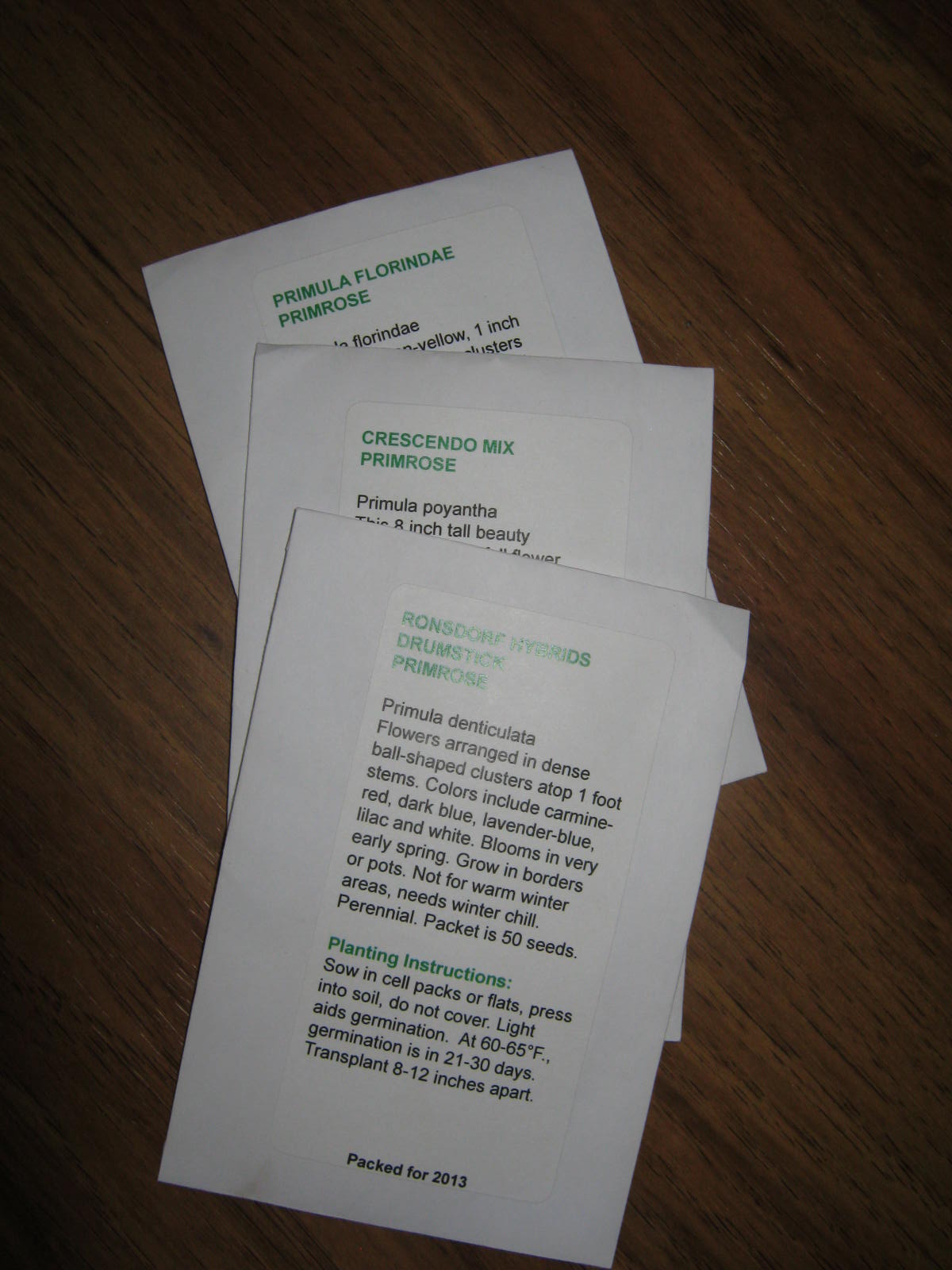
IMG_9845

I have three packets of primrose (primula) seeds I purchased last year from Swallowtail Garden Seeds. A link to their online seed catalog can be found here: Swallowtail Garden Seeds

Two of the varieties I purchased will grow indoors or out, one type with flowers held atop a three foot stem is better suited to grow outdoors. All need cool temperatures and moist soil to thrive. My past experience with primrose plants has shown them to be akin to pansies and other cold weather annuals and perennials, they die back when temperatures become too warm.

Here is a terrific article on how to grow primrose from seed: Growing Primrose From Seed

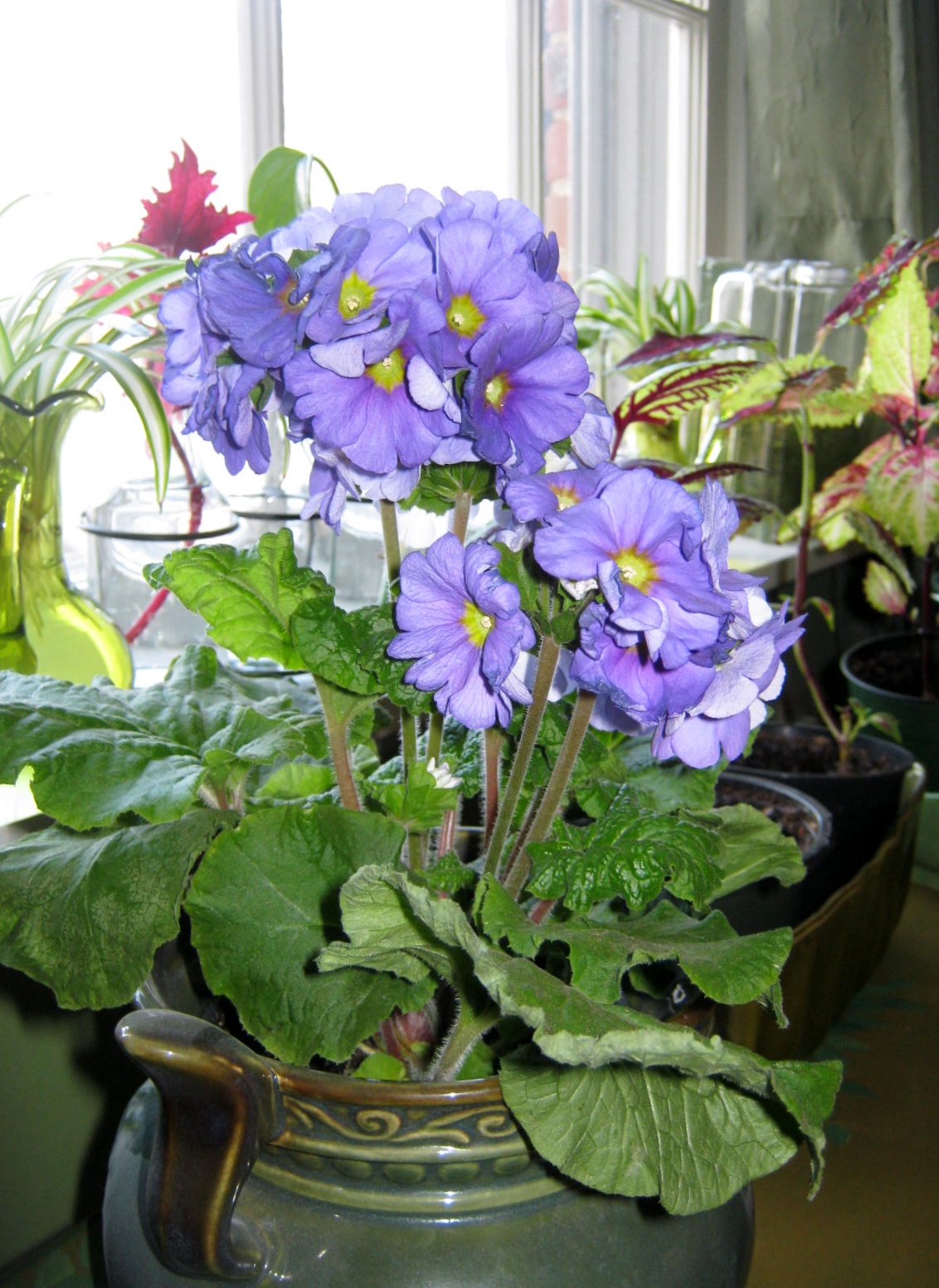
Because the primrose seed are very small, and hard to sow evenly by broadcasting on top of the seed starting medium, I will use my method of sowing small seeds to avoid the possibility of fungal diseases taking hold of the small seedlings. Here is a link to a post on how to sow small seeds: Sowing Small Seeds

IMG_9835

Follow Me on Pinterest

Planting & Problem-Solving – Tulip Bulbs/Update

tulips 1

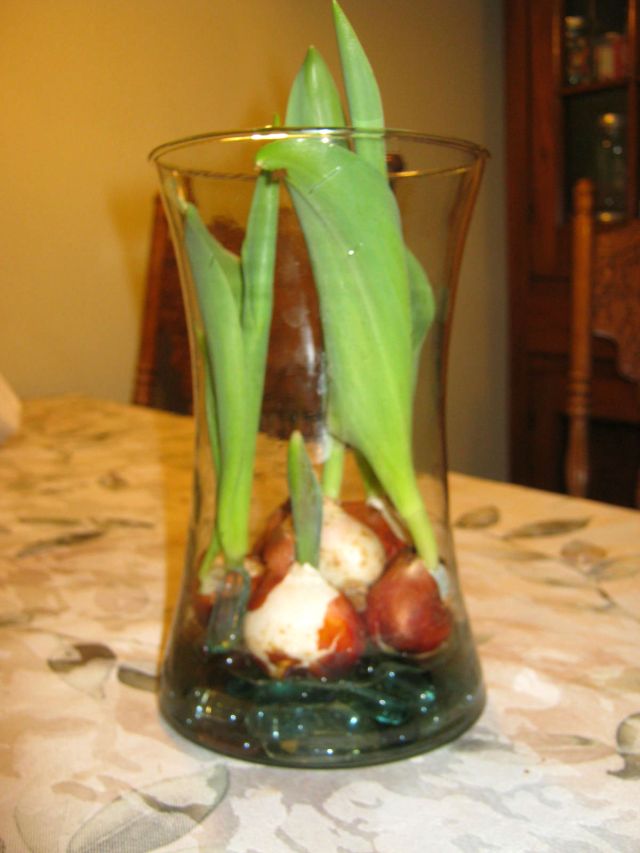
On February 20th, I shared a post on how my grandsons and I placed pre-chilled tulip bulbs in a vase of pebbles and water in an attempt to bring them into bloom.

You can read the post here: Planting/Tulip Bulbs

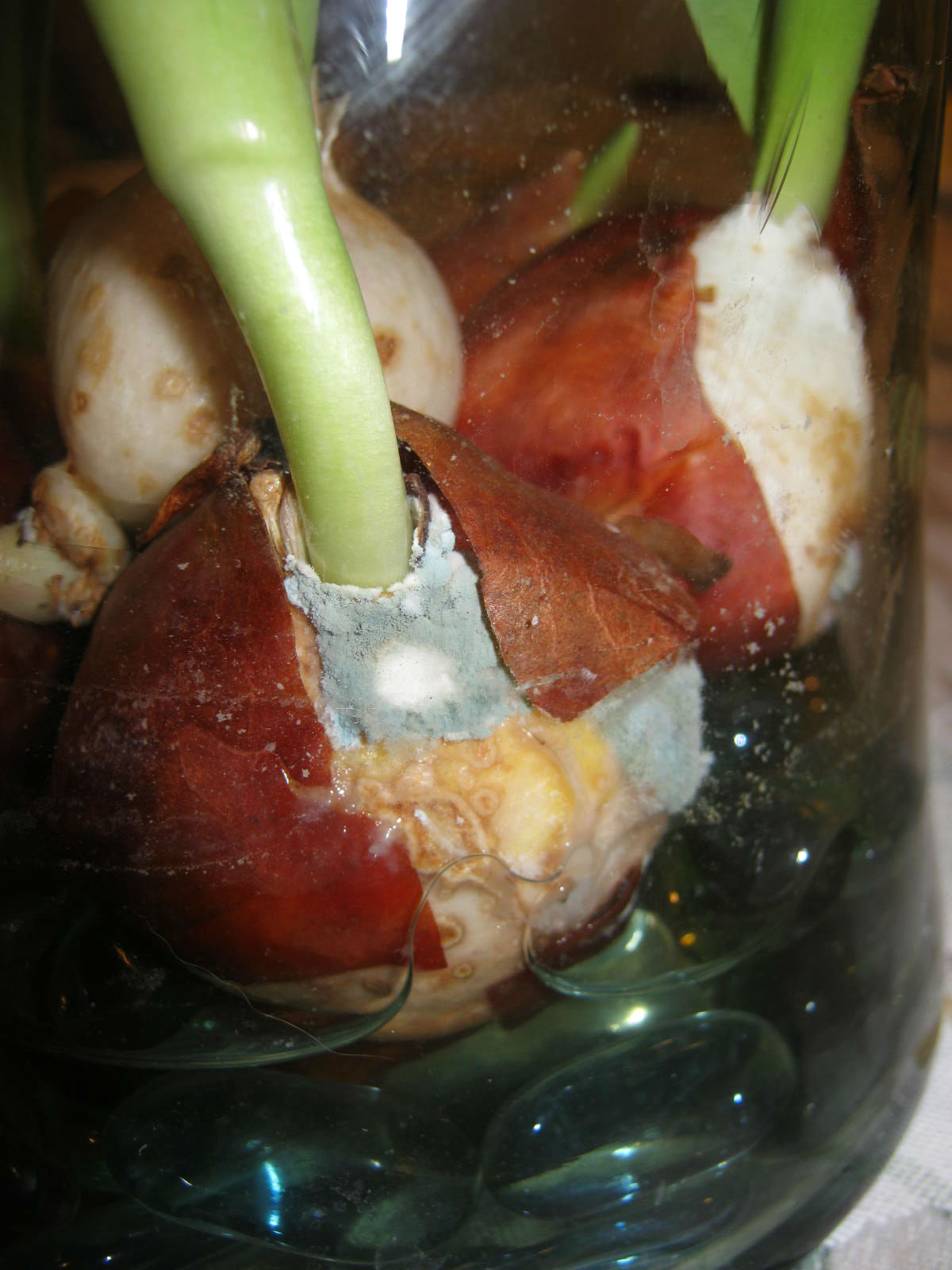
We are watching their progress now. The bulbs have sprouted at different rates, some leafing out quickly, others plodding along, but all are showing signs of growth. A few days ago I noticed a problem that needed solving if I hoped to continue bringing the tulips into flower, yucky green mold thriving on a bulb where it touched the side of the vase.

tulip2

I decided to give my trusty bottle of alcohol a try. Alcohol, safe and pure, is usually my first go-to solution for houseplant or gardening problems.

tulip 3

A few swipes of the alcohol and “Voila,” goodbye pesky green mold.

tulip 4

I realized another solution was keeping the bare portion of the bulbs away from the side of the vase and let the skin side protect the bulb from another bout of mold. I’m looking forward to showing my grandsons the progress of their tulips this week. Happy Gardening!

tulip 5

Follow Me on Pinterest

Planting – Seed Sorting

IMG_9825

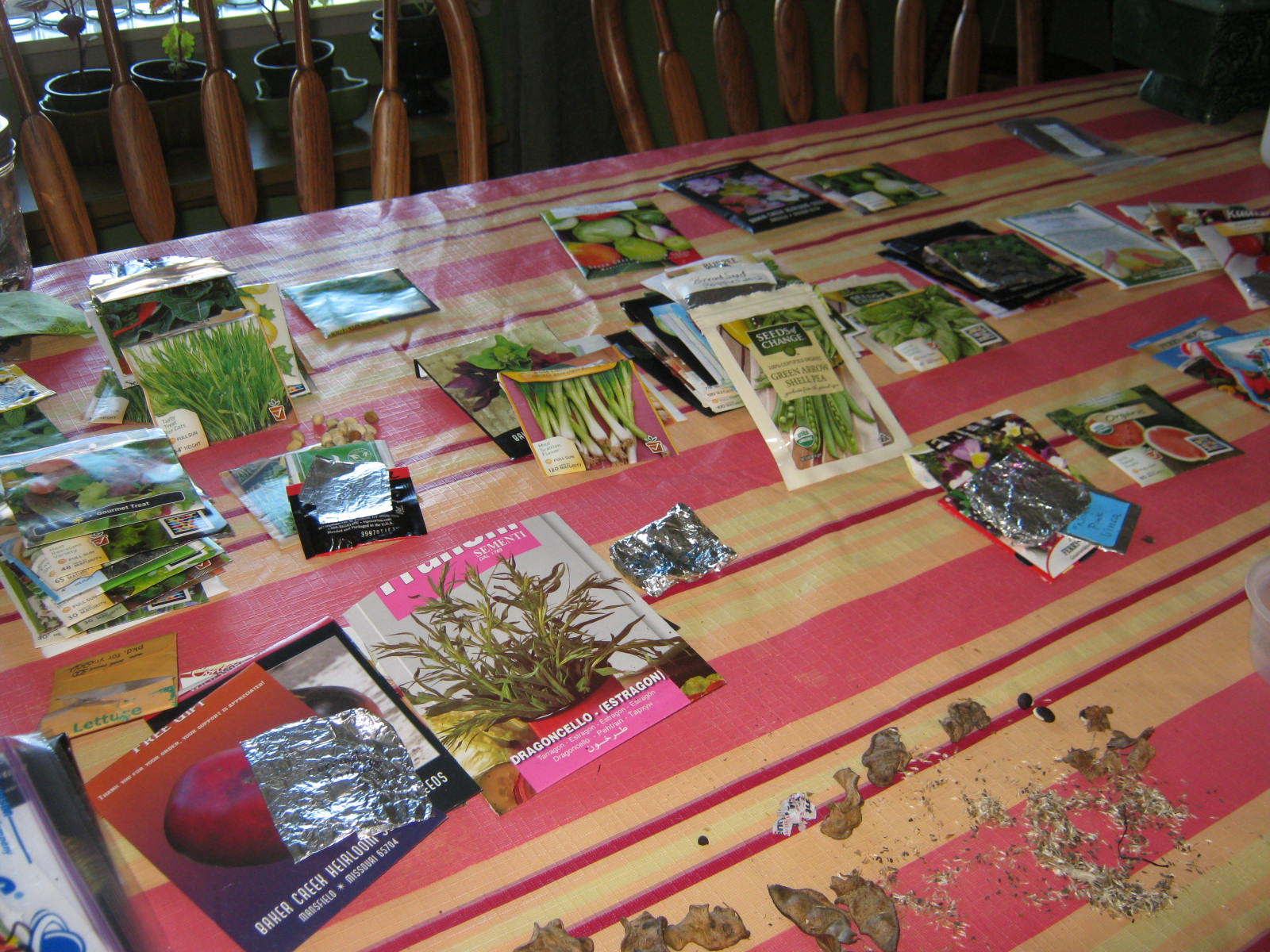
Busy, busy, busy is my motto this weekend. Except for three containers of coleus I am WAY behind on my winter-sowing and indoor seed starting. Yesterday I sorted out every seed packet in the house, checking the dates, and  discarding those completely empty. I have hundreds of seeds to plant, some held over in my cool, dark basement since 2011. My Square Foot Garden book lists the amount of time you can store seeds and expect them to be viable. I will be using this terrific garden manual almost daily for the next few weeks as I plan out this year’s square foot plots. I am also going to grow some veggies in containers this year. Oooops! I am too long on here already…time to end this post and begin to plant, plant, plant…happy planting to you!

For those of you wondering when to plant indoors and out for your area, check out this terrific site: Let’s Grow Veggies The site allows you a free fourteen day trial period without a credit card commitment first.

Plants – Cyclamen

IMG_9818

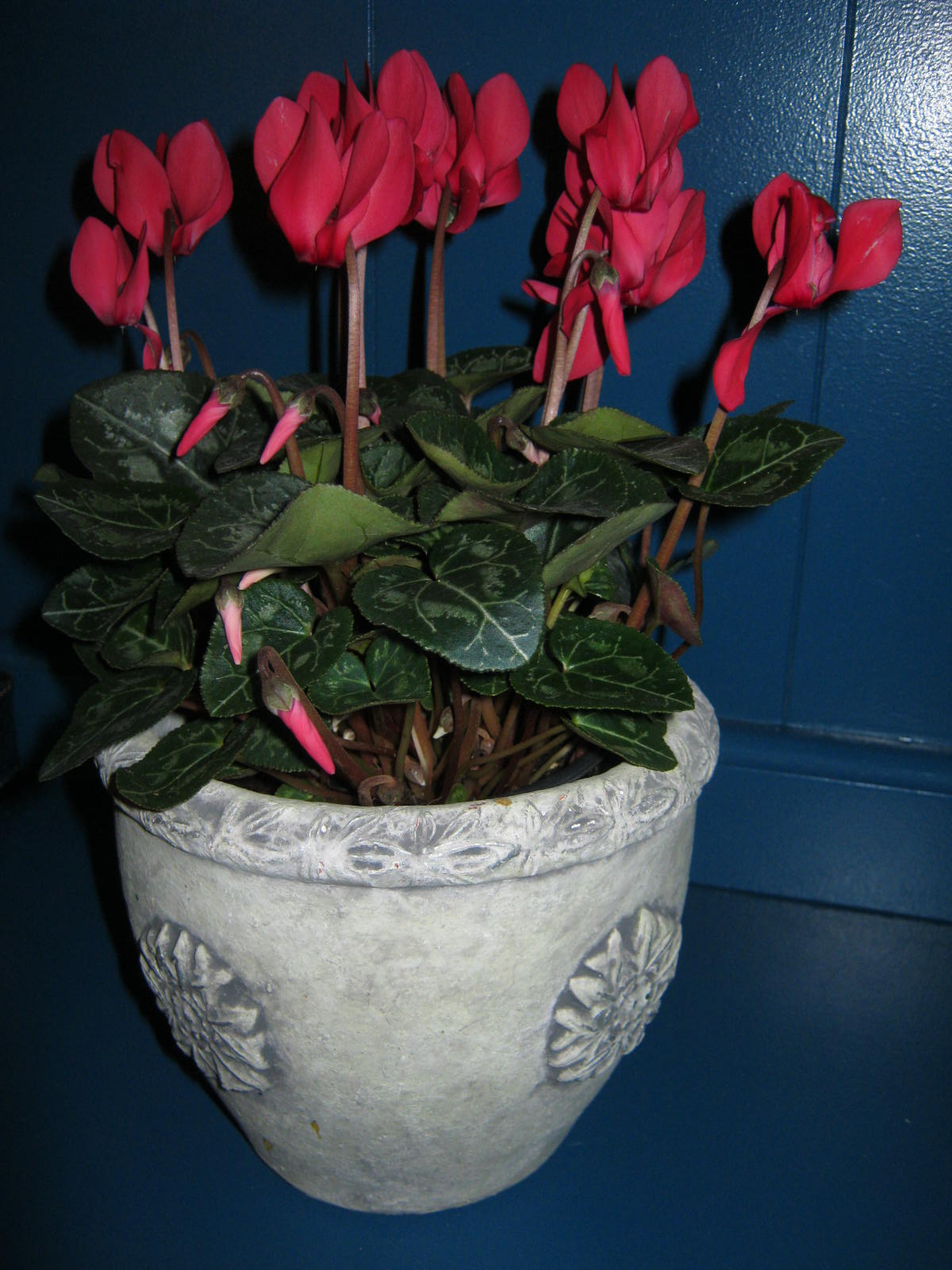
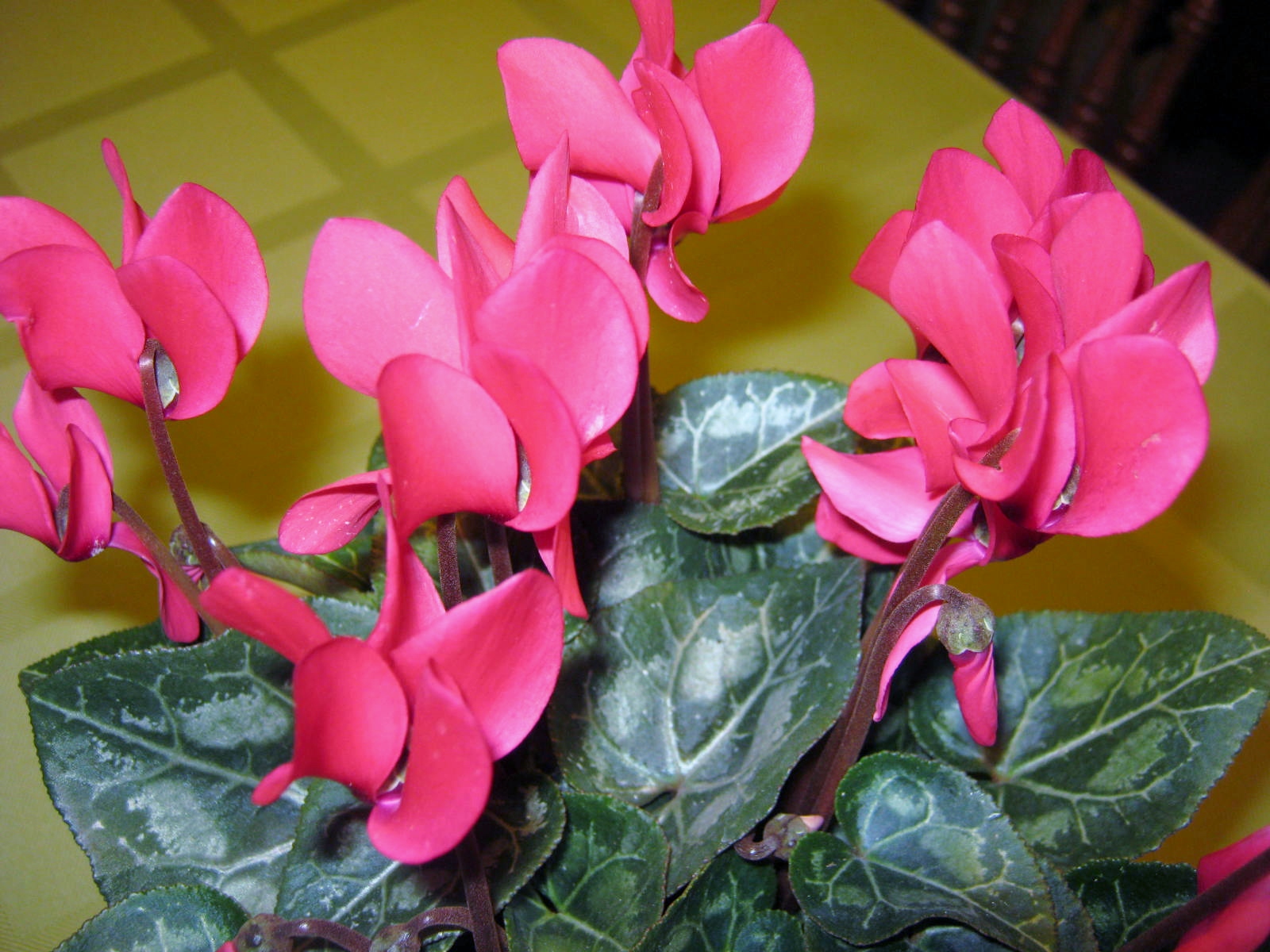
Cyclamen are one of my favorite houseplants. Arriving when I am flower-starved, near Christmas through Springtime, the blossoms give the appearance of butterflies hovering over the white-splotched foliage.

IMG_9819

The flowers come in many colors, pinks, reds, crimsons and purples are a few of the choices. When I purchased the plant in the photographs I had a hard time deciding between the bright red and a white with a pink edge. The vivid hue won out this time.

IMG_9822

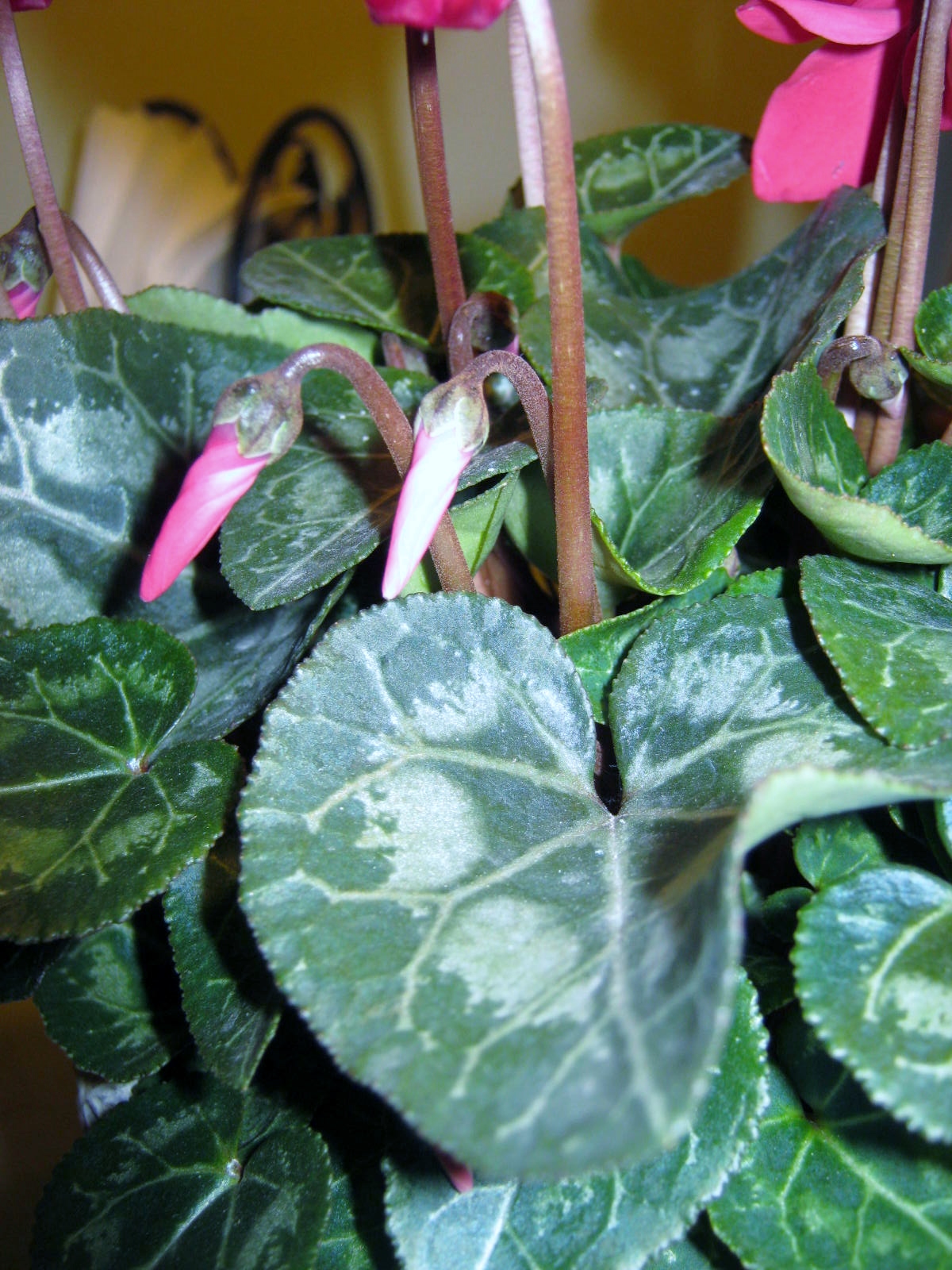
When I choose a cyclamen I always look within the swirl of leaves to see if there are several new buds showing. This will ensure I have cyclamen blossoms for several weeks.

Cyclamens are seasonal plants that grow from a corm. They can be brought back into bloom from their dormancy period, but I usually discard the plant when the blossoms are gone and the leaves become straggly in appearance. Perhaps this is the year I will coax one back into bloom…we’ll see.

Read more on how to grow a cyclamen plant here: The Cyclamen Society FAQ’s

Phavorites – Links I Love/Bible Gateway

HEART FOR LINKSFINISHED

Bible Gateway is a Bible verse search site. Type a keyword into the search box, and you can find Bible verses that correspond to your search word. Another terrific feature is the option of choosing the translation of the verse. My favorite translations are The Living Bible, The New International Version and The Message.

You can find Bible Gateway here: Bible Gateway

Project – Greeting Cards/Black and White Photo with Glitter

IMG_9803

I enjoy taking photographs to use as greeting cards. In the Autumn I was able to capture this photograph of a dandelion. I was so pleased when I downloaded it onto my computer and saw that I had also captured rays of light. I loved the photo and decided to have it developed in many ways, full color, black and white, sepia tones, etc. Each one turned out well.

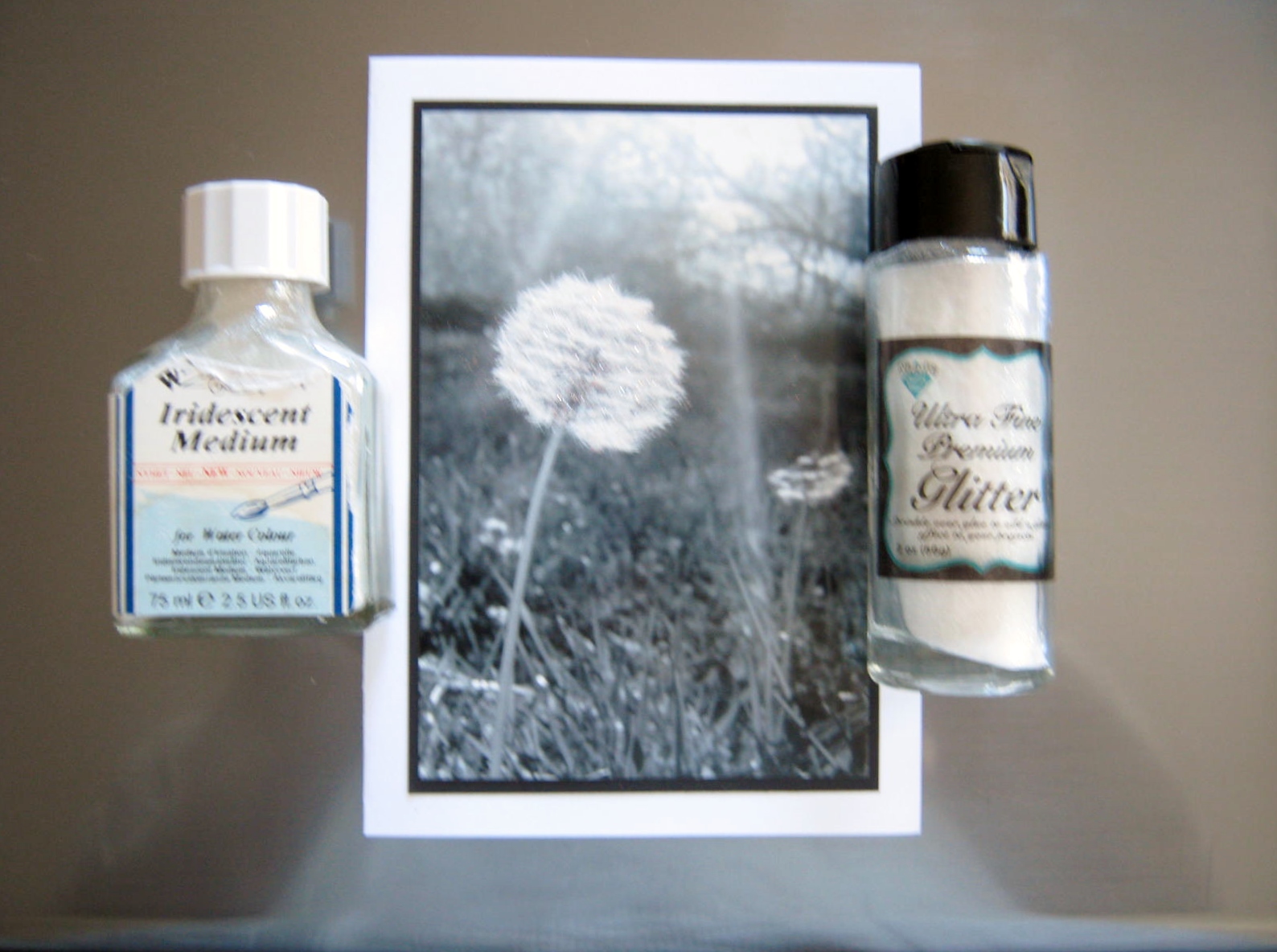
I had a birthday gift to give last week and wanted to enclose it in a photo card. The recipient loves pink, so I glammed up the plain photo with a little bit of glitz. Glitter doesn’t photograph well, but you can see a bit of the sparkle I achieved in the photo above.

IMG_9807

I brushed a bit of iridescent medium on the photograph. The iridescence did not show up as much as I had hoped. Since the medium, when it dries, will also glue anything on it in place, I also added some ultra-fine glitter. It did the trick. The dandelion glimmered. Double-mounted on plain white and black card stock, the card had a bit of pizazz. I plan to try adding a bit of glimmer to more of my photographic cards. Happy Glimmering!

*Note: You don’t have to exclusively use acrylic medium. Try watered down white glue, mod podge, or anything else that will dry crystal clear. I also need to add that the medium you use as a “glue” might not cover well. Mine wafted about and made little rivulets, but in my opinion, this tendency to separate created a better, more ethereal look on the card front.

Pressed Flowers – Fairy Dress

dress of leaves

In January I walked the woods and searched my yard for anything leafy or green to press. I found an assortment of items, you can read the post about my search and what I found here: January Pressings

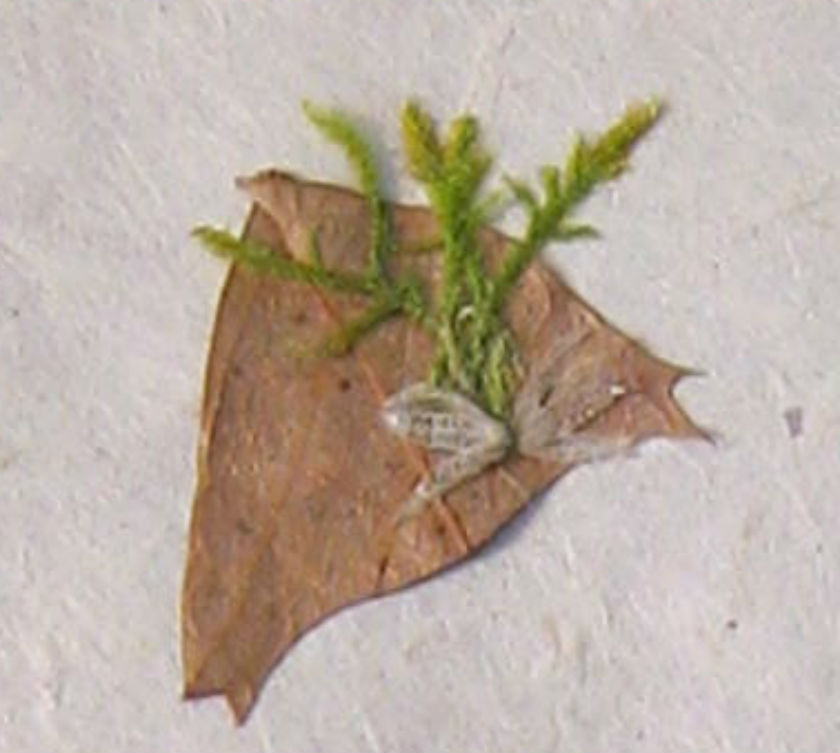
This week I used my pressings to create a sweet fairy dress. The whimsical side of my nature was quite pleased with the result. The picture measures 5 x 7, and is bordered with words cut from a children’s paperback. I used an old book that was yellowed  with age. This enabled the words to blend into the mulberry paper and create an aged look.

material

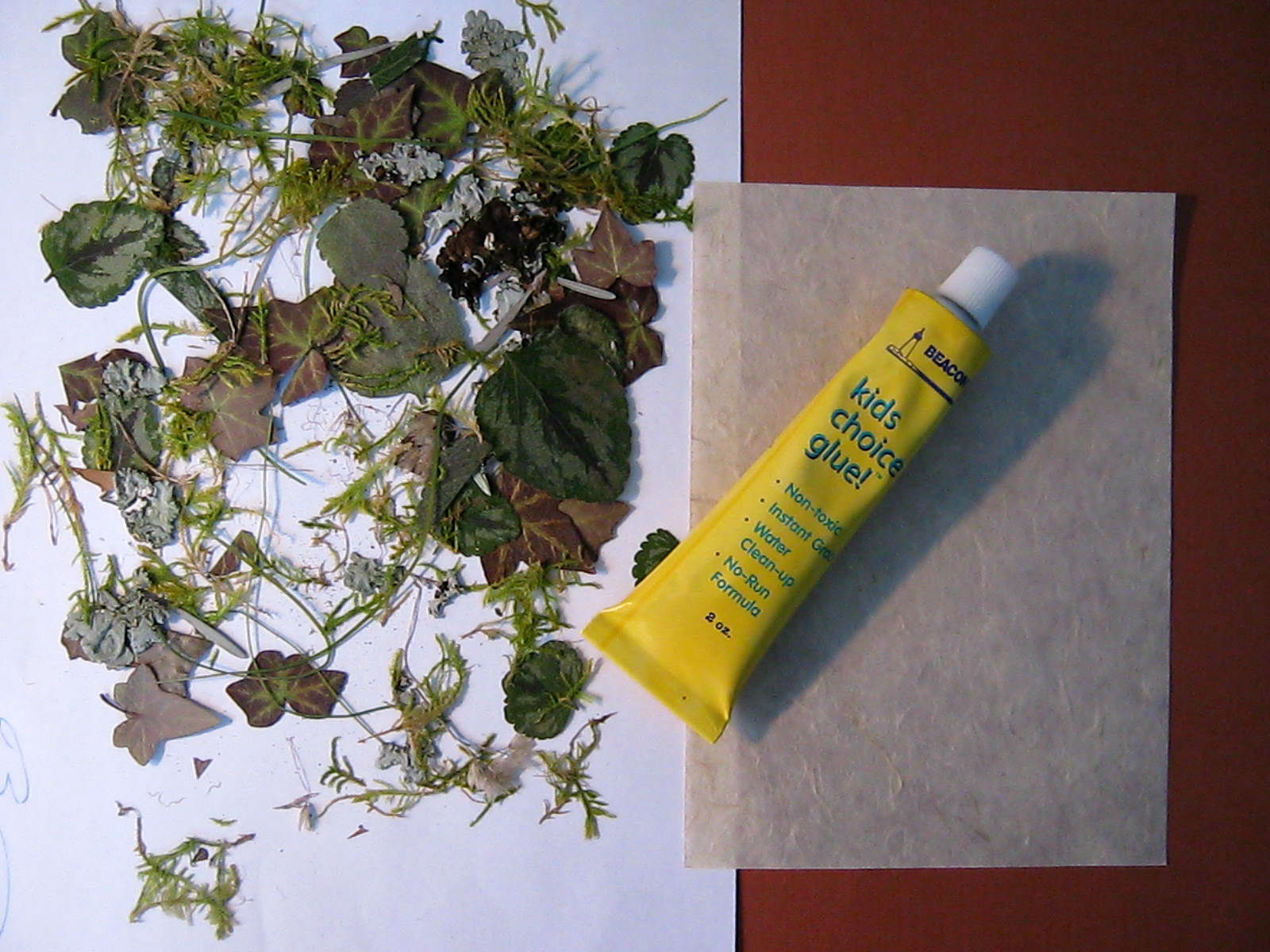
The materials I used to create my fairy dress were a piece of 5 x 7 beige mulberry paper and an instant grab glue.

floral pin tool

Two additional tools I use for pressed flower work are a paintbrush, good for lifting fragile flowers, and a pearl floral pin, perfect for running a small amount of glue beneath an errant edge.

I began my designing by cutting a bodice top and waist into an ash leaf. Remembering that most fairy dresses have the look of the ethereal about them, I cut a slit up the front of the skirt in order to take away the impression of heaviness and formality.

bodice

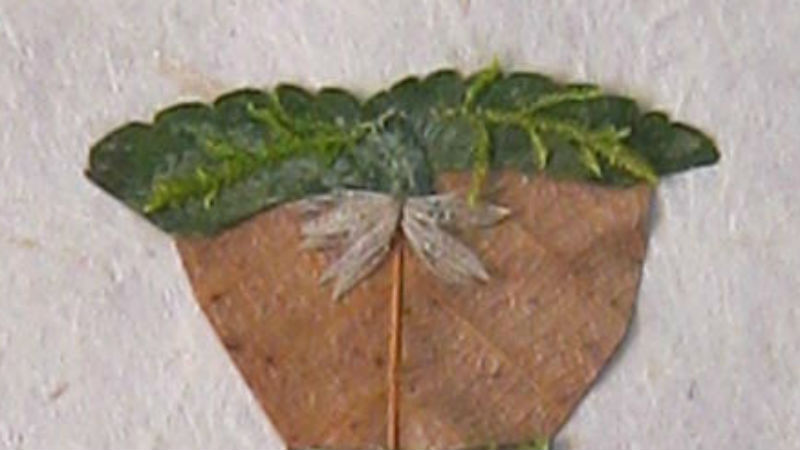
I added a decorative edge of trimmed lamium leaves, a sprig of moss, and the lace-like petals of a spent sage flower.

belt and peplum

To give the dress an airy look I created a peplum ruffle out of moss sprigs and a belt out of a cut ivy leaf.

hat

I crafted a hat out of the top of the ash leaf, adding a jaunty sprig of moss and flower petals.

shoes

I adore the shoes. They are cobbled out of one ivy leaf and sport some lacy sage flower petals.

purse

The handbag is composed of an ivy leaf and sage petals. A moss sprig handle adds a touch of greenery. I used the backside of the ivy for the top of the bag, and the front of the same leaf, pointed edge cut away, for the bottom.

So much fun…yesterday I went out to collect for February’s fairy dress, alas, there is very little out there. The snow and frigid temperatures of winter haven’t left much for pressing. I plan to go out again soon and make a more thorough search…updates will follow.

Follow Me on Pinterest

Pressed Flowers – First Flowers of 2014/Crocus

IMG_9799

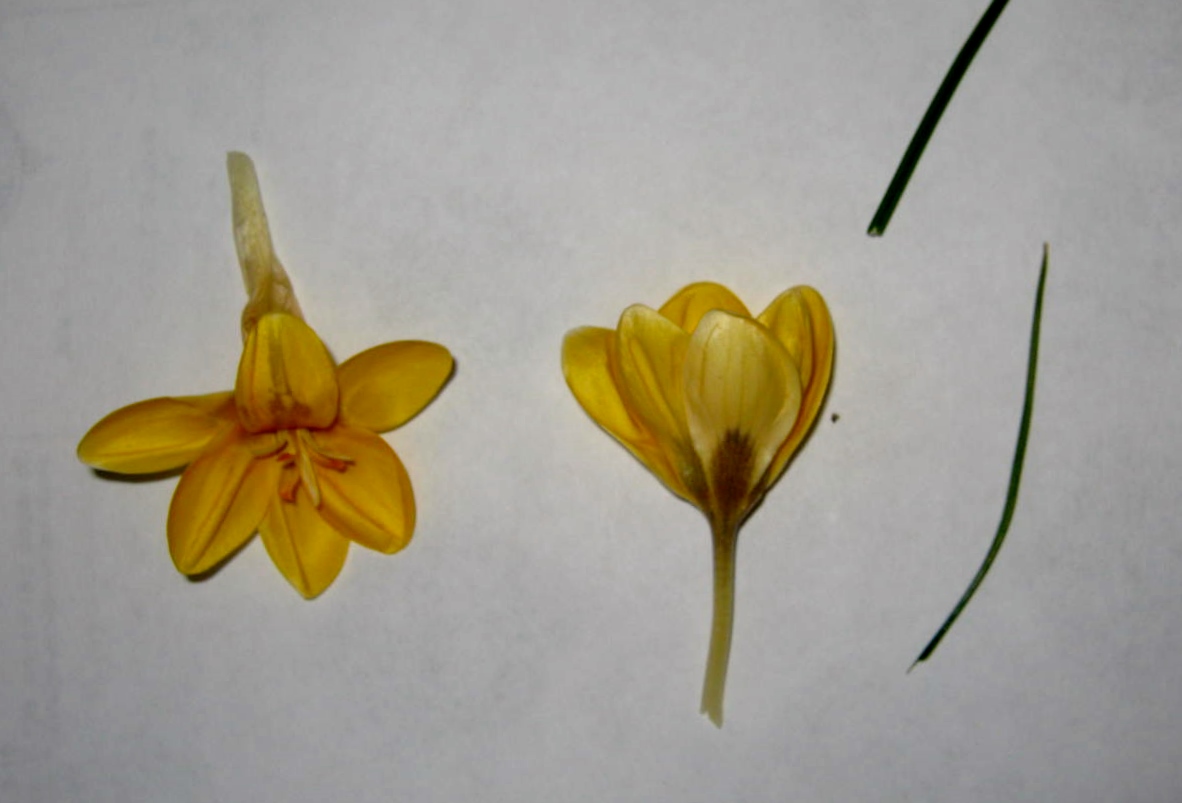
Oh Happy Day! Crocus are blooming in my side garden. How exciting to have something to press with a little bit of color to it.

I press crocus in two ways, open and cup-shaped. To press a crocus in an open position gently press the petals flat to reveal the pollen stems. I pressed these flowers between the pages of acid-free paper in a weighted down book.

Plants – Forcing Hyacinth Bulbs

IMG_9767

Forcing bulbs: “Forcing is a technique that imitates the environmental conditions that bulbs encounter outdoors, thereby tricking them into flowering earlier.” Beginner’s Guide to Forcing Bulbs

Another way to enjoy Spring bulbs is to force Hyacinths. The same protocol applies to these bulbs, place them in a cold place for at least twelve weeks before forcing. I bring my Hyacinth bulbs into bloom by using a special vase, named quite appropriately, a Hyacinth Vase.

IMG_9614

In my experience, the plant usually becomes top-heavy if I allow it to continue growing in water. When the beautiful blooms open their bulk causes the bulb to topple out of the vase. To counteract this problem I have begun planting the bulb in dirt when it nears bloom time. This has worked very well for me. Happy Gardening!

In-depth directions on forcing bulbs can be found here: Forcing Spring Bulbs

Follow Me on Pinterest

Planting – Poppies & Winter-Sowing

IMG_9719

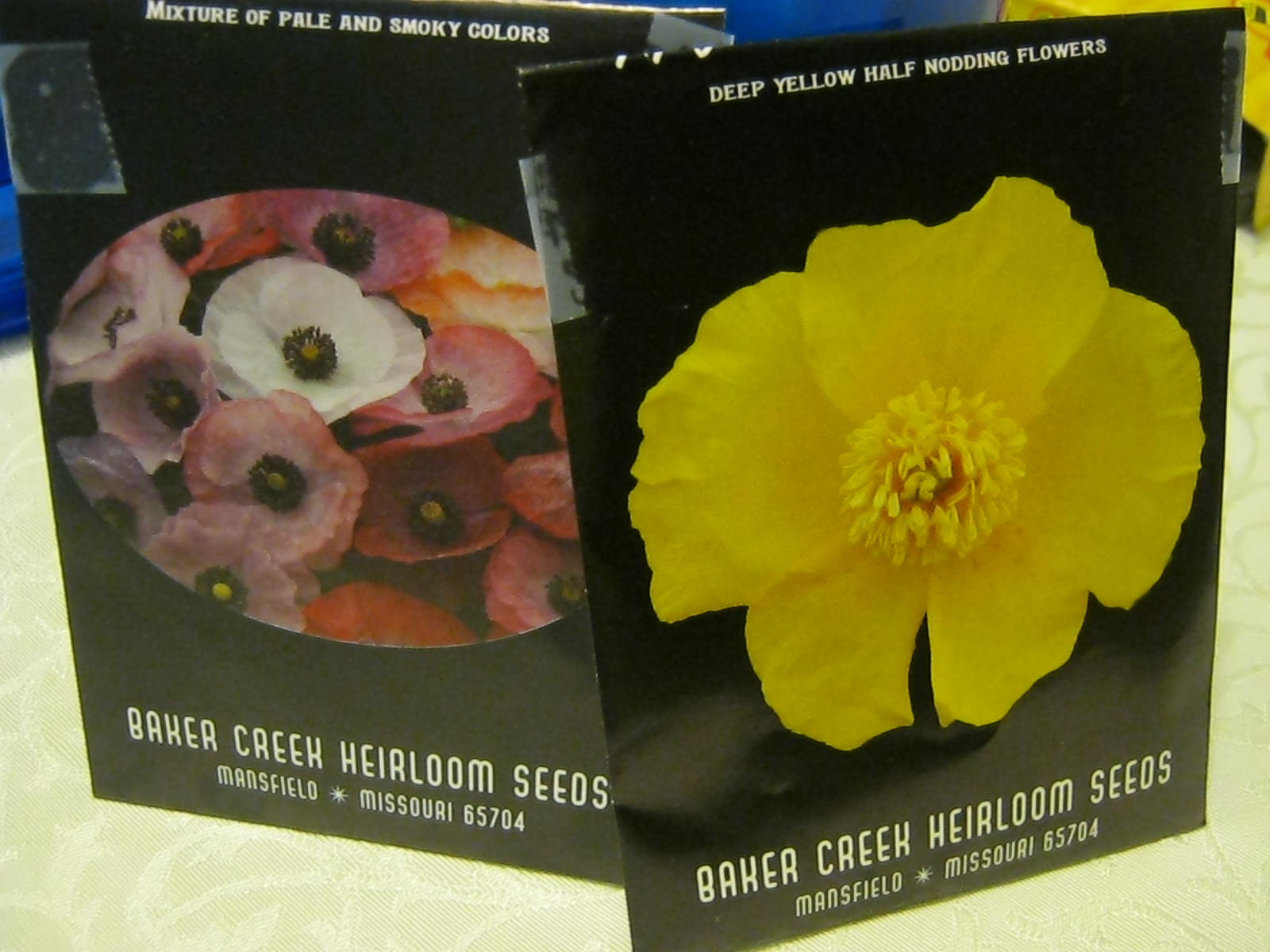
Poppies! I LOVE poppies, but I have some problems with poppies too. Number one on my list of loves is the way poppies develop big, luscious looking pods. When the pods begin to widen and split to reveal the color of the flower inside, honestly, I must admit I run out into the yard several times a day to see if the silken petals have opened. There is something magical in the wispy crown in the center of each flower too. Often there will be a splotch or two of contrasting color at the base of each petal. The foliage of many poppy plants glows in beautiful bluish green tones. Yes…I LOVE poppies.

One of the major drawbacks of poppies, at least in my opinion, is how hard it is to grow them from seed. For years I followed the advice on the back of the packets and on the pages of reliable gardening books and sowed them directly in the ground. This NEVER worked for me. Heavy spring rains ALWAYS washed my poppy seeds away before they could sprout, or if they did, the delicate small seedlings would be beat into the ground by that same rain. the “experts” say poppies don’t transplant well. I think I probably agree if they are grown in the house, but I have found a way to get a head start on poppies and that is through winter sowing.

I’ve written many times about winter sowing, so I am not going to take the time to rewrite what I have already posted. You can read about winter-sowing here and follow some of the links I list for more information: Winter Sowing

I am also including a post that shows the results of my winter sown poppies: Poppies

If you want to grow poppies this year, and have a milk carton or two on hand, give winter-sowing a try. It only takes a few minutes to create a miniature greenhouse to place outside in the sunshine. Happy Gardening!

Follow Me on Pinterest

Planting – Tulip Bulbs

IMG_9733

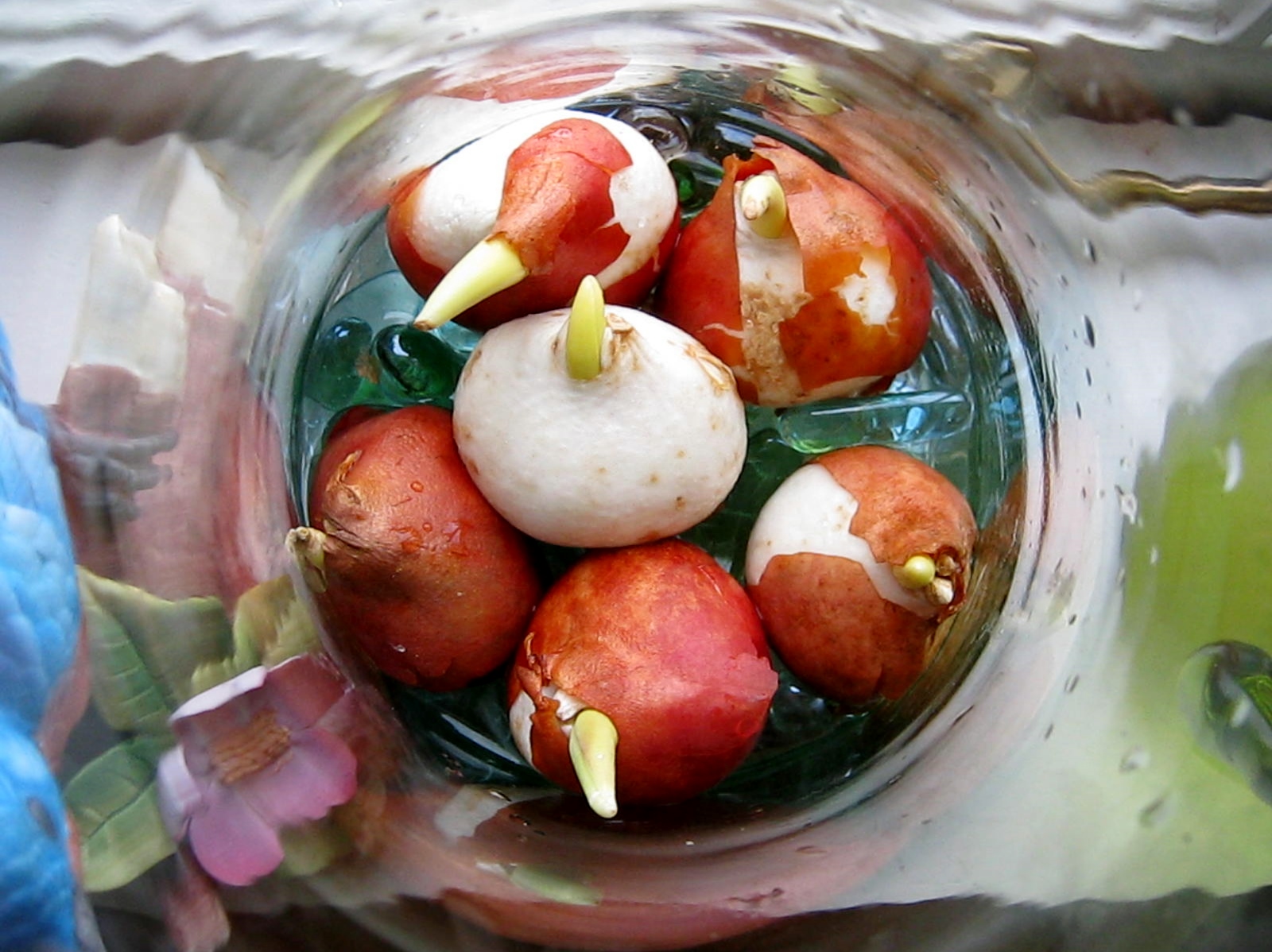
I purchased tulip, daffodil and hyacinth bulbs in the Autumn months, when they were placed on clearance. My grandsons and I planted the daffodils in pots of dirt and placed them in the refrigerator. Later, when winter arrived, they were moved into the garage. These flowers are now growing and are near blooming. This week we turned our attention to the tulip bulbs. Put to bed for three months in the refrigerator, with only a plain brown lunch bag for protection, the bulbs had already begun sprouting when we released them from their cold confinement.

IMG_9734

I had come across a beautiful picture on Pinterest of tulip bulbs growing in a glass container. I thought we could create a version of our own. Into a tall glass vase, we placed some glass pebbles, added the bulbs, and poured in enough water to barely cover the bottom of the tulips. This is where the roots will form. We will need to keep a daily watch so the water level does not fall too low.

IMG_9741

I’ll post an update on the tulips as they grow. Happy gardening!

IMG_9743

Photographs & Phlowers – A Bee-autiful Wednesday

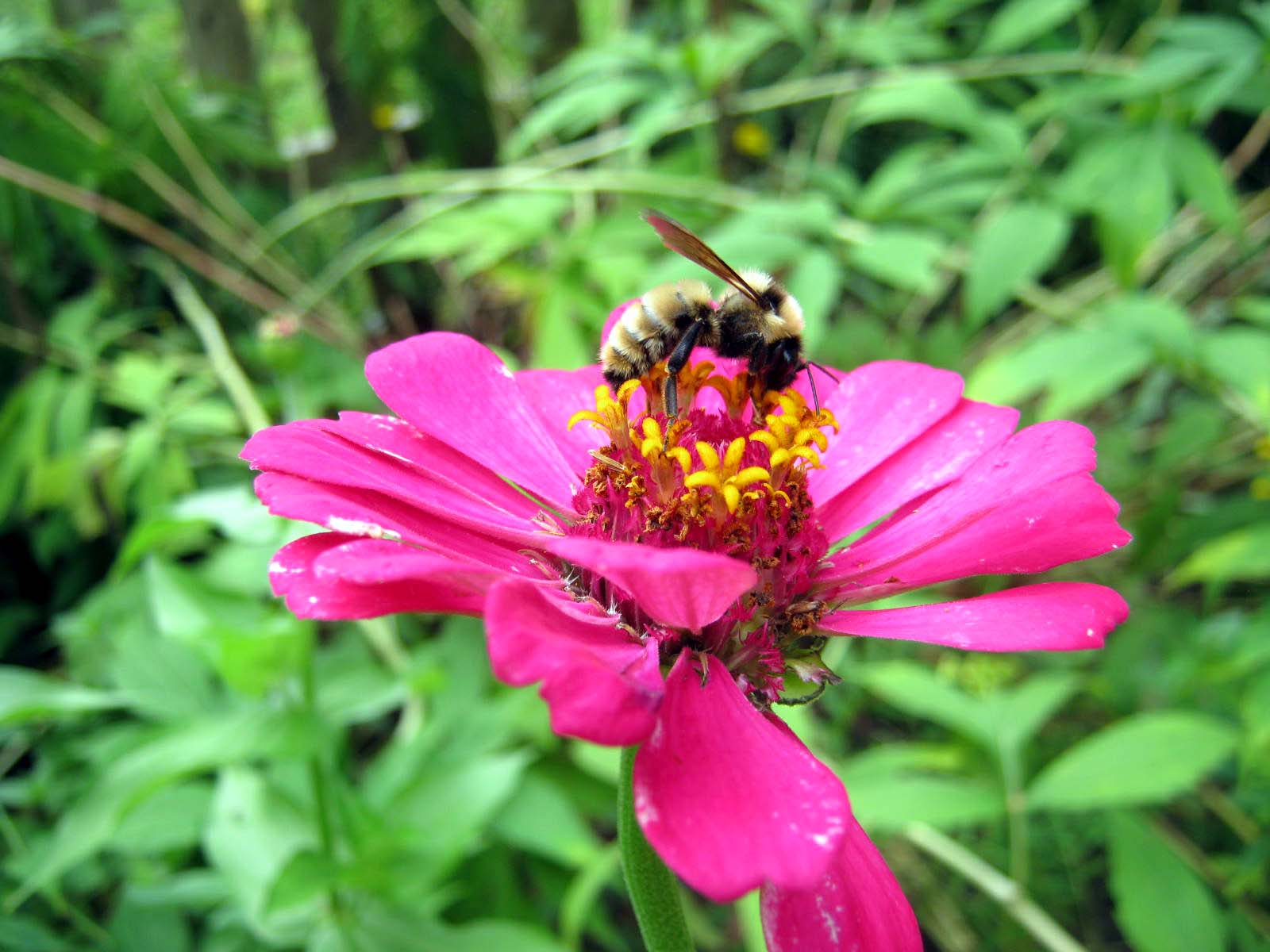
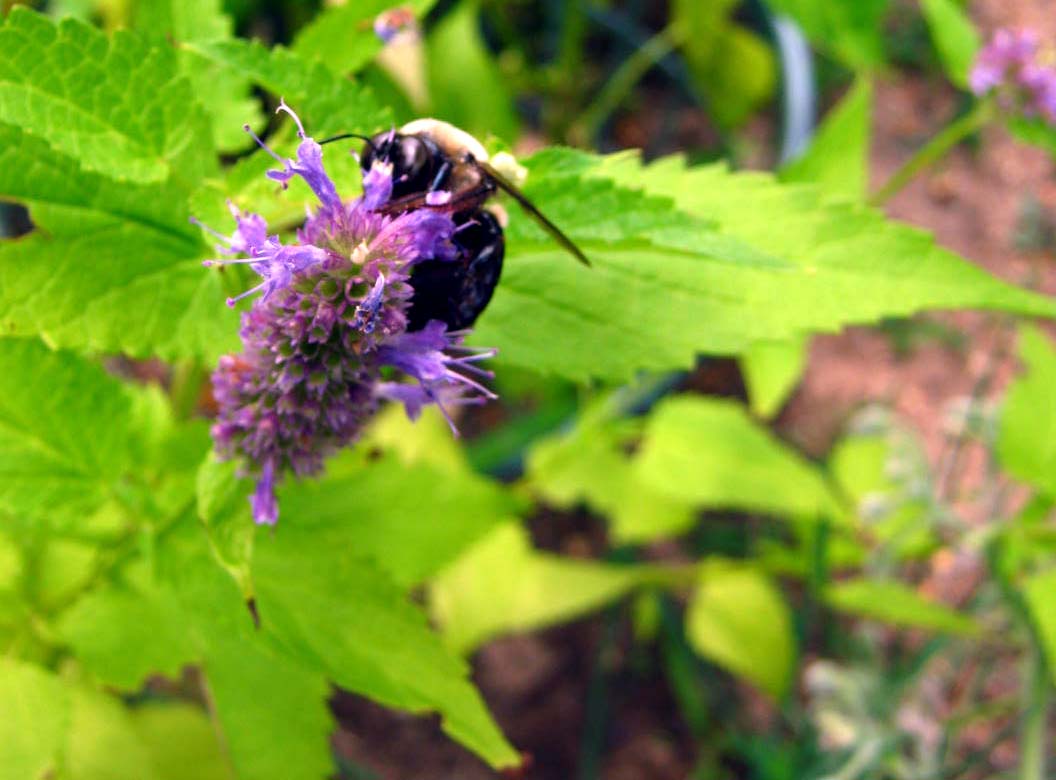
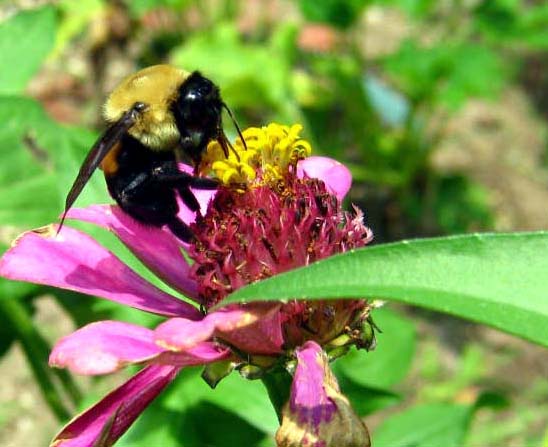
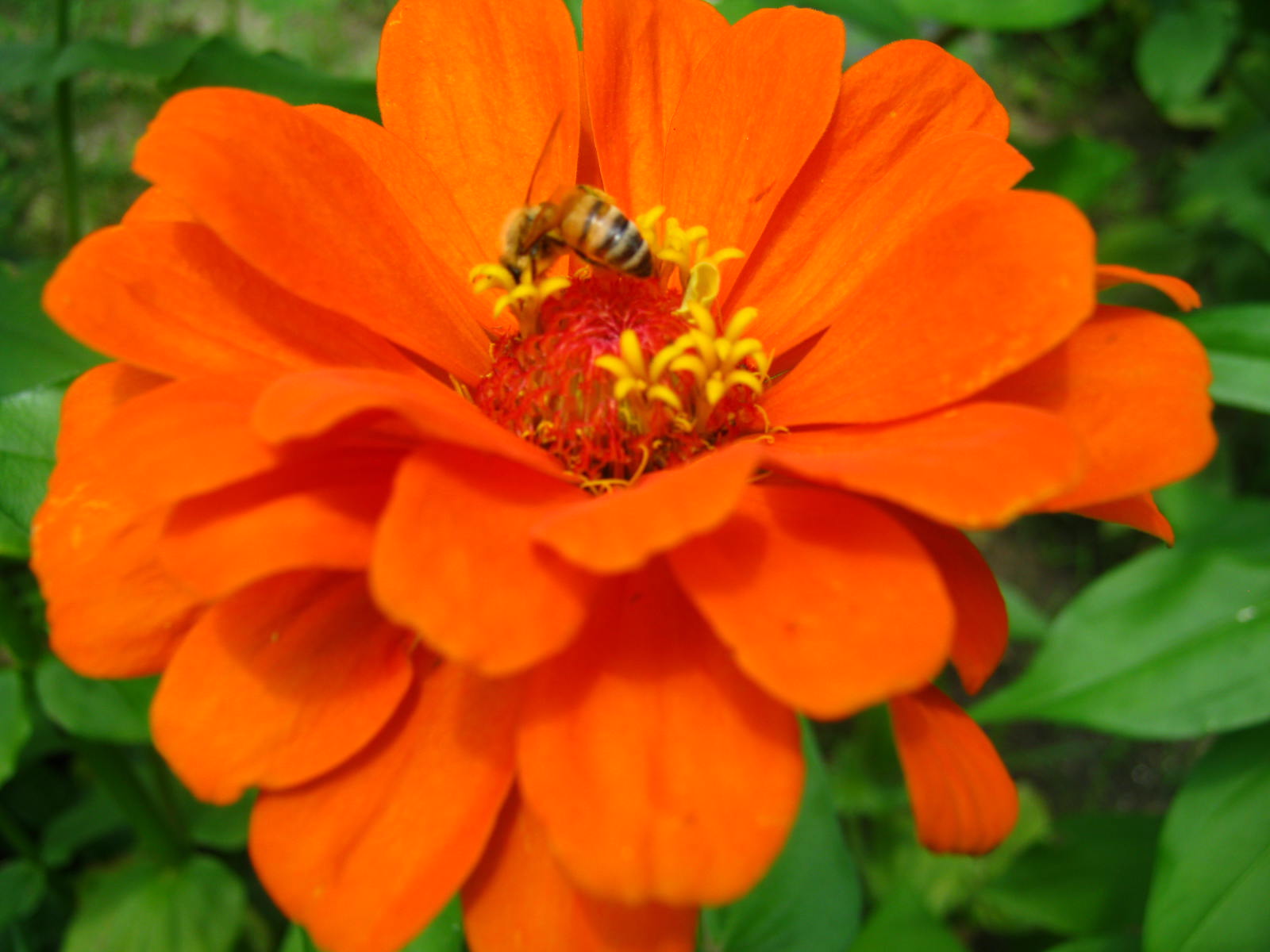
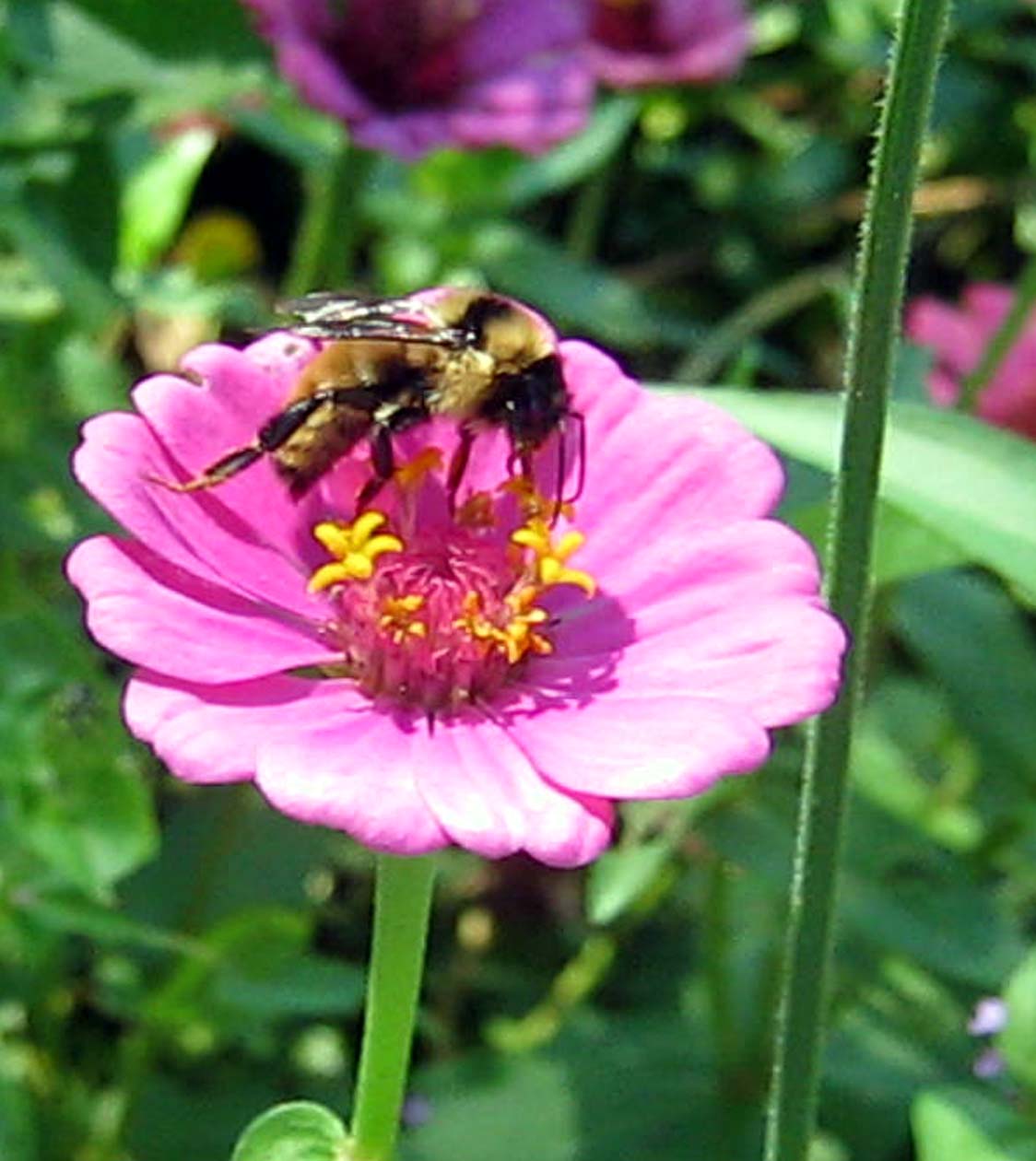
I need a little something to remind me of Spring and Summer today…perhaps the thought of “phlowers” and some buzzy insects. Artists and crafters feel free to use these photographs as copyright free reference.

August 19, 2011 059

Picture 101

Copy of Picture 133

Picture 124

September 12, 2011 029

Project – Tissue Paper Pots

spring pots 5

My grandsons created beautiful flowerpots with just a few inexpensive items:

Plastic flowerpot

Elmer’s Glue

Tissue Paper

Paintbrush

Disposable container for glue mixture

*Cover work surface before you begin. Artists smocks or aprons are a good idea too! 🙂

spring pots 3

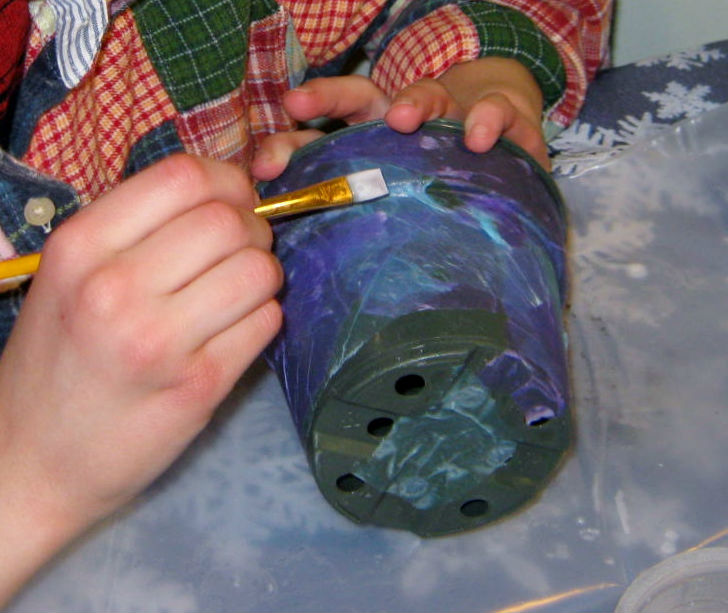
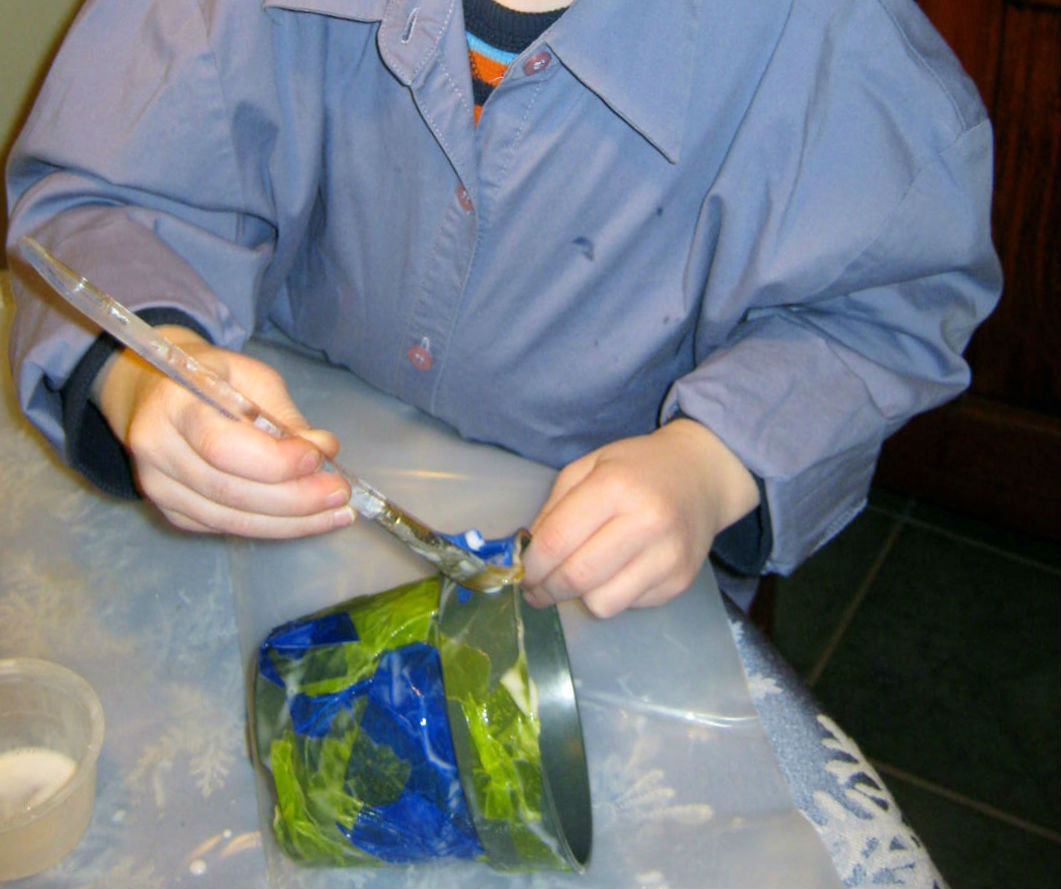
We tore the tissue paper into small squares. To apply the tissue we used a solution of 1 part Elmer’s Glue to 1 part water. We dabbed a bit of this well-stirred mix onto the pot, topped it with a tissue square, and covered the whole pot in this fashion.

*Keep in mind that it is best to use colors that will blend with each other well. Red and green together might form a brown tone. Use a monochromatic scheme or primary colors that will blend to create a new secondary color.

spring pots 2

When we were near finished we dabbed down any edges that were not adhering to the pot. Drying time was about 24 hours.

spring pots 1

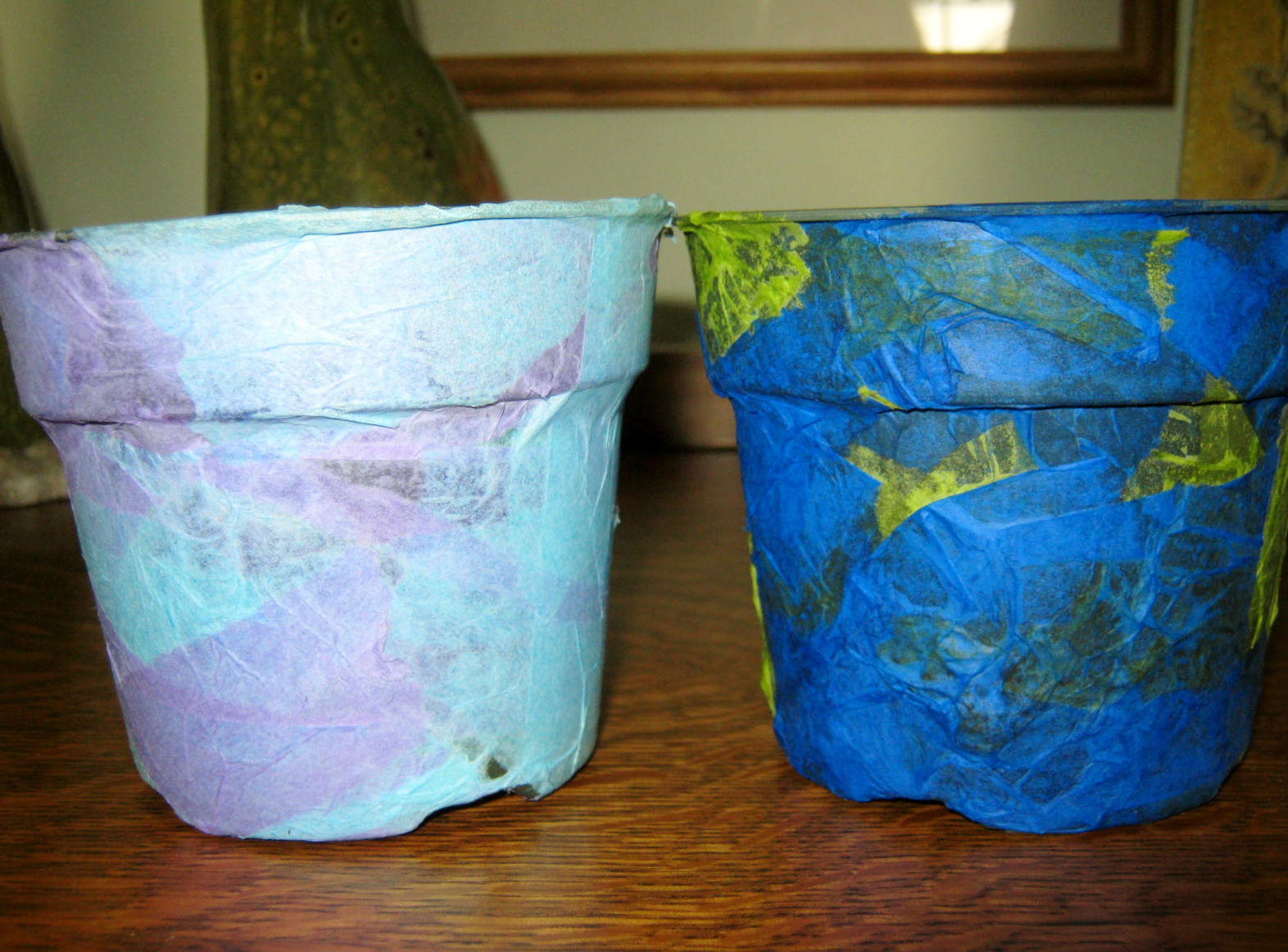
This project was enjoyed by my grandsons ages seven and four. I think with supervision and help, an even younger child could attempt the project. The pots looked sensational slipped over pots of daffodil bulbs we had forced in the cold garage and fridge.